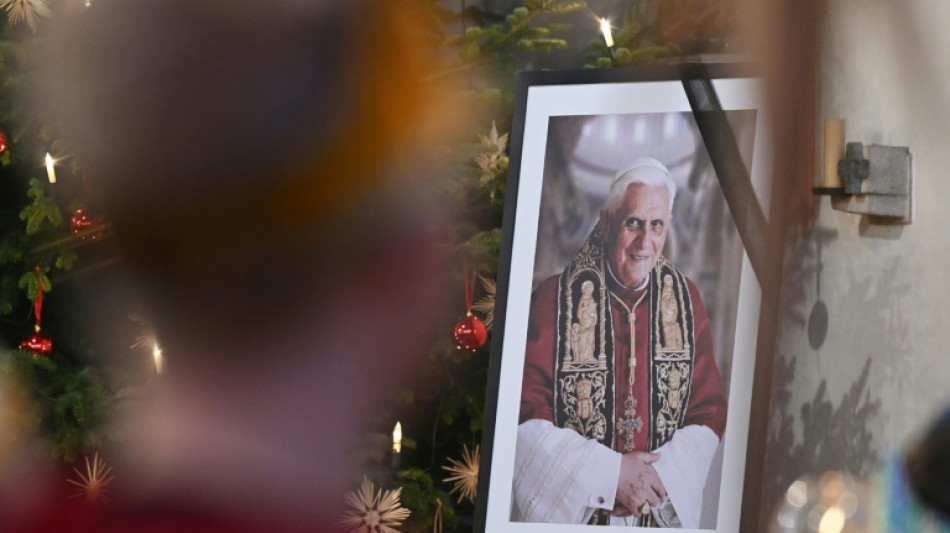
Popes through history: felled by illnesses and intrigues / Photo: KERSTIN JOENSSON - AFP

 Inside the Venezuelan prison meant to 'drive you insane'
 UK king braces as memoir by Diana's brother goes on sale
 No green light to lift EU sanctions on Russian oligarchs, talks to resume
 UK agrees support for Saudi in struggle with Houthis: reports

 EU foreign policy chief calls for continued sanctions on Russia
 Flights scrapped, evacuations urged as Typhoon Dujuan wallops Japan
 Fonseca to take break from tennis
 A Cuban zoo, and its animals, in epic battle for survival

 Infantino proposes consulting federations to reform FIFA
 El Nino weather pattern enters record territory: scientist
 OpenAI calls for US to lead global effort on AI standards
 South African ostriches plucked alive for luxury fashion: report
 US networks halt Trump coverage in revolt over White House ban
 Paramount settles with US states to clear Warner Bros. mega-merger

 Climate crisis a job for world leaders, not just activists: UK FM
 US networks halt Trump coverage over White House ban
 French singer accuses Miley Cyrus of plagiarism

 EU fines Google 403 mn euros for location data breach
 'Best is yet to come,' says De la Fuente after Spain extension
 Why diesel prices are rising more than crude oil

 COP31 host says AI's climate footprint to be a summit priority

 Renewables hit record in 2025, but world must move faster: report
 US media outlets to sue Trump administration after White House ban
 Global stocks rally on lower oil prices, US-China hopes
 EU proposes energy rating for data centres
The peaceful death of Benedict XVI in a monastery in the Vatican contrasts with the painful, violent or sometimes mysterious deaths of many of his predecessors.
Here are some striking examples:
- John Paul II's long ordeal -
Benedict's predecessor, John Paul II, died on April 2, 2005 in the Vatican aged 84, after a long illness that turned the end of his 26 years at the helm of the Catholic Church into an ordeal.
After two successive hospitalisations and a tracheotomy in February 2005, John Paul II's condition had worsened abruptly a few days before his death, following a urinary infection, sepsis and cardiac arrest.
He mostly lost his speech after the tracheotomy and managed to utter a few words in public on March 13, before returning to the Vatican. He later remained silent.
On his last Good Friday, he was filmed from behind in his apartments so that the faithful could see him following the Way of the Cross via video.
The one-time sportsman's pontificate was marked by a slew of health issues.
He was weakened by Parkinson's disease and by the after-effects of injuries sustained in the attempted assassination carried out by Turkish extremist Mehmet Ali Agca on May 13, 1981 in Saint Peter's Square.
He also battled cancer in the intestine and two fractures, one in the shoulder and one in the femur.
- Sudden death of John Paul I -
His predecessor, John Paul I, nicknamed "the good pope" or "the smiling pope", was one of the most ephemeral popes in history.
Elected in August 1978 at the age of 65, he died 33 days and six hours later, apparently from a heart attack, although no autopsy was carried out to confirm the causes of his death.
Books have speculated that the pope might have been assassinated because he wanted to put the church's affairs in order, particularly the financial embezzlement of Monsignor Paul Marcinkus.
Marcinkus, the then-head of the Vatican bank, was suspected at the time of links with the mafia.
No official inquiry has confirmed the suspicions.
- The mysterious death of Alexander VI Borgia in 1503 -
The death of Alexander VI, who was pope from 1492 to 1503, was also subject to intense speculation.
On August 6, 1503, after a dinner with his son Cesare at a cardinal's house, both went down with a fever.
A first theory attributed the illness to malaria, which was prevalent in Rome at the time.
The other hypothesis was that the pope would have wanted to get rid of some of his enemies and would have himself poisoned the wine, inadvertently falling into his own trap.
Johann Burchard, a close associate of the pope who was present at his death, said: "His body swelled so much that we couldn't put it in the coffin we were meant for him. He was temporarily rolled into a carpet while his apartments were looted."
- Formosa, exhumed for trial in 897 -
Known as the "corpse council", the posthumous trial of Pope Formosa (891-896) is testament to the chaos that prevailed in the ninth century in Rome and the Vatican.
In 897, on the orders of Pope Etienne IV, a sworn enemy of Formosa, his corpse was exhumed, clad in papal ceremonial clothing and sat on a throne to be judged.
The verdict said the deceased was not worthy of the pontificate.
All his actions were annulled and orders issued by him were declared invalid.
Papal ceremonial clothes were ripped from his body, the three fingers of his right hand that the pope had employed in consecrations were cut off and the corpse thrown into the Tiber.
- A hammer blow to confirm the death -
Vatican protocols state in precise detail the procedure that must be followed on the death of a pope, with a senior cardinal known as a "camerlengo" ("chamberlain") given charge of day-to-day affairs until a new pontiff is elected.
Traditionally, his main role has been to certify the death, once done by tapping the pontiff's forehead three times with a special silver hammer and calling out his birth name.
The tradition fell into disuse after the death of John XXIII in 1963.
X.M.Francisco--PC