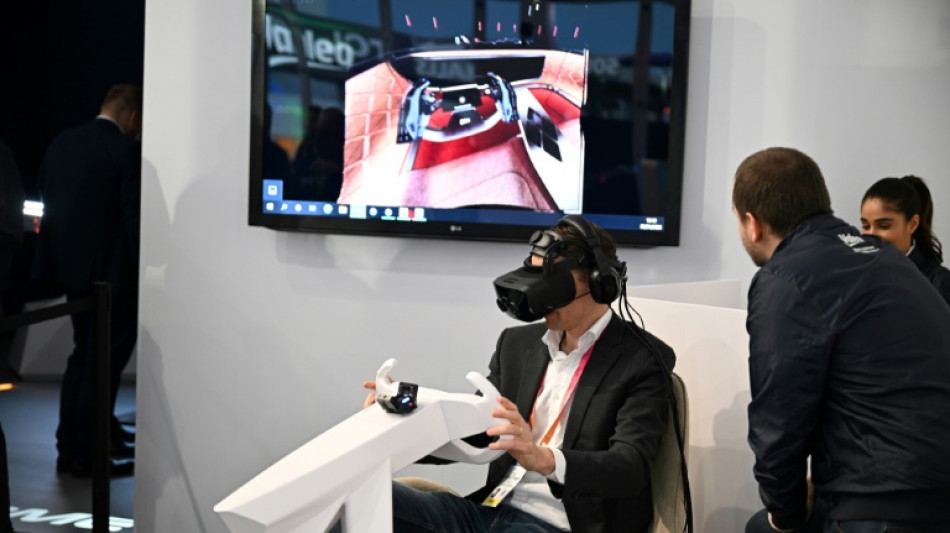
Auto industry races into metaverse at CES / Photo: Robyn BECK - AFP/File

 Google data centre sparks protests in Austria

 Shin Ohashi: Junk food-loving teen and Japan's next big swimming hope

 Stocks rise on AI buzz, drop in oil prices

 China's robot dancers limber up for America's Got Talent final

 Despite military might, Saudi struggles to crush the Houthis
 Trump to tout deals, defend Iran war in UN speech
 Sri Lanka to issue verdict in landmark Easter attack trial

 Macron says talks with Trump on Red Sea, Ukraine 'constructive'

 Green policies just good politics, says UK minister

 Bardot auction in Paris fetches nearly one million euros

 No timeline on Daniels injury return, says Commanders coach

 British Columbia sues OpenAI in US court over Canada school shooting

 French star Batum retires after 18-year NBA career

 Zidane leads first France training session

 Man shot by ICE agent in Texas detained with bullet inside him: lawyer

 California declares state of emergency ahead of El Nino

 South Africa arrests three more suspects, after nine women murdered

 Carse needs time away from England, says captain Brook

 NOWPayments Releases Cross-Chain Payout Data Revealing Key Performance Benchmarks Across TRON, BNB Chain, and Solana

 British Museum bans photos of Bayeux Tapestry as crowds linger
 COP31 host says AI climate footprint to be a summit priority

 Berlin's far-left vote winners reject anti-semitism charges

 Mancini eager for 'new adventure' on Italy return

 Mbappe says having Zidane as France coach 'like a film'

 Palmer, Rice out of England Nations League squad

Allowing the driver of an autonomous vehicle to watch a movie, a dealer to sell automobiles from a "virtual" car lot, or an engineer to simulate how a new part fits: the auto industry is getting a tantalizing taste of the metaverse at the huge CES technology show.
One gadget on display in Las Vegas is an in-car television system, developed by French parts maker Valeo, that needs no remote.
To change the channel, drivers or passengers wearing a headset make a simple swipe in the air with their hand, and sensors in the car detect the movement.
For users who dislike the feel of a full headset, sensors on a vehicle's exterior make it possible to integrate actual pedestrians or landscapes into virtual reality (VR) images, said Ghaya Khemiri, who leads the Valeo project.
And if sensors detect that a person is feeling stressed, the system can offer soothing images to promote relaxation.
At Valeo, "we're doing a lot of work on electric and autonomous cars, and work a lot on sensors," Khemiri said. "We had asked ourselves what we could offer (with them) for users' pleasure."
The company's system, still in prototype, would initially be meant for use by passengers, or drivers on break, such as when charging their electric vehicle.
Once vehicles become entirely autonomous, the driver could possibly use it while on the road.
- Movies on the windshield -
Holoride, a start-up backed by automaker Audi, is already selling a virtual reality headset intended solely for rear-seat passengers.
The system allows users to watch a movie or play a video game using a controller, and synchronizes VR content to the movements of the car to prevent nausea.
A new version introduced by Holoride at CES can work in any car.
German automaker BMW on Wednesday presented a concept car for upcoming models that combines "the real and virtual worlds."
The system showcases a potential project involving augmented reality images projected on the windshield -- such as the car's speed or direction -- and could even transform the entire windshield into a screen to watch a movie.
"Although a fully immersive, interconnected metaverse remains years away, mobility stakeholders can already capture real business value from the technologies designed to enable it," said a report from the McKinsey consulting firm, published on the eve of the CES show, which ends Sunday.
One example: Italian carmaker Fiat in December launched what it called "a metaverse store" where clients can research, configure and even purchase a vehicle with the help of an online assistant.
- Remote repairs -
If technologies continue to improve -- notably the "haptic" devices that simulate a touching sensation -- consumers could virtually "examine a highly realistic replica of a vehicle, opening its doors, feeling its seats, accelerating onto a highway — just as they would with a real car," McKinsey said.
And if a vehicle breaks down, a technician could remotely guide a user to make simple repairs.
The metaverse can play a role in designing new products or more easily testing them in differing environments.
Alexandre Corjon, the head of innovation for French parts maker Plastic Omnium, came to CES to explore ways his company could apply the new technologies.
The metaverse could, for example, make it possible to show a client how a recycled material might react in a specific form and "demonstrate to the designer the effect that would have" on the vehicle, he said. It could also show the superiority of a new product.
The group might also experiment with using the metaverse for meetings of its global management team -- saving them the hassle of hitting the road in the first place.
X.Matos--PC