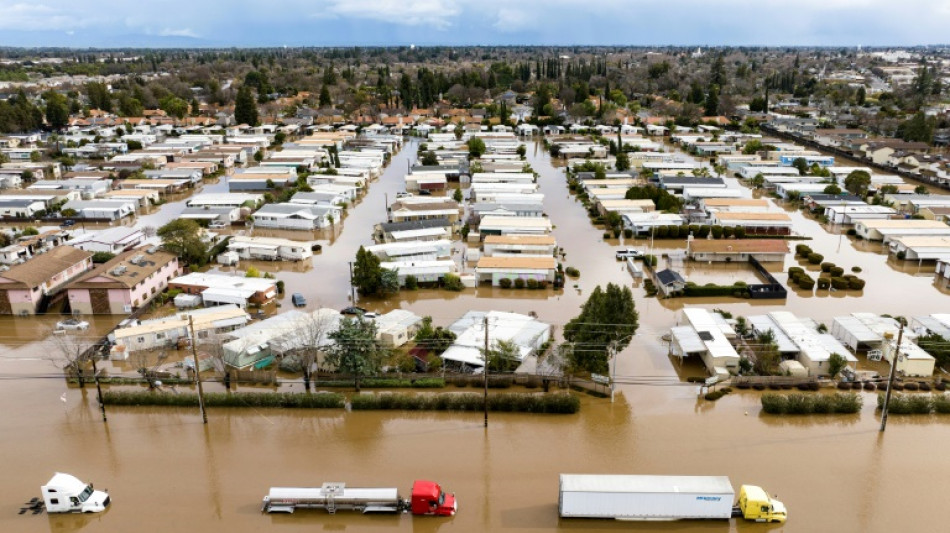
California downpours won't fix decades of drought: scientists / Photo: JOSH EDELSON - AFP

 Typhoon Dujuan leaves four dead in Japan, 45,000 houses without power

 G7 leaders condemn Houthi strikes on Saudi Arabia

 Google data centre sparks protests in Austria

 Shin Ohashi: Junk food-loving teen and Japan's next big swimming hope

 Stocks rise on AI buzz, drop in oil prices

 China's robot dancers limber up for America's Got Talent final

 Despite military might, Saudi struggles to crush the Houthis

 Trump to tout deals, defend Iran war in UN speech

 Sri Lanka to issue verdict in landmark Easter attack trial

 No green light to lift EU sanctions on Russian oligarchs, talks to resume

 UK agrees support for Saudi in struggle with Houthis: reports

 EU foreign policy chief calls for continued sanctions on Russia

 Flights scrapped, evacuations urged as Typhoon Dujuan wallops Japan

 Fonseca to take break from tennis

 A Cuban zoo, and its animals, in epic battle for survival

 Infantino proposes consulting federations to reform FIFA

 El Nino weather pattern enters record territory: scientist

 OpenAI calls for US to lead global effort on AI standards
 South African ostriches plucked alive for luxury fashion: report

 US networks halt Trump coverage in revolt over White House ban

 Paramount settles with US states to clear Warner Bros. mega-merger

 Climate crisis a job for world leaders, not just activists: UK FM

 US networks halt Trump coverage over White House ban

 French singer accuses Miley Cyrus of plagiarism

 EU fines Google 403 mn euros for location data breach

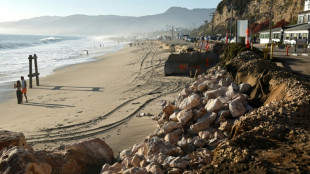
Near-record rainfall has battered California for weeks, sparking floods and landslides as the state struggles to cope with so much water.
But scientists say even this much precipitation won't reverse the western US state's decades-long drought.
A parade of atmospheric rivers -- massive flows of moisture dragged through the skies from the oceans -- has unleashed staggering volumes of rain and snow since December.
San Francisco got more rain in the last two weeks than it has done in any similar period for 150 years, while the Sierra Nevada mountains have been buried in as much as 33 feet (10.5 meters) of snow.
Peter Gleick, co-founder of the Pacific Institute in Oakland, a research organization that specializes in water issues, says it's difficult to quantify exactly how much water has fallen from the sky.
"But we're definitely talking about trillions of gallons (liters)," he told AFP.
"There's no doubt that the water we're getting now is a great help in eliminating the drought... But it is too soon to say that the drought is over."
"2023 could be a wetter year than normal," he said, but we'll have to wait until the end of winter to know for sure.
The western United States is in its 23rd year of drought, with major rivers and reservoirs at a fraction of capacity.
California's largest reservoir, Lake Shashta, is only 42 percent full, official data shows, even after all this rain.
The monster snowpack in the Sierra Nevada mountains -- it is currently twice what it normally is in January -- is most helpful, because this provides the gradual run-off that drip-feeds reservoirs in drier months.
- Aquifers in deficit -
Beyond its reservoirs and snow reserves, the state faces a much deeper-seated problem with its depleted groundwater, says Nicholas Pinter, a geologist from University of California, Davis.
About half of measured wells in California have seen their water levels decline over the past 20 years, according to a report from the California Natural Resources Agency released in October.
And the torrents of rain that have fallen are not all that effective at recharging them -- the soil became saturated quickly, so instead of being absorbed, subsequent downpours just ran off.
"Groundwater is like our retirement account. It's slow to go in and we have to withdraw it very, very carefully," says Pinter.
"Only, a lot of California water users draw on that retirement account like if it was the savings for tomorrow."
California's vast agricultural sector -- which supplies a swathe of America's supermarkets -- is a heavy user of this underground water.
That intense need -- coupled with big cities like Los Angeles that have nowhere near enough of their own water to support their populations -- means almost no matter how much it rains, it will not be enough.
"We will never end the discussion of drought in California because drought in California is largely driven by water demand," says Pinter.
- Climate change -
Human-caused climate change is already making itself felt, with average global temperatures up 1.2C since pre-industrial times.
That contributes to longer term trends like the drought, as well as to the increasing ferocity of winter storms like those that are whipping the western US coast now.
Adapting to the climate that we have altered is going to be key, says Gleick.
That includes learning how to retain the water when it falls as rain, to tide us through the hotter, drier summers.
"California built levees to protect communities from flooding, but they prevent the aquifers from recharging," he said.
"Every major river would benefit from widening the floodplains, by moving the levees back from the river and letting the rivers flood more.
"Instead of thinking we can control all floods, we have to learn to live with them."
Crucially, that means not assuming we can just go back to the way things were before a disaster struck.
"When communities are hit by repeated flooding, we should not rebuild in the same place," he said.
V.Dantas--PC