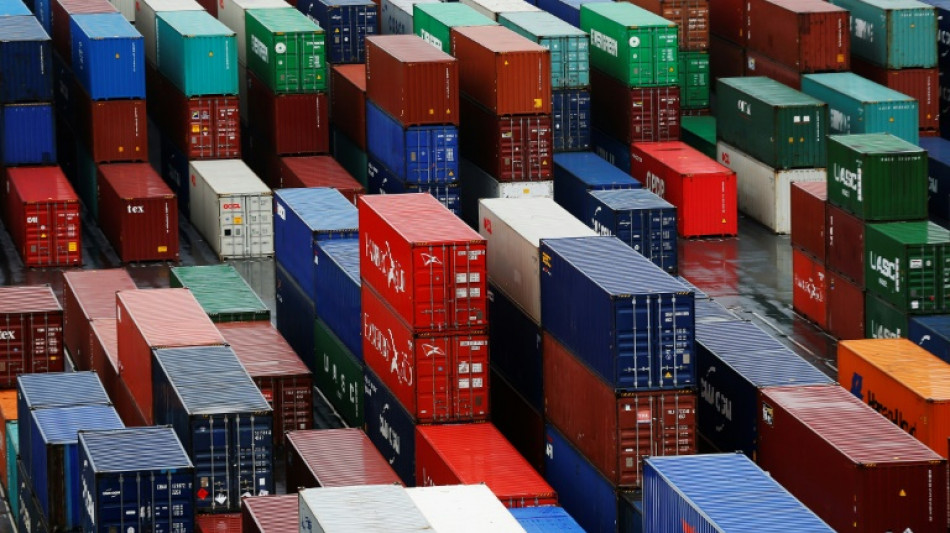
Dockers killed, kidnapped and corrupted by drugs mafia / Photo: CHARLY TRIBALLEAU - AFP/File

 Typhoon Dujuan leaves four dead in Japan, 45,000 houses without power

 G7 leaders condemn Houthi strikes on Saudi Arabia

 Google data centre sparks protests in Austria
 Shin Ohashi: Junk food-loving teen and Japan's next big swimming hope
 Stocks rise on AI buzz, drop in oil prices
 China's robot dancers limber up for America's Got Talent final

 Despite military might, Saudi struggles to crush the Houthis
 Trump to tout deals, defend Iran war in UN speech
 Sri Lanka to issue verdict in landmark Easter attack trial
 No green light to lift EU sanctions on Russian oligarchs, talks to resume
 UK agrees support for Saudi in struggle with Houthis: reports

 EU foreign policy chief calls for continued sanctions on Russia

 Flights scrapped, evacuations urged as Typhoon Dujuan wallops Japan
 Fonseca to take break from tennis
 A Cuban zoo, and its animals, in epic battle for survival

 Infantino proposes consulting federations to reform FIFA

 El Nino weather pattern enters record territory: scientist
 OpenAI calls for US to lead global effort on AI standards
 South African ostriches plucked alive for luxury fashion: report
 US networks halt Trump coverage in revolt over White House ban
 Paramount settles with US states to clear Warner Bros. mega-merger
 Climate crisis a job for world leaders, not just activists: UK FM
 US networks halt Trump coverage over White House ban
 French singer accuses Miley Cyrus of plagiarism
 EU fines Google 403 mn euros for location data breach

They could be scenes straight from gangster movies, except all happened for real in the French port of Le Havre over the past year.
A drug gang smashing its way out of the port in a lorry loaded with cocaine under police fire; another criminal band storming a depot inside the tightly-controlled zone to grab a hidden shipment of the drug.
And then there was the container cracked open in daytime traffic just outside the gates by a gang who set it on fire once they retrieved a cache of the white powder.
"There is so much money to be made they do not think twice about taking big risks," a police officer in the Channel port told AFP.
Le Havre is one of northern Europe's big five container ports. And its vast cargo terminals where the River Seine reaches the sea have become the main point of entry for cocaine into France.
A record 10 tonnes of the drug were seized on its quays in 2021 -- up 164 percent on the previous year -- as a vast wave of cocaine has poured into Europe from South America.
The explosion in the trade has led to a massive escalation in violence and corruption in the port, most of it focused on the port's 2,200 dockers, the main target of the drug trafficking mafia.
- 'Price list' of bribes -
The dockers, organised under the banner of the communist union, the CGT, have long been the masters this world apart of giant cranes and mountains of multi-coloured containers.
"Not just anyone can get into the port of Le Havre, so to get the drugs out, the traffickers need accomplices -- most of all dockers," a police source told AFP.
Several dockers have been jailed over the past few years for working with the drug gangs, and the names of others have popped up in police wiretaps.
One of them told his lawyer how he got entangled in the trade. "Before I used to make 200 or 300 euros ($320) a month from selling (stolen) perfume or cartons of cigarettes. One day some guys asked me to take some bags out (of the port) for 1,000 euros a bag.
"It started like that," he said.
In fact, according to a "price list" discovered in 2017, the "narcos" were offering dockers up to 75,000 euros to help get a container out of the port, with 10,000 for the loan of a security badge and 50,000 for moving a container.
"Some dockers do it for the money, but most are threatened or pressured into it," insisted lawyer Valerie Giard, who has defended several.
"The traffickers come up to them at the school gates or in a cafe and show them photos of their family," Giard said. "They tell them that if they don't do what they say, they'll be trouble. Once they get them involved, they never get out."
Those who resist face more muscular methods.
- Death on the docks -
In June 2018, a docker was kidnapped near his home and found a few hours later his face battered and the calves of his legs stabbed with a screwdriver.
The 54-year-old told police his abductors demanded he pay them several million euros, saying he was "a big fish. We know where you work, and that you can get containers out" of the port.
A police informant later told investigators that the man had "refused to work" for a trafficker.
Two dozen Le Havre dockers have been kidnapped or held hostage since 2017, the authorities say -- some by drug traffickers but others by small-time hoodlums who assumed they had profited from trade.
"Abducting port workers has become the big local sport," said Giard.
At least one of the kidnappings turned deadly. On June 12, 2020 the bloodied body of docker Allan Affagard was found behind a school in a suburb of Le Havre.
The big outspoken union man had been investigated two years earlier, accused of helping get a tonne of cocaine out of the port -- a claim he denied.
His wife told police that the 40-year-old had been abducted the night before he was found dead by three masked men. Shortly before he had gone to the police after receiving "threatening messages".
Three well-known Le Havre underworld figures have since been hit with conspiracy charges but the docker's killers are still free.
Affagard's murder sent a chill through the port.
"The press see this case as being the arrival of drug cartel violence here," said lawyer Guillaume Routel, who has made his name defending dockers. "That is certainly exaggerated, but anyone handling cargo in the port feels in danger."
- 'They are watching us' -
A fearful silence hangs over the Neiges district hard by the port where many of the dockers traditionally live.
The dockers' union is no more talkative. With members told to keep their mouths shut, the CGT refuses to discuss publicly the bad apples who have been purged from its ranks.
"Everybody is worried on the port," said Alain Le Maire, of the customs officers' union. "The traffickers are watching us with their binoculars or their drones. Now when we check a container, we are guarded by colleagues armed with assault rifles."
Since the "electric shock" of the Affagard murder, security has been further tightened.
"Safety and security are some of our main priorities," port chiefs said. More guards have been hired, the security badge system toughened and more than a million euros are being spent on new CCTV cameras.
But the flow of drugs has not been stemmed, with more than 8.5 tonnes of "coke" seized in 2022, according to a police officer.
"Progress has been made, but we cannot lie, the port is still a sive," admitted a customs official, who asked to remain annoymous.
- Huge pressure -
"All the cameras in the world won't make a huge difference against determined traffickers."
"The dockers are less complicit. They have understood that they are playing with something that is stronger than them," a police officer said.
"But the pressure is still huge. If we are not careful, we could slip into what has happened in Antwerp and Rotterdom," North Sea mega ports through which most of Europe's cocaine is smuggled.
It is a frightening prospect. In the Netherlands, the Dutch-Moroccan "Mocro maffia" -- a key cog in the trade -- have been accused of assassinating an investigative journalist and a lawyer, with Belgium's justice minister the target of a kidnap plot.
"Things could get bad here too," Le Havre prosecutor Bruno Dieudonne admitted.
"We are not yet at the stage of attacks with assault weapons like in Antwerp, but the danger is not far off."
H.Silva--PC