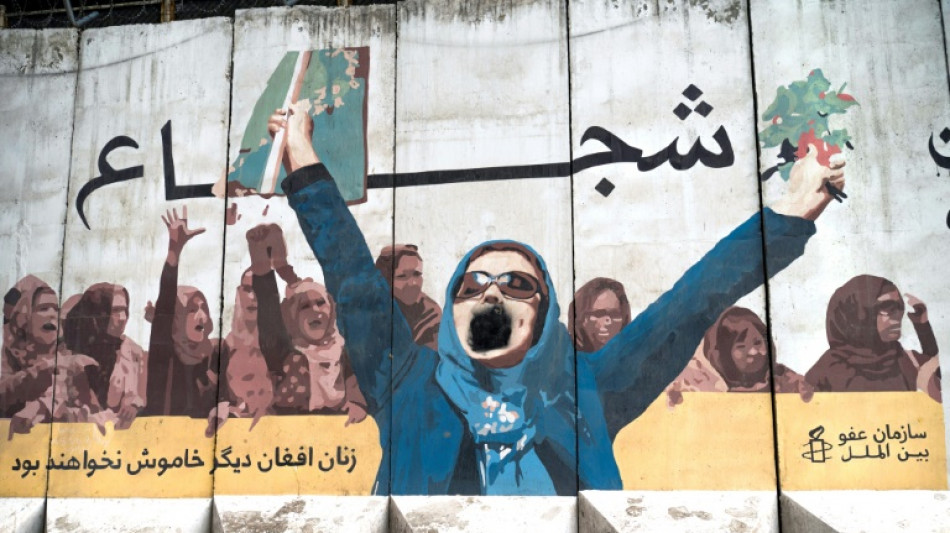
Three foreign NGOs partially resume aid in Afghanistan with women workers / Photo: Wakil KOHSAR - AFP

 Typhoon Dujuan leaves four dead in Japan, 45,000 houses without power

 G7 leaders condemn Houthi strikes on Saudi Arabia

 Google data centre sparks protests in Austria

 Shin Ohashi: Junk food-loving teen and Japan's next big swimming hope

 Stocks rise on AI buzz, drop in oil prices
 China's robot dancers limber up for America's Got Talent final

 Despite military might, Saudi struggles to crush the Houthis
 Trump to tout deals, defend Iran war in UN speech

 Sri Lanka to issue verdict in landmark Easter attack trial

 No green light to lift EU sanctions on Russian oligarchs, talks to resume

 UK agrees support for Saudi in struggle with Houthis: reports

 EU foreign policy chief calls for continued sanctions on Russia

 Flights scrapped, evacuations urged as Typhoon Dujuan wallops Japan

 Fonseca to take break from tennis

 A Cuban zoo, and its animals, in epic battle for survival

 Infantino proposes consulting federations to reform FIFA

 El Nino weather pattern enters record territory: scientist
 OpenAI calls for US to lead global effort on AI standards

 South African ostriches plucked alive for luxury fashion: report
 US networks halt Trump coverage in revolt over White House ban

 Paramount settles with US states to clear Warner Bros. mega-merger

 Climate crisis a job for world leaders, not just activists: UK FM

 US networks halt Trump coverage over White House ban
 French singer accuses Miley Cyrus of plagiarism

 EU fines Google 403 mn euros for location data breach

At least three leading international aid agencies have partially resumed life-saving work in Afghanistan after assurances from the Taliban authorities that Afghan women can continue to work in the health sector.
Hundreds of NGOs have been instrumental in trying to address one of the world's worst humanitarian crises, with half of Afghanistan's 38 million people hungry and three million children at risk of malnutrition.
CARE, Save the Children and International Rescue Committee (IRC) suspended their operations in late December in protest against a government order banning Afghan women from aid work, the latest rollback of women's rights in the country.
"We have received clear, reliable assurances from relevant authorities that our female staff will be safe and can work without obstruction," Save the Children said in a statement, confirming they had resumed work in the health sector in the past few days.
"However, with the overarching ban still in place, our other activities where we do not have reliable assurances that our female colleagues can work, remain on hold."
The IRC and CARE also confirmed they had resumed work with women staff in the health sector.
The international community has been urging the government in a series of high-level meetings to reverse the order banning women in the aid sector, which was expected to have heavy consequences on aid flows coming into the country.
Abdul Rahman Habib, spokesman for the ministry of economy that ordered the ban, told AFP that it was "a need for our society" that women were allowed to work in the health sector.
"We need them to support the malnourished children and other women who need health services. They (women staff) are working in line with our religious and cultural values."
- 'New guidelines' -
Two aid officials said negotiations were ongoing with the authorities to allow women to work in other sectors, including education, water, sanitation and food distribution.
"We are hopeful that there will be new guidelines soon," said an aid official with a foreign NGO, who asked not to be named.
The authorities might "selectively open" other sectors for women, another aid worker said, also speaking on condition of anonymity.
"They are expected to ask NGOs which specific departments within their organisations and work sectors they need women staff for, and accordingly, permissions could be given," he said.
A senior Taliban official who spoke to AFP on condition of anonymity said NGOs would have to provide reasons for employing women.
"The ministry of economy will look into these reasons and if an understanding is reached then the NGOs will be asked to provide a good working atmosphere for women employees," the Taliban official said.
The ban was imposed because women were not observing the rules issued by the ultra-conservative authorities on wearing the hijab or being accompanied by a male relative while travelling, Taliban officials say.
But aid officials have dismissed those charges, insisting their organisations had already segregated men and women employees and that women were wearing hijabs.
Women workers are vital for on-the-ground aid operations in Afghanistan, particularly in identifying other women in need.
"From the start of winter our situation has been worse. We have not eaten anything for four days," said Parveen, a mother of eight, standing in a queue to receive food aid in Kabul.
She said she preferred receiving aid from women workers rather than men.
"I can't tell a man to give me aid first because I have a small kid or I am sick," said Parveen, 38.
"To a woman, you can tell everything."
The ban was one of two crushing orders made in rapid succession last month, after authorities had first barred women from university education.
Since the Taliban returned to power in August 2021 they have imposed a slew of restrictions on Afghan women, effectively squeezing them out of public life.
Secondary school education is already banned for girls, and many women have lost government jobs.
Women have also been barred from going to parks, gyms and public baths.
A.F.Rosado--PC