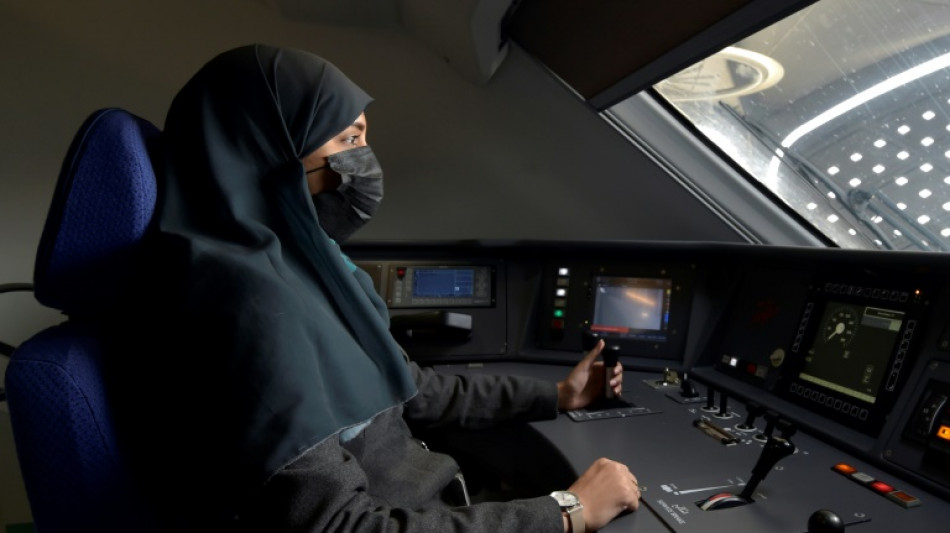
Women drive fast train to Mecca as Saudi workforce evolves / Photo: Amer HILABI - AFP

 Stocks rise on AI buzz, oil prices cool
 India narrowly survive huge scare against minnows Japan

 Missing F-35 fighter parts 'not sensitive', says Australia minister
 Cambodia showcases scams crackdown with global conference
 Afghan cyclist who disguised herself as man wins Asian Games silver

 Typhoon Dujuan leaves four dead in Japan, 45,000 houses without power
 G7 leaders condemn Houthi strikes on Saudi Arabia
 Google data centre sparks protests in Austria
 Shin Ohashi: Junk food-loving teen and Japan's next big swimming hope
 Stocks rise on AI buzz, drop in oil prices
 China's robot dancers limber up for America's Got Talent final

 Despite military might, Saudi struggles to crush the Houthis
 Trump to tout deals, defend Iran war in UN speech
 Sri Lanka to issue verdict in landmark Easter attack trial

 No green light to lift EU sanctions on Russian oligarchs, talks to resume
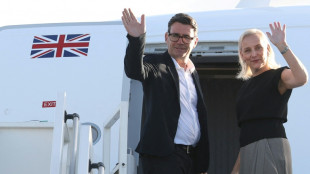 UK agrees support for Saudi in struggle with Houthis: reports

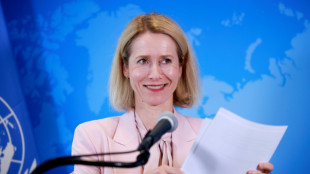 EU foreign policy chief calls for continued sanctions on Russia
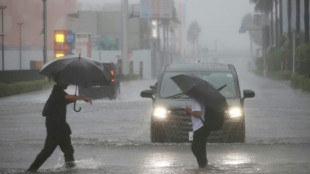 Flights scrapped, evacuations urged as Typhoon Dujuan wallops Japan
 Fonseca to take break from tennis

 A Cuban zoo, and its animals, in epic battle for survival

 Infantino proposes consulting federations to reform FIFA

 El Nino weather pattern enters record territory: scientist
 OpenAI calls for US to lead global effort on AI standards
 South African ostriches plucked alive for luxury fashion: report
 US networks halt Trump coverage in revolt over White House ban

Driver Tharaa Ali takes her seat at the helm of a high-speed train ferrying pilgrims to Mecca, a beneficiary of conservative Saudi Arabia's bid to employ its booming female workforce.
Saudi women only gained the right to drive in 2018, and until recently 25-year-old Ali's transportation experience was limited to cruising around her native Jeddah in the family sedan.
But last year she joined some 28,000 applicants vying for just 32 slots for women drivers on the Haramain High Speed Railway, which plies the 450-kilometre (280-mile) route between the holy cities of Mecca and Medina at speeds of up to 300 kilometres (186 miles) per hour.
To her astonishment, the former English teacher was among the lucky few selected, and she completed her first trip last month.
"The first day working here was like a dream for me –- entering the train, entering the cabin," she told AFP.
"When you are in the cabin, you see things heading towards you at a very high speed. A feeling of fear and dread came over me, but thank God, with time and intensive training, I became confident in myself."
The proportion of Saudi women in the workforce has more than doubled since 2016, from 17 percent to 37 percent.
The statistic feeds a narrative of expanding women's rights under Crown Prince Mohammed bin Salman, even amid ramped-up repression of activists, making it a reliable applause line at events like the World Economic Forum in Davos.
Yet unemployment among Saudi women is high –- 20.5 percent last year, compared to 4.3 percent for Saudi men.
That figure, much like the flood of applicants for the driver positions, highlights an urgent task facing Saudi policymakers: creating jobs for all the women newly interested in participating in a changing economy.
"The challenge has shifted," said Saudi economist Meshal Alkhowaiter, "from encouraging women to join the workforce, to creating a sufficient number of jobs to employ the thousands of Saudi women entering the workforce every quarter."
- Winning over sceptics -
Saudi women have traditionally thrived in select fields like education and medicine.
Yet rules introduced in recent years barring workplace gender discrimination and easing dress code restrictions have created new opportunities.
That includes positions as waiters, baristas and hotel receptionists that were previously dominated by foreigners, a boon to the government's "Saudization" agenda.
Social mores don't always keep up with changing regulations, however, something the women train drivers have seen firsthand.
Raneem Azzouz, a recent recruit, said that at the end of one trip to Medina, a woman passenger explained that she didn't believe women could do the job until she saw it with her own eyes.
"She said: 'Frankly, when I saw the (job) advertisement, I was totally against it. I said that if my daughter was going to drive me, I wouldn't ride with her,'" Azzouz recalled.
With the journey safely completed, the woman gushed that Azzouz had "proved herself" and that she "didn't feel any difference".
The women drivers are "highly qualified and proved their worth during training," said Rayan al-Harbi, executive vice president of the Saudi Railway Company.
"This is evidence that Saudi women have full capacity when they are empowered to perform tasks like their brothers."
- Passengers 'thank me' -
Not everyone is convinced.
Mohammed Issa, an Emirati civil servant who recently rode the high-speed train to Jeddah airport, said women should focus on homemaking.
"If the woman devotes herself to her home, there is no doubt that it will be a successful family," he said.
"But if the woman is absent from home, and work certainly keeps her away from the home, who will play her role?"
Such statements appear to represent a minority view among Saudis, said Sussan Saikali of the Arab Gulf States Institute in Washington.
"There have been some comments from men claiming that women are now taking their jobs, but those comments are few and far between," she said.
"We can't expect a whole population to support every policy in the country," said Najah Alotaibi, associate fellow at the King Faisal Center for Research and Islamic Studies.
"But the majority of people are supportive of change."
As they settle into their new jobs, the women conductors are focusing on the positive feedback they receive, including from passengers who request selfies at the end of each trip.
"Every time I finish my journey, when I get off the train and meet the passengers, they greet me saying, 'Thank you, thank God for safety,'" Ali said.
"They thank me that it was a smooth journey."
G.M.Castelo--PC