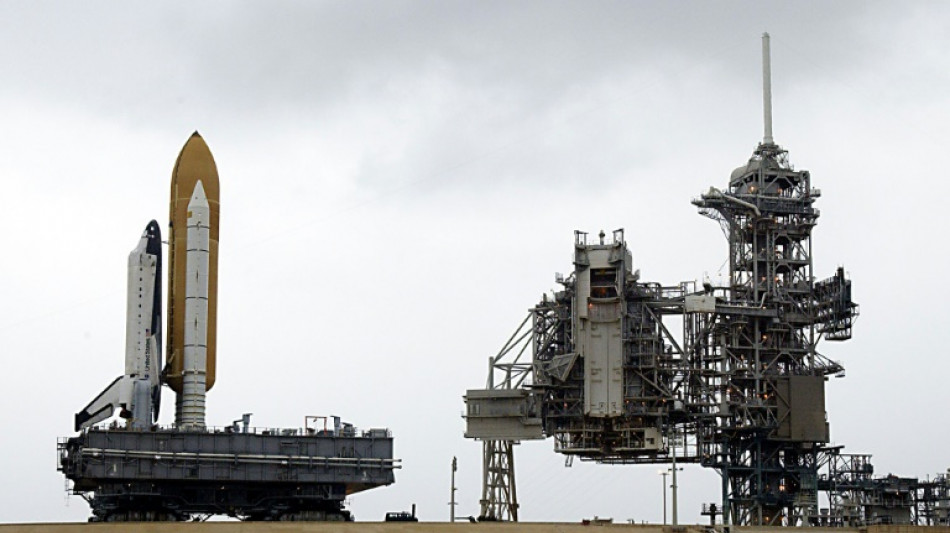
Columbia disaster that scuttled the space shuttle
/ Photo: NASA PHOTO - AFP/File

 Stocks rise on AI buzz, oil prices cool

 India narrowly survive huge scare against minnows Japan

 Missing F-35 fighter parts 'not sensitive', says Australia minister

 Cambodia showcases scams crackdown with global conference

 Afghan cyclist who disguised herself as man wins Asian Games silver

 Typhoon Dujuan leaves four dead in Japan, 45,000 houses without power

 G7 leaders condemn Houthi strikes on Saudi Arabia

 Google data centre sparks protests in Austria

 Shin Ohashi: Junk food-loving teen and Japan's next big swimming hope

 Stocks rise on AI buzz, drop in oil prices
 China's robot dancers limber up for America's Got Talent final

 Despite military might, Saudi struggles to crush the Houthis

 Trump to tout deals, defend Iran war in UN speech
 Sri Lanka to issue verdict in landmark Easter attack trial

 No green light to lift EU sanctions on Russian oligarchs, talks to resume

 UK agrees support for Saudi in struggle with Houthis: reports

 EU foreign policy chief calls for continued sanctions on Russia

 Flights scrapped, evacuations urged as Typhoon Dujuan wallops Japan

 Fonseca to take break from tennis

 A Cuban zoo, and its animals, in epic battle for survival

 Infantino proposes consulting federations to reform FIFA

 El Nino weather pattern enters record territory: scientist
 OpenAI calls for US to lead global effort on AI standards

 South African ostriches plucked alive for luxury fashion: report
 US networks halt Trump coverage in revolt over White House ban

America may now be aiming to put astronauts back on the Moon, but for years the United States turned its back on manned missions after the Columbia space shuttle disaster.
Its space programme suffered a catastrophic setback when all seven astronauts were killed when the shuttle broke up on re-entering the Earth's atmosphere 20 years ago on February 1, 2003.
It was the second shuttle disaster after the Challenger explosion of 1986 which also killed the crew and led to sharp criticism of the safety culture at NASA.
The shuttle fleet was grounded for two and a half years and it sparked a major shift in American space flights.
In 2004, president George W. Bush announced that the eye-wateringly expensive programme would be retired.
For years after the last shuttle flight in 2011, NASA found itself dependent on Russia for transport to the International Space Station (ISS) until Elon Musk's Space X began flying passengers there in 2020.
As well as the Moon, Washington is now preparing for a manned mission to Mars, scheduled tentatively for the late 2030s or early 2040s.
- 'Trails of smoke' -
Columbia broke up at 203,000 feet (61,900 metres) over eastern Texas just as the mission controller in Houston was talking to Columbia commander Rick Husband.
"To Columbia, here is Houston... we did not copy your last" message.
After a moment, Husband replied: "Roger but..."
After a brief crackling noise, contact was lost.
Columbia disappeared from radar screens at 9:00 am (1400 GMT), 16 minutes before it was due to land.
The flaming debris from the 80-tonne craft was caught streaking across the sky over the southern US by local TV stations, with parts scattered over Texas and Louisiana.
Bob Molter from Palestine, Texas, told National Public Radio how he saw the shuttle break up in the sky.
"There was a big boom that shook the house for more than a minute, and I went outside because I thought there had been a train accident on the nearby line.
"But there was nothing, and then I looked up and saw the trails of smoke zig-zagging, going across the sky."
- Heroes -
Columbia was the oldest shuttle to fly in orbit.
When it took off on its 28th flight on January 16, 2003 for a 16-day mission to carry out experiments it had been in operation for over 20 years.
Flight STS-107 was launched under extremely tight security in the wake of the September 11, 2001 attacks and due to the presence on board of Israel's first astronaut, Ilan Ramon.
Bush cut short a stay at the Camp David presidential retreat and raced back to Washington following the tragedy. In a televised address he hailed the crew, two of whom were women, as heroes.
A probe revealed that the shuttle disintegrated due to damage caused by a piece of foam from the external fuel tank that took a chunk out of the orbiter's left wing during liftoff.
This left it unable to withstand the extreme temperatures generated by re-entry.
- End of shuttle programme -
The shuttle programme was born in 1972 under president Richard Nixon and went on to become the major focus of US human spaceflight ambitions over the next four decades.
The fleet also acted like space trucks, carrying more than 1,500 tonnes of equipment to help build the first space telescope, Hubble, and the International Space Station.
After the Columbia disaster, NASA underwent sweeping changes aimed at improving its culture and safety.
The agency resumed shuttle flights in July 2005, with Discovery, then Endeavour and finally Atlantis continuing to fly missions to the ISS until 2011.
L.E.Campos--PC