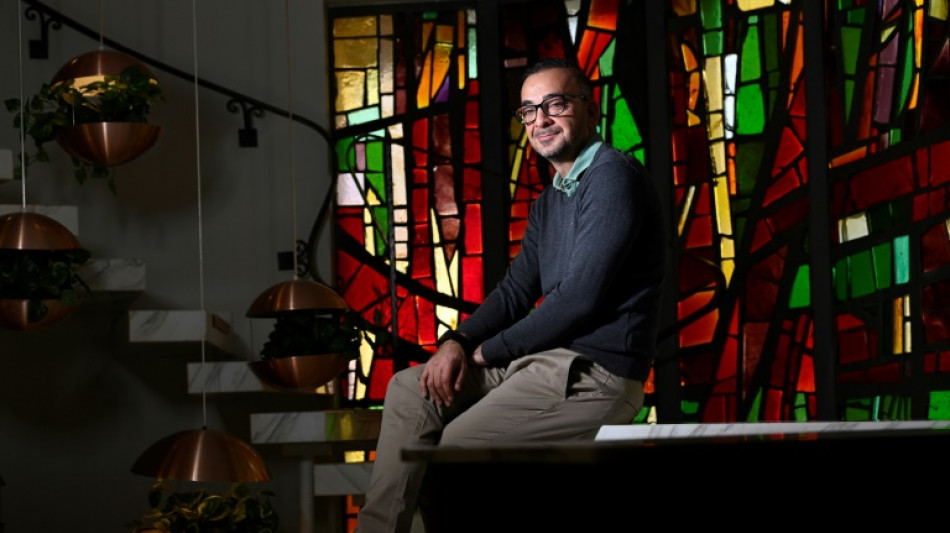
Oscar-bound short lifts veil on Iranian women rejecting male domination / Photo: JOHN THYS - AFP

 Stocks rise on AI buzz, oil prices cool
 India narrowly survive huge scare against minnows Japan

 Missing F-35 fighter parts 'not sensitive', says Australia minister
 Cambodia showcases scams crackdown with global conference
 Afghan cyclist who disguised herself as man wins Asian Games silver

 Typhoon Dujuan leaves four dead in Japan, 45,000 houses without power
 G7 leaders condemn Houthi strikes on Saudi Arabia
 Google data centre sparks protests in Austria

 Shin Ohashi: Junk food-loving teen and Japan's next big swimming hope
 Stocks rise on AI buzz, drop in oil prices

 China's robot dancers limber up for America's Got Talent final
 Despite military might, Saudi struggles to crush the Houthis
 Trump to tout deals, defend Iran war in UN speech
 Sri Lanka to issue verdict in landmark Easter attack trial

 No green light to lift EU sanctions on Russian oligarchs, talks to resume

 UK agrees support for Saudi in struggle with Houthis: reports

 EU foreign policy chief calls for continued sanctions on Russia
 Flights scrapped, evacuations urged as Typhoon Dujuan wallops Japan

 Fonseca to take break from tennis
 A Cuban zoo, and its animals, in epic battle for survival

 Infantino proposes consulting federations to reform FIFA

 El Nino weather pattern enters record territory: scientist
 OpenAI calls for US to lead global effort on AI standards
 South African ostriches plucked alive for luxury fashion: report
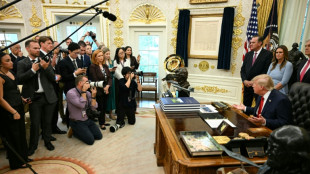 US networks halt Trump coverage in revolt over White House ban

Short movies nominated for an Oscar often don't get wide public attention. But when one is about an Iranian girl seeking freedom from male domination by taking off her veil, interest is sure to spike.
That's the premise of "The Red Suitcase", a 17-minute movie that, at the Oscar ceremony in Los Angeles on March 12, will shine a bright light on the protests that have gripped Iran since last September.
Set in Luxembourg's airport, it tells the story of a 16-year-old Iranian girl freshly arrived from Tehran who, with trepidation, takes off her veil to escape an unhappy fate dictated by men.
For director Cyrus Neshvad, born in Iran but of Luxembourgish nationality, the Oscar nomination is a chance to highlight what the "virus" of the Islamic regime is doing to the "beautiful body" of his birth country.
"Once we get this virus out, the body will be flourishing again," he told AFP.
The demonstrations in Iran were sparked by the September 16 death in custody of a young Iranian woman, Mahsa Amini, who was detained for incorrectly wearing the headscarf mandated by the country's religious rulers.
Since then they have spread to become one of the most serious popular challenges to the hardline Islamic theocrats who took power in 1979.
The regime has responded by cracking down on the protesters with arrests and executions -- but also turning against those voicing support, among the country's sportspeople and filmmakers.
- 'Take your hijab off' -
For Neshvad, "The Red Suitcase" wasn't born of the current uprising in Iran -- it was filmed a year before it started.
But it has its roots in the injustices faced by his family -- of the Bahai religion, systematically persecuted in Iran -- as well as those long experienced by Iranian girls and women before Amini's death brought them to global attention.
"For me, it (the movie) was about a woman, which are the women in Iran being under domination of the man," said the director, aged in his 40s.
In Iran, "If a woman wants to do something, or go visit something, the man (her father or husband) has to consent and write the paper and sign it," he said.
For the girl in his movie to take her veil off, it was a moment of "courage" -- for her to rebel against a path forced upon her, but also to inspire those watching.
"It will be a message: 'Follow me -- like me, take your hijab off, don't accept this domination, and let's be free, at least have the free will to decide'," Neshvad said.
His actress, Nawelle Evad, 22, isn't Iranian and used a dialogue coach to deliver the few lines in Farsi required.
But as a French-Algerian, the issue of women and Islamic headscarves -- and the debate in the West around them -- was familiar to her.
"I had a Muslim upbringing and I used to wear it," she told AFP in Paris, where she lives.
But for her "it was never an obligation" to wear one, she noted.
And even for her character in the movie, when she takes her headscarf off, "It's not of her will, it's despite herself that she removes it -- I think there are many women in Iran, and elsewhere, where the headscarf is an extension of themselves."
- Criticism of West too -
In the film though, by removing the headscarf, her character ultimately "chooses herself".
"That's what I find so beautiful in this film... the doubts that anybody, in any country, in any culture, faces... What do I choose for myself? Do I listen to my family? Am I making my own choices?"
Neshvad's French scriptwriting partner, Guillaume Levil, also suggested that the sexualised airport ads in the film underline that the West, too, can be criticised for exploiting women and their public image.
The final image of the movie, an ad showing a blonde model with abundant curly hair, was emblematic of both social diktats, the director said.
"The closer we go with the camera on her face, slowly we see that she's not happy, and when we are very, very close, we see that (she) is even frightened," he said.
"And with this, I wanted to finish the movie. So to have both sides, not only one side, but both sides."
A.Seabra--PC