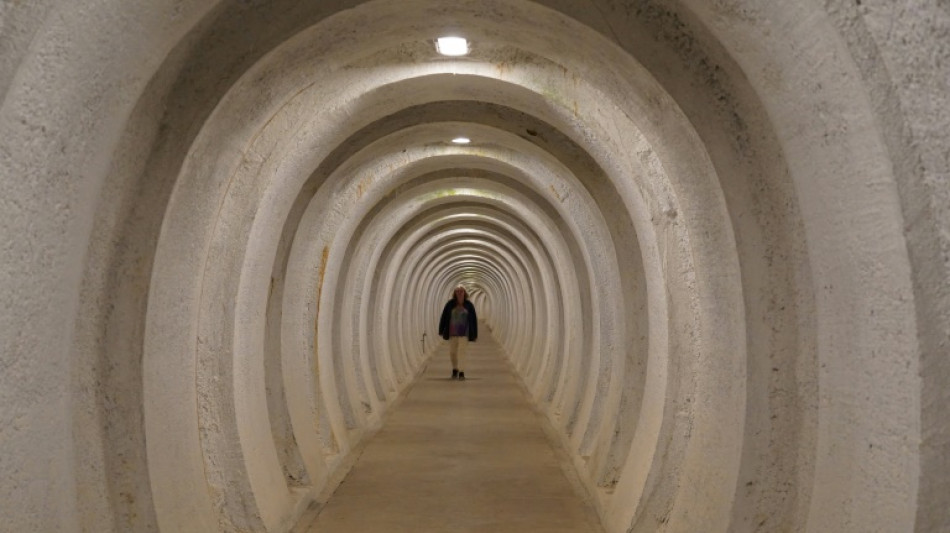
Cold War fears revisited in Danish nuclear bunker / Photo: James BROOKS - AFP

 Newcomers South Korea face holders Italy in Davis Cup finals

 Japan's Kojima sounds Marchand warning with Asian Games gold

 England rugby star Pollock signs new Northampton deal

 STARTRADER Expands Its Chinese Equity CFD Range with CXMT and Unitree Robotics

 MEXC Expands Opportunity Compass with Stock Trading Handbook to Help Crypto Users Build Investment Knowledge

 England paceman Wood retires from international cricket

 Magnificent Mandhana's 79 helps India to Asian Games cricket gold

 Marchand 'stressed' about racing Japanese rivals at LA Olympics
 Mobile boat clinics bring healthcare to India's remote islands
 Former India paceman Zaheer Khan named Chennai coach in IPL

 Six-year-old Chinese girl sets world record with Rubik's Cube
 Swimming prodigy Yu, 13, says 'interviews way harder than racing'
 Star coaches make their bows as Nations League returns
 Rams bounce back as Giants reel from Dart injury

 In Bangladesh, Pakistan's Jinnah photo stirs anger

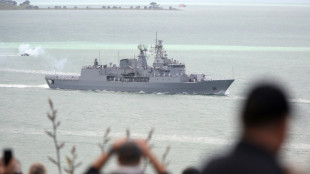 Two New Zealand naval ships transit Taiwan Strait
 Zidane gets down to work as France start new era
 Inside the Venezuelan prison meant to 'drive you insane'
 UK king braces as memoir by Diana's brother goes on sale
 Akkodis and Hamburg Public Transport Association Showcase hvv mia at InnoTrans 2026, Demonstrating the Future of AI-Powered Mobility

 Macron says talks with Trump on Red Sea, Ukraine 'constructive'

 Green policies just good politics, says UK minister
 Bardot auction in Paris fetches nearly one million euros
 No timeline on Daniels injury return, says Commanders coach

 British Columbia sues OpenAI in US court over Canada school shooting

Hidden deep in northern Denmark's Rold Forest, a sprawling top secret nuclear bunker is opening to the public for the first time, shedding light on daily life during the Cold War.
The underground shelter, where everything is still intact as in a time capsule, becomes a museum from Monday, amid revived fears in Europe of a nuclear conflict following Russia's invasion of Ukraine.
The bunker was built between 1963 and 1968 at NATO's insistence, following Soviet nuclear tests and the Cuban Missile Crisis.
Dubbed "Regan West", it was designed to house the Danish government and the sitting monarch in the event of nuclear war.
Nestled beneath trees, 60 metres (200 feet) under a chalk hill, it was meant to be "the last bastion" of democracy in Denmark, museum director Lars Christian Norbach told AFP.
Located almost 400 kilometres (250 miles) northwest of Copenhagen, the bunker was set up to house Danish authorities for 30 days.
"The H-bomb totally altered the situation about how you could react to a nuclear attack", museum curator and historian Bodil Frandsen told AFP.
"The bunkers you already had could in no way withstand the blast from that. So you had to do something new", she said.
The survival of the government in the event of a nuclear disaster was essential to the nation's sovereignty, she noted.
"As long as you could have a government here that could claim control of at least some part of the country, and you have a government still rooted in Denmark, then Denmark, as a sovereign democratic state, was still alive", Frandsen explained.
- ' Time capsule' -
Never used, the bunker was taken out of service in 2003 and first revealed to the world in 2012.
Walking through the long, arched corridors, visitors see the basic bedroom intended for the monarch, the cafeteria, the government conference room and 60s-style decor in a dimly-lit lounge.
"It's a time capsule of papers, pencils, everything is where it was left", Norbach said.
An exhibit also outlines the main events during the period, with everyday objects on display.
Museum visitors will walk two kilometres (1.2 miles) during the 90-minute tour, and still only see about 40 percent of it.
"This is a very important place in terms of showing younger people... how anxious people actually were during the Cold War," Frandsen said.
And now, heightened tensions between Russia and the West have made the topic all-too relevant again.
"The Cold War has gained actuality again, and that's what we are saying in the museum", Norbach added.
V.F.Barreira--PC