Turkey tragedy jolts quake-prone Central Asia / Photo: Ruslan PRYANIKOV - AFP

 Hurricane Polo strengthens to top category 5 off Mexico

 11 hurt as teen opens fire outside school in western Turkey

 UN chief says 'Big Oil' treats atmosphere as open sewer

 Tunisia says 2026 summer hottest on record

 England's Rashid out of Sri Lanka ODIs with hand injury

 Houthis accuse Saudi Arabia of deadly strikes as thousands flee

 Stocks climb as oil slides, AI buzz returns

 India cricketers win in style as Afghan savours 'special' Games silver

 La Liga president hits out at Real Madrid refereeing 'conspiracy' claims

 MEXC Launches “Real Stocks, Real Friends” with Rewards for Bringing Friends to Wall Street

 Mbappe continues media push for Ballon d'Or recognition

 Stocks rise on AI buzz, oil prices cool

 India narrowly survive huge scare against minnows Japan

 Missing F-35 fighter parts 'not sensitive', says Australia minister
 Cambodia showcases scams crackdown with global conference

 Afghan cyclist who disguised herself as man wins Asian Games silver

 Typhoon Dujuan leaves four dead in Japan, 45,000 houses without power

 G7 leaders condemn Houthi strikes on Saudi Arabia

 Google data centre sparks protests in Austria

 Shin Ohashi: Junk food-loving teen and Japan's next big swimming hope

 Stocks rise on AI buzz, drop in oil prices

 China's robot dancers limber up for America's Got Talent final

 Despite military might, Saudi struggles to crush the Houthis
 Trump to tout deals, defend Iran war in UN speech

 Sri Lanka to issue verdict in landmark Easter attack trial

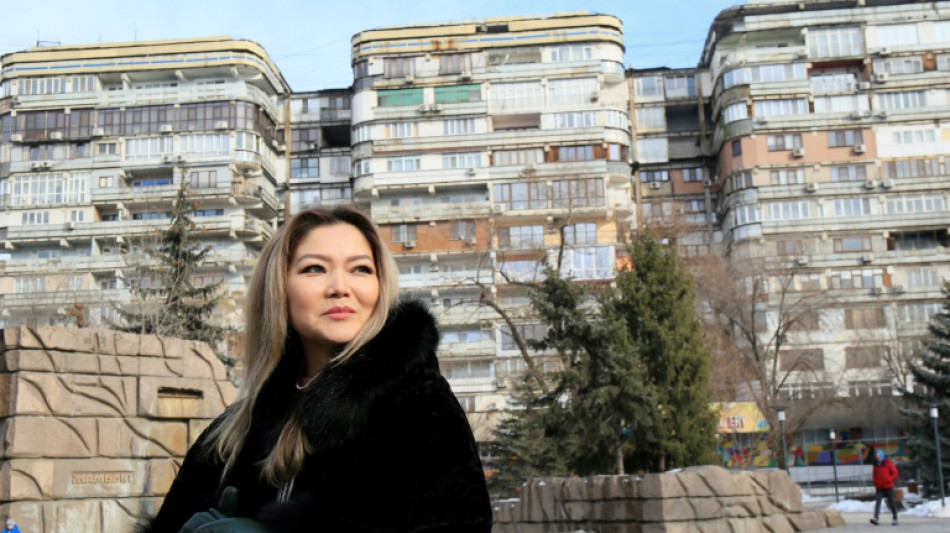
When a devastating earthquake and aftershocks struck Turkey and Syria this month, Klara Imangalieva -- who lives in the Central Asian country of Kazakhstan -- realised she had to move.
"We are also in danger," said Imangalieva, a resident of Almaty, Kazakhstan's largest city dominated by the snow-capped Tian Shan mountains.
"I'm looking to move into a single-storey house to at least have a chance of surviving in the event of an earthquake," said Imangalieva, who lives on the ninth floor of a high-rise building.
Almaty, which has a population of around two million people, sits in a high seismic hazard zone in southeastern Kazakhstan.
Small tremors are fairly common in the country although there has not been a major quake in living memory.
Three historic earthquakes hit Almaty -- then known as Verny -- more than a century ago in 1887, 1889 and 1911. Each time the city was heavily destroyed and had to be rebuilt.
The horrific earthquake and aftershocks that shook Turkey and Syria in early February, killing more than 45,000 people, stirred fears about a possible new disaster in the former Soviet country and drew fresh attention to its past and current building practices.
Architect Almas Ordabayev says it is unclear how many buildings in Almaty would be able to withstand powerful shocks, singling out early Soviet-era houses as a particular concern.
"All the buildings built before the end of the 1950s which have not been reinforced will not survive an earthquake like the one in Turkey", said 84-year-old Ordabayev.
Ordabayev also raised concern about the construction practices in the post-Soviet era.
"Only a strong earthquake will reveal what will happen to buildings built in the 1990s by corrupt and criminal companies," he said.
- 'Lesson to authorities' -
Ordabayev expressed hope that the catastrophe in Turkey and Syria could serve as a cautionary tale.
The scale of the destruction has ignited fury in Turkey, which has multiple fault lines and a history of major tremors, over poor construction standards.
"I hope that the earthquake in Turkey will serve as a lesson to our authorities and builders," Ordabayev said.
According to estimates, more than five million people in Kazakhstan live in a high seismic zone covering over 11 percent of the country's territory.
Deputy head of Almaty's Institute of Seismology, Nursaren Uzbekov, said around 40,000 earthquakes had been recorded in the country over the past five years.
On average, between nine to 15 quakes can be felt each year, he added.
Uzbekov's institute, founded in 1976, studies vibrations deep inside the Earth and the behaviour of animals such as snakes, birds, rabbits and fish.
A network of seismic stations monitors real-time ground motion in Kazakhstan and neighbouring countries.
Grigory Kochkarov works at one such station perched in the mountains overlooking Almaty.
"If there is an earthquake, we immediately see it on the screen, receive an audible signal and in ten minutes maximum, we transmit the information", he told AFP.
The station's seismographs are sensitive to minute vibrations and can detect activity occurring 3,000 kilometres (1,860 miles) away, he said.
He demonstrated long sheets of white paper -- some of the seismograms recorded by the observatory date back to the 1930s.
Kochkarov then opened a heavy door leading to a side chamber hewn out of the earth. Inside there was a long-corridor -- where "normally, nobody goes" -- containing sensitive measuring equipment.
But experts say that the energy-rich country does not have enough seismic stations and the majority of seismographs date back to the Soviet-era.
- Quake fears -
Other countries in former Soviet Central Asia also fear that a destructive earthquake could wreak havoc sooner or later.
After the earthquakes in Turkey and Syria, authorities in mountainous Kyrgyzstan pledged to assess the seismic resilience of high-rise buildings.
In Uzbekistan, an earthquake destroyed much of the capital Tashkent in 1966, and Soviet authorities had to rebuild the city.
Pensioner Nuriddin Ibragimov said he was 13 when the tragedy struck.
"Tashkent was in ruins," he said, noting that the Soviet authorities covered up the real death toll.
Ashgabat, the capital of Turkmenistan, was razed to the ground in 1948 in one of the deadliest quakes of the 20th century. The disaster claimed an estimated 100,000 lives.
Today Turkmenistan, one of the most secretive countries in the world, takes "necessary measures to preserve the structural integrity of buildings", a government source told AFP.
The lake is located behind a natural dam deep in the Pamir mountains, and if the dam is breached, the consequences will be catastrophic.
P.Queiroz--PC