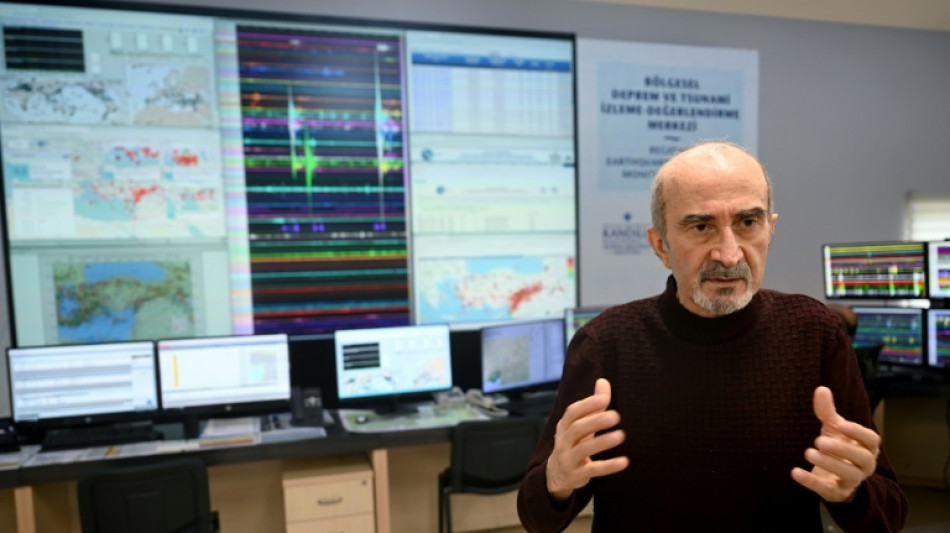
Quake-prone Istanbul not at heightened risk: expert / Photo: OZAN KOSE - AFP

 Trump renames AI "super intelligence," rejects international oversight

 Trump rejects international regulation of AI

 How is the EU approaching record fuel prices?

 Sri Lanka's Colombage strikes on debut as England dismissed for 265 in first ODI

 Hurricane Polo strengthens to top category 5 off Mexico

 11 hurt as teen opens fire outside school in western Turkey

 UN chief says 'Big Oil' treats atmosphere as open sewer

 Tunisia says 2026 summer hottest on record

 England's Rashid out of Sri Lanka ODIs with hand injury

 Houthis accuse Saudi Arabia of deadly strikes as thousands flee

 Stocks climb as oil slides, AI buzz returns

 India cricketers win in style as Afghan savours 'special' Games silver

 La Liga president hits out at Real Madrid refereeing 'conspiracy' claims

 MEXC Launches “Real Stocks, Real Friends” with Rewards for Bringing Friends to Wall Street

 Mbappe continues media push for Ballon d'Or recognition

 Stocks rise on AI buzz, oil prices cool

 India narrowly survive huge scare against minnows Japan

 Missing F-35 fighter parts 'not sensitive', says Australia minister

 Cambodia showcases scams crackdown with global conference

 Afghan cyclist who disguised herself as man wins Asian Games silver

 Typhoon Dujuan leaves four dead in Japan, 45,000 houses without power

 G7 leaders condemn Houthi strikes on Saudi Arabia

 Google data centre sparks protests in Austria

 Shin Ohashi: Junk food-loving teen and Japan's next big swimming hope

 Stocks rise on AI buzz, drop in oil prices
Fears of another major earthquake have been rekindled in Istanbul since the February 6 disaster that hit Turkey and Syria, but a prominent Turkish seismologist has reassured the risk "hasn't increased".
"The risk hasn't increased because we are talking about completely different systems," Dogan Kalafat, the director of the Kandilli Observatory's Earthquake-Tsunami Monitoring Center in Istanbul, told AFP.
Turkey's most populated city is situated near the North Anatolian Fault while the recent 7.8-magnitude quake that killed 43,500 people occurred along another fault in the country's southeast, Kalafat explained.
Still, the 16 million residents of Istanbul, a city that spreads over two continents and has seen skyscrapers mushroom in recent years, are wondering if they're ready for the "Big One".
"I'd like to say it, but sadly, it's a very big city with too many poorly constructed buildings," said Kalafat, who has denounced using low-quality cement and building on "soft soils".
While waiting for a large-scale quake, "we must make good use of the time. We must build earthquake-proof houses on solid soil. It's the most important precaution to take," the seismologist stressed.
At the observatory, seismologists take turns every eight hours watching a series of computer screens monitoring potential tremors.
In front of them, on a wall at least five metres (16 feet) tall, a giant screen provides real-time readings from 260 seismic stations across the country.
"Nine thousand aftershocks have taken place in Turkey since February 6," which is more than "seven or eight times normal", Kalafat said.
- Early warning -
On one of the desks, a laminated map shows the North Anatolian Fault, which crosses the Sea of Marmara, only "15 to 17 kilometres" from the southern shores of Istanbul, Kalafat said.
In 2001, two years after a 7.4-magnitude quake left 17,000 people dead in northwest Turkey, Kalafat calculated a 65 percent probability that a quake with a magnitude above 7 would occur before 2030 in the same region -- which includes Istanbul.
The risk climbed to 75 percent in 50 years and 95 percent in 90 years.
"These statistics are still relevant," said Kalafat, adding: "even with the technology of today, it is impossible to predict an earthquake."
"We can indicate, with a certain margin of error, where an earthquake can occur and what magnitude it can be, but we can't know when it will occur," he said.
The Kandilli Observatory has developed an early warning system "but Istanbul is too close to the fault line" for a system to be effective, Kalafat said.
On one of the desks, sitting between two screens, is a black telephone with two red labels with the public disaster management agency's acronym, allowing scientists to send an alert for a major earthquake.
The early warning could win "a maximum of seven or eight seconds" -- not enough time to allow inhabitants to get to safety.
In comparison, the telephonic warning system in Japan's Tohoku region, which was struck by a devastating earthquake and tsunami in March 2011, buys the public 45 seconds.
"There, you can send a message warning citizens, but we don't have this possibility here," he said.
M.A.Vaz--PC