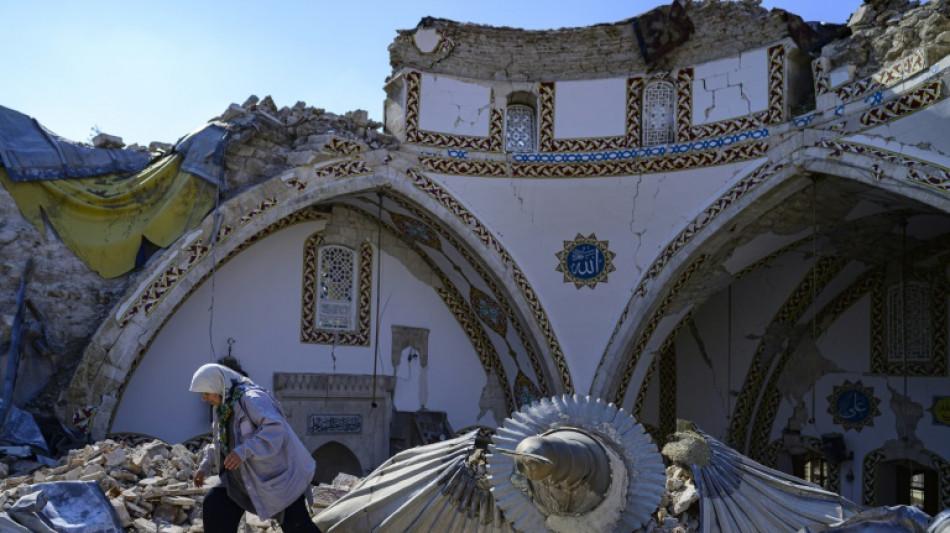
Fabled Antakya fears losing 'soul' in Turkish quake ruins
/ Photo: Yasin AKGUL - AFP

 Geri Halliwell-Horner Embraces Queen Camilla at Commonwealth Writing Competition

 Meta Quest 3 and 3S Gain Access to Over 150 3D Movies

 Sarah Bajada Shares Message on Pregnancy Loss

 ALIX LASERS shareholders remove Michael Sobitsch as managing director in view of the circumstances

 Euroseas Q3 Net Profit Falls to $91.4 Million Amid Fleet Reduction

 Daily Horoscope November 20, 2026: Astrological Predictions for All Signs

 Tosca's 2026 Sustainability Report Makes the Case for Packaging as Critical Supply Chain Infrastructure

As they left Antakya, Turkey's earthquake-shattered home of ancient civilisations, its anguished residents scribbled farewell messages on the ruins: "We'll come back" and "Don't lose hope."
Last month's deadly 7.8-magnitude quake and its aftershocks came down hard on Antakya -- a fabled city near Syria once known as Antioch -- ravaging centuries of treasured history.
Now, its residents fear the city they eventually return to will lack the vibrance and tradition of cultural acceptance that distinguished Antakya from the rest of Turkey until disaster struck on February 6, claiming more than 50,000 lives.
"In Turkey, those who are not Turkish and Sunni Muslim are seen as rare objects worthy of a museum. But in Antakya, it was different," said Emre Can Daglioglu, a volunteer for Nehna, an online platform dedicated to Antakya's Orthodox Christian culture.
"The church was at the centre of daily life, just as much as the synagogue was. Your tailor could be Jewish or Christian, and your grocer could be Alevi or Armenian," he said.
"They lived their identities openly and celebrated their holidays together."
- Rush to rebuild -
Framed by mountains running between the Mediterranean Sea and Turkey's border with Syria, Antakya was home to Greek, Roman, Byzantine, Persian, Arab and Ottoman empires over more than two millennia.
It was even briefly placed under a French mandate, before becoming part of modern Turkey in 1939.
Arab speaking Muslim and Christian communities lived in harmony with Turks, Kurds, Armenians, Greeks and Jews.
This multicultural life and attitude -- its "soul", according to some residents -- is now in peril.
Some point with worry to Diyarbakir, a mostly Kurdish city further to the east.
Its historic Sur district was destroyed during clashes between the Turkish army and outlawed militants in 2015-16. Locals lament that the rebuilding project failed to recapture the charm and spirit of what was lost.
Under fire for his government's slow response to the disaster and facing a difficult re-election on May 14, President Recep Tayyip Erdogan has vowed to rebuild the entire quake-hit region within a year.
He has issued a decree giving his government the right to take ownership of the destroyed property and adopting urban renewal projects that cannot be discussed or appealed by residents of the affected provinces.
- Moving to the mountains -
"We are going to rebuild Antakya on the outskirts of the mountains," Huseyin Yayman, lawmaker of the ruling AKP party, told the private CNN Turk broadcaster.
"We will rebuild a new city there."
Antakya's cultural heritage sites will be restored but residential buildings will be moved out of the historic city centre, Yayman said.
The locals are unimpressed.
"Experts say that we can rebuild Antakya safely, without having to move it," said Anna Maria Beylunioglu, a political scientist who was born in the city and is now trying to arrange shelter for earthquake survivors.
"We must listen to them, as well as the inhabitants. But with such haste, I fear that it will be impossible."
Beylunioglu is also part of the Nehna platform, which is helping deliver aid to the disaster zone.
"The historic mosques, churches and synagogues will certainly be restored," added Daglioglu.
"But if we depopulate the city centre, it will lose its soul. It will be like a museum."
- Documenting the past -
The platform reflects the fears of people such as Yakup Cemel, who penned an article for the online magazine Avlaremoz about the destroyed Jewish quarter of the city he loved.
"There is nothing left of my synagogue, of my alleys, of my favourite restaurant, of my childhood," Cemel wrote.
"The construction companies are rubbing their hands."
Erdogan's close relationship with the construction sector has been a point of endless concern for his critics, who fear that developers will put profit above all else as they descend on the earthquake ruins.
With this in mind, Nehna volunteers are trying to restore the memory of the old Antakya, creating an online map to which people add pictures and stories of what their lives used to be like.
"We will give a voice to the inhabitants of Antakya, so that the city can be rebuilt as before," said Beylunioglu.
"I don't know if it will be heard, but it will remain as a reference point."
H.Portela--PC