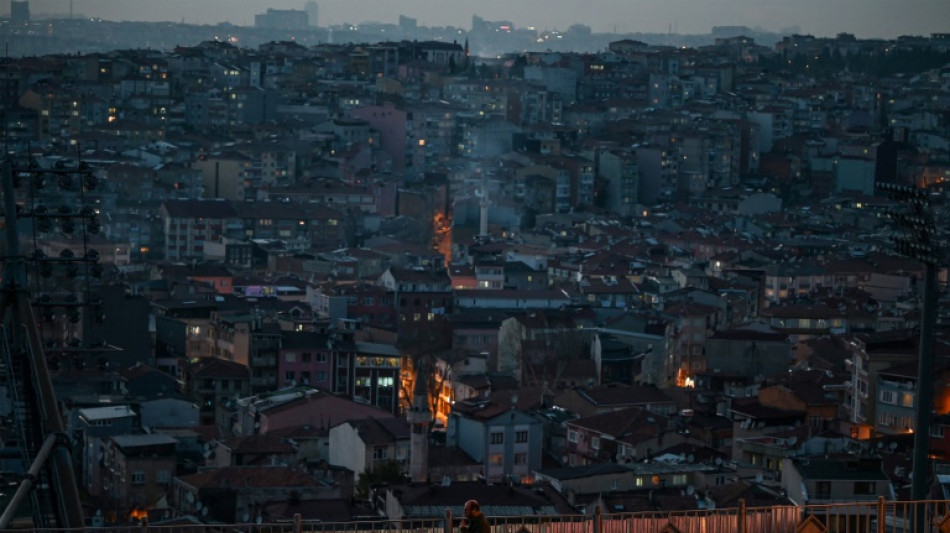
'No longer safe' from quakes: fear of 'Big One' grips Istanbul / Photo: OZAN KOSE - AFP

 Trump renames AI 'super intelligence' as leaders jostle over dangers

 Oil prices retreat as markets welcome US-Iran talks

 US refusing to give Sudan's de facto leader visa for UN: diplomatic sources, UN
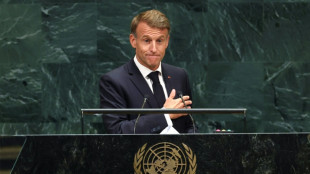 Macron urges world to choose UN over 'law of the jungle'

 All-rounder Jacks stars as England beat Sri Lanka in 1st ODI
 Man City peg back Bayern to start Women's Champions League
 Trump beats 'America first' drum at UN as allies tread carefully
 Snedeker backs Spaun for Ryder Cup after Presidents snub

 French prosecutors probe secret filming of women with smart glasses

 Trump renames AI "super intelligence," rejects international oversight

 Trump rejects international regulation of AI

 How is the EU approaching record fuel prices?

 Sri Lanka's Colombage strikes on debut as England dismissed for 265 in first ODI
 Hurricane Polo strengthens to top category 5 off Mexico

 11 hurt as teen opens fire outside school in western Turkey

 UN chief says 'Big Oil' treats atmosphere as open sewer

 Tunisia says 2026 summer hottest on record
 England's Rashid out of Sri Lanka ODIs with hand injury

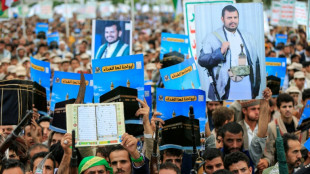 Houthis accuse Saudi Arabia of deadly strikes as thousands flee

 Stocks climb as oil slides, AI buzz returns

 India cricketers win in style as Afghan savours 'special' Games silver

 La Liga president hits out at Real Madrid refereeing 'conspiracy' claims

 MEXC Launches “Real Stocks, Real Friends” with Rewards for Bringing Friends to Wall Street

 Mbappe continues media push for Ballon d'Or recognition

 Stocks rise on AI buzz, oil prices cool
The helmet-topped engineer drove his pointy instrument into the concrete to test whether Durmus Uygun's building will crumble when the feared big quake finally strikes Istanbul.
"I'm pretty confident but my children aren't convinced, so we're having this test done," said Uygun, who lives in one of the Turkish megalopolis's poorer and more densely packed neighbourhoods.
"If the result is good, we will live in peace. But who knows where we will be when the earthquake hits? We may be at the supermarket or at work -- that's what scares us."
In his fifties and wearing a black beret, Uygun is far from the only one living in fear in Istanbul.
Turkey's cultural and economic capital is home to up to 20 million people, many still haunted by memories of the last "Big One" that struck just east of the city in 1999. More than 17,000 people died, including 1,000 in Istanbul.
The city has grown substantially since then, becoming a magnet for people attracted by its booming economy -- and oblivious to the active fault line running along its southern edge.
That changed on February 6, when a 7.8-magnitude earthquake killed more than 48,000 in southeastern Turkey and nearly 6,000 over the border in Syria, leaving entire cities in ruins.
A state of collective psychosis has since gripped Istanbulites, who have requested more than 140,000 checks of the type being conducted on Uygun's apartment building.
- Disaster a 47-percent chance -
By the municipality's own admission, nearly 100,000 buildings will collapse or be seriously damaged in the event of a 7.5-magnitude quake.
Fifty teams of engineers have been roaming the city since last month's disaster, measuring the quality of concrete and the width of steel reinforcement bars.
If the risk to the building is deemed "very high", it could be condemned to demolition and occupants forced to move out.
Some of Istanbul's southern districts lie just 15 kilometres (nine miles) from the North Anatolian Fault, which is distinct from the equally active East Anatolian Fault on which last month's quake struck.
Seismologists have calculated a 47-percent chance of an earthquake with a magnitude above 7.3 hitting Istanbul within 30 years.
Two blocks from Uygun's building, hardware store owner Ali Nezir has started selling whistles to locals who fear getting trapped under tonnes of concrete.
"People are scared," said Nezir, whose small shop is on the ground floor of a 12-storey tower.
- Whistles and water bottles -
Some residents say they have started storing biscuits and water bottles at the foot of their beds in case the quake comes in the middle of the night, leaving them trapped.
Uygun has prepared some emergency bags for his family containing enough to survive on while waiting for help.
Ugur Erisoglu, an Istanbul wholesaler, offers earthquake survival bags for 200 lira ($10) containing torches, blankets, medical kits and neck braces.
"We used to sell 1,000 a month," Erisoglu said. "We have received 15,000 orders since the earthquake, including 8,000 from Istanbul."
The sudden reminder of the threat hanging over Turkey's main city is forcing some to seriously contemplate moving home.
"There is strong demand for northern districts of Istanbul, further from the fault line, and for individual houses," said Mehmet Erkek, the general manager of Zingat, a real estate listings platform.
Searches have also exploded for cities such as Edirne and Kirklareli, located in a less quake-prone region 200 kilometres northwest of Istanbul.
- 'Always on alert' -
Nil Akat, a clinical psychologist, says she has been receiving patients "who are making very concrete plans to move out of Istanbul".
"Many no longer feel safe at home. They are on high alert, always on alert. Out on the street, they pick out safer looking sidewalks in case a building should collapse."
Akat said she spoke to some colleagues who told her: "Some (of our patients) can no longer think rationally."
This fear can grip anyone, without distinction for age or social class, she said.
Cisel Aktimur, a young Istanbulite who enjoys a breathtaking view of the city from her 12th-floor apartment, had been thinking of leaving for some time.
Last month's disaster has made moving a "priority", she said.
"Even if nothing happens to my building, I probably wouldn't be able to bear what I see," she said.
J.V.Jacinto--PC