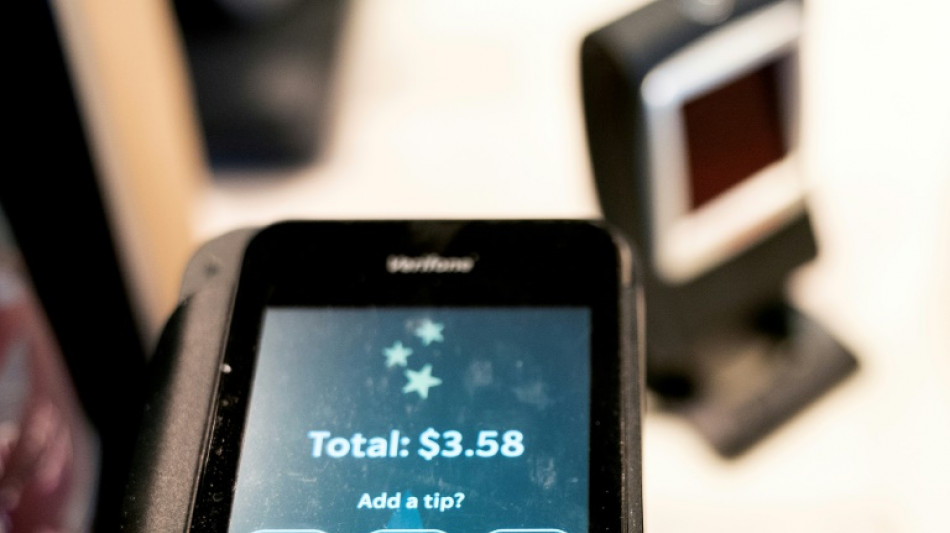
In US, 'tip fatigue' raises questions about sacrosanct habit / Photo: Stefani Reynolds - AFP

 San Ġiljan Defeat Paredes 20-12 in Challenger Cup Opener

 2027 Toyota Sienna Gets Sixth-Gen Hybrid System, More Power, and Trim Changes

 Burnham Government Announces Neighbourhood Support Teams to Reduce Hospital Admissions

 KFF Health News Readers Weigh In on Healthcare Policy, Ethics, and Workforce Shortages

 16-Year-Old Founder Targets 'Cost Per Kill' With AI Missile Startup

 Elon Musk Promises Steering-Wheel-Free Tesla Model Y Amid Cybercab Sales Launch

 APEX FTE Expo 2026 Unites Aviation Leaders in Singapore and Honors Passenger Experience Excellence

 West Midlands Shoppers Urged to Guard Against Black Friday Scams
To tip, or not to tip? That is the question many Americans are grappling with in a country where the tip is king -- but even at a grocery store? Or for a bunch of flowers?
"Either way, you feel guilty," said Matt Schottland, 41, in downtown Washington, a salad and a fruit juice in hand.
In the United States, tipping is not a matter of debate in restaurants. A gratuity of around 15 to 20 percent of the value of a meal is a must, as it often makes up the bulk of the waiter's salary.
But for a sandwich to go? For Schottland, outside of restaurants, the answer is generally no. Unless the employees are "super nice", or he is feeling particularly generous.
But no solution is perfect. If he tips, he may feel "guilty in some way or annoyed or resentful" for spending more money.
And if he doesn't leave anything, he feels "guilty" toward the employees.
"It's not a great system," he sighs.
The dilemma is relatively new. Tipping is spreading into more and more walks of life, making bills heftier in businesses where it was never expected before.
In response, experts warn of the risk of "tip fatigue," a scenario in which Americans, overworked and hit by inflation, will no longer know where to tip, or how much.
And that phenomenon is in turn likely to open up debate on the increasingly criticized system of remuneration in the hospitality industry.
- 'Guilt' -
According to Dipayan Biswas, professor of marketing at the University of South Florida, this expansion is largely due to "digital kiosks," the electronic checkouts that have become ubiquitous in recent years.
On these screens, on which customers pay their bill, companies can add a lot of options, including tips. In order not to cough up, the customer must deliberately click on the "no tip" button.
"That makes a lot of people uncomfortable. They don't want to do that," says Biswas. "Companies utilize the guilt factor."
The strategy works on Hannah Koban, 30, who admits she does "tip a lot more than I used to."
The continual request for a gratuity for the server "does feel like a little bit more pressure," says the lawyer.
And digital kiosks sometimes suggest amounts of up to 30 percent of the total, well beyond the usual rate.
As a result, "trying to figure out like, when to tip, when not to tip, what is the appropriate tip, is it like always 20 percent now? I don't know. And so I feel like I'm googling constantly when I should be tipping," said Koban.
She may smile at the whole thing, but she said she has "friends who are quite upset."
Biswas fears that if Americans feel they have to tip everyone, there will be less for those who really need it the most, like restaurant waiting staff.
- 'Revolution' -
For Saru Jayaraman, president of the One Fair Wage association, which defends a "fair" salary for waiters, to speak of tip fatigue is "missing the point."
"If we're sick of continuously tipping, then join the movement to end the subminimum wage for tipped workers," she advised.
The pandemic, by reducing the number of times people were eating out, exposed the fragility of the remuneration system for waiters, in which their bosses pay less than the legal minimum wage.
While Americans have since then returned to restaurants, the sector -- known for its stressful working conditions -- is still struggling to recruit.
The industry is undergoing "a revolution" because its employees are "resigning en masse," said Jayaraman.
"Workers are saying, 'I just won't do it anymore,'" she said.
And things are changing. The capital Washington in November joined a number of states in imposing a minimum wage, even for employees who are paid with tips.
"As long as there is a subminimum wage that exists for some, other industries are going to want to get the same free labor the restaurant industry has access to," Jayaraman added.
P.Serra--PC