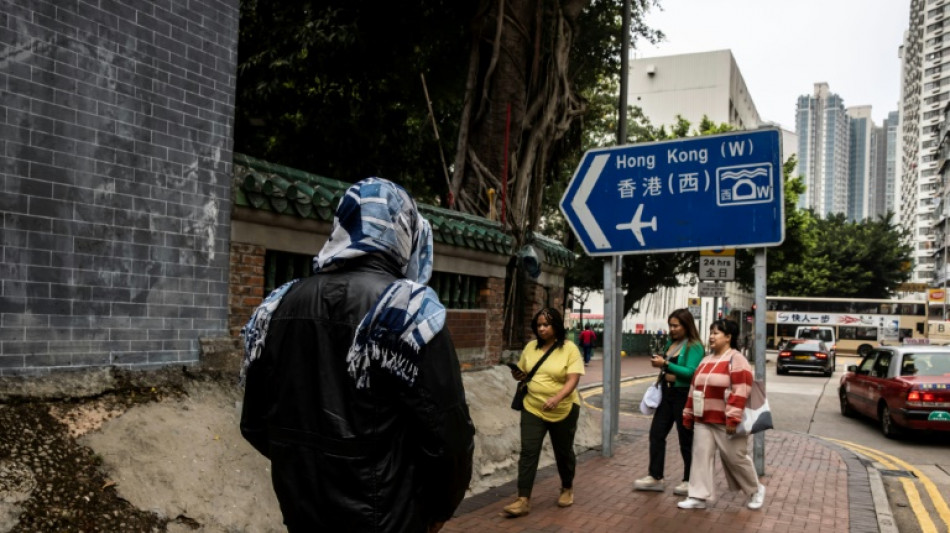
Hong Kong asylum seekers fear deportation under tightened policy / Photo: ISAAC LAWRENCE - AFP

 Texas Sports Betting Status: No Legal Options Amid Legislative Push for 2027 Referendum

 Geri Halliwell-Horner Embraces Queen Camilla at Commonwealth Writing Competition

 Meta Quest 3 and 3S Gain Access to Over 150 3D Movies

 Sarah Bajada Shares Message on Pregnancy Loss

 ALIX LASERS shareholders remove Michael Sobitsch as managing director in view of the circumstances

 Euroseas Q3 Net Profit Falls to $91.4 Million Amid Fleet Reduction

 Daily Horoscope November 20, 2026: Astrological Predictions for All Signs

 Tosca's 2026 Sustainability Report Makes the Case for Packaging as Critical Supply Chain Infrastructure
After more than five years navigating the bureaucratic maze of Hong Kong's asylum system, John faces a new fear: deportation under a recently amended "removal policy".
"When you're running for your safety, you never know where you go. You just want to go where you can be safe," said John, an African man in his 40s, who asked to use a pseudonym and hide his nationality due to these concerns.
There are nearly 15,000 asylum seekers in the southern Chinese city applying for resettlement abroad, according to official figures.
Rules passed in December allow authorities to expel people whose applications were rejected but are awaiting appeal court verdicts.
Twenty-seven people have been removed as a result of the policy since it was enacted, with another 1,100 now vulnerable to immediate deportation, according to official data.
John is one of them.
"It's eating our mind, our spirit inside," he said of the rule change.
- 'Hostile' narrative -
Many asylum seekers see Hong Kong as a stepping stone towards relocation elsewhere -- often not knowing that, over the past decade, 99 percent of applications have been rejected.
The city, a special administrative region of China with its own set of laws, does not grant asylum seekers refugee status.
China is a signatory to the UN Convention on Refugees, but has not extended its application to Hong Kong.
But the city does have an obligation of non-refoulement -- meaning people should not be deported to their home countries if they face persecution there -- under the Convention Against Torture, which China has extended to Hong Kong.
Rejected applicants can appeal their case in court. In many jurisdictions internationally, claimants are usually not at risk of deportation while awaiting rulings on their appeals.
But Hong Kong's new rules mean that an asylum seeker has, in effect, just one shot at making their case in front of a judge.
In December, Under Secretary for Security Michael Cheuk told lawmakers that some claimants were "clearly using court proceedings to prolong their illegal stay in Hong Kong" and were causing a "burden to society".
Surabhi Chopra, a law professor at the Chinese University of Hong Kong, said "the official narrative is very, very hostile to non-refoulement claimants".
Chopra said there was an "inherent contradiction" in deporting a claimant and then expecting them to follow up on non-refoulement claims long-distance.
- 'Life and limb' -
The updated rules have sent ripples of anxiety through Hong Kong's asylum seeker community, according to human rights lawyer Mark Daly, whose firm takes on non-refoulement cases.
"(The government) is taking away their appeal rights on an issue of life and limb," he told AFP, adding that the changes were made without consulting the public or the legal sector.
While none of his clients have yet been deported as a result of the policy, Daly said immigration officials had used the rules as justification for his clients facing lengthier detentions.
Last year, officials outlined plans to increase the number of detention facilities, which many asylum seekers enter upon arrival, for non-refoulement claimants to four.
Former detainees at Hong Kong's immigration detention centres have alleged poor conditions, lengthy solitary confinement and even violent beatings -- accusations the government has roundly denied.
- Cycle of detention -
While the majority of asylum seekers are released from detention, they are legally prohibited from working and most rely on government allowances of around HK$3,300 ($420) a month -- an amount many struggle to live off.
In 2021, authorities arrested 438 non-refoulement claimants for unlawful employment, which for many meant returning to a detention cell.
Last year, Hong Kong deported 1,097 asylum seekers and officials say that, with more international flights resuming post-pandemic, the number may rise.
The Immigration Department told AFP it would "continue to adopt a multi-pronged approach... with a view to expediting removal of unsubstantiated claimants from Hong Kong under the Updated Removal Policy."
Leafing through his well-worn court documents, John said he was not aware of Hong Kong's high rejection rate when he first sought asylum, and had struggled to find a sympathetic ear from officials in the system.
"It depends on the judge... Some judge(s) can just reject you, and it's so painful," he said. "We are running because we need protection."
Nevertheless, he said he was not disappointed with the life he had built in Hong Kong, forming bonds with those trapped in the same purgatory he finds himself in.
"We discuss, we make each other hope."
V.Fontes--PC