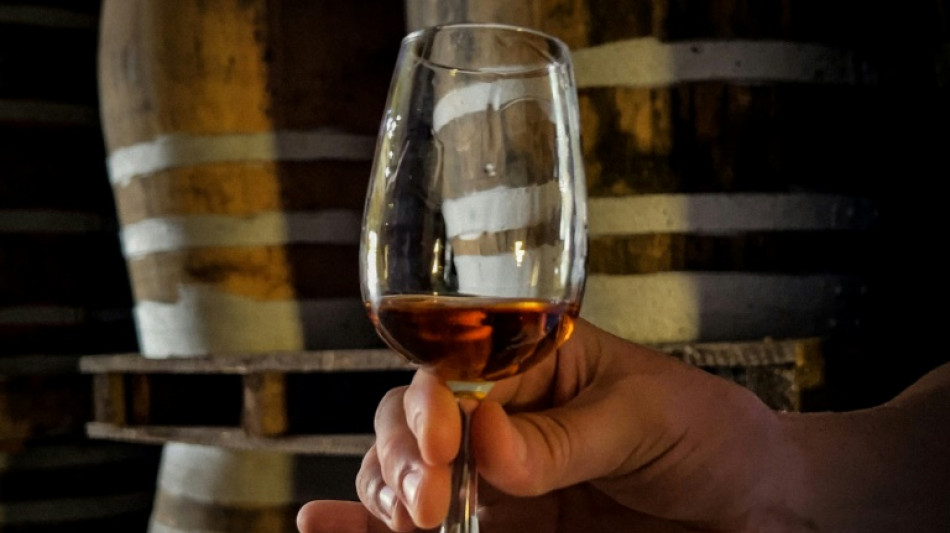
Cuban rum masters preserve a century-old tradition / Photo: Adalberto ROQUE - AFP

 Texas Sports Betting Status: No Legal Options Amid Legislative Push for 2027 Referendum

 Geri Halliwell-Horner Embraces Queen Camilla at Commonwealth Writing Competition

 Meta Quest 3 and 3S Gain Access to Over 150 3D Movies

 Sarah Bajada Shares Message on Pregnancy Loss

 ALIX LASERS shareholders remove Michael Sobitsch as managing director in view of the circumstances

 Euroseas Q3 Net Profit Falls to $91.4 Million Amid Fleet Reduction

 Daily Horoscope November 20, 2026: Astrological Predictions for All Signs

 Tosca's 2026 Sustainability Report Makes the Case for Packaging as Critical Supply Chain Infrastructure
Rum-maker Cesar Marti says that even after 20 years he feels the same pleasure each morning entering his distillery in Santo Domingo, Cuba, where he is preserving a century-old tradition recently added to UNESCO's intangible cultural heritage list.
An aroma of sugar, spices, ripe fruit and alcohol mix in the cellar of the "Central Rum Factory," where barrels are piled up to the ceiling.
These are unique fragrances that change regularly but always delight Marti, who has never tired of working in this distillery in the center of the country, some 270 kilometers (170 miles) southeast of Havana.
"It is here that the oldest rums and spirits in the center of Cuba relax patiently," Marti said proudly, showing off the American oak barrels where alcoholic beverages have been matured naturally, some for as long as seven decades.
Marti, 46, is the custodian of a secular tradition that was refined in the 19th century when the first modern stills were introduced to Cuba during a sugar boom.
Cuban rum is unique since it is entirely made from molasses, the viscous residue produced by refining sugarcane, followed by a short period of fermentation and discontinuous distillation, which produces the light-colored product the Caribbean island is known for.
- 'Extremely difficult' -
Cuban rum masters have ever since been the guardians of this tradition, "picking the molasses, producing the best liquors, ensuring the mixtures, the aging," said Marti.
He insists rum is "extremely difficult" to make.
Today there are two "first rum masters", the most experienced ones, seven rum masters, including two women, and five "apprentices" working in Cuba.
Each has been rigorously coopted.
Although a background in studying science at university is a prerequisite to improve technical processes, oral transmission remains essential to passing on knowledge and experience from one generation to the next.
Marti spent his childhood in sugarcane fields before studying science at university.
He was hired by the rum master of the era at his state-owned distillery and has worked there ever since.
He spent nine years as an apprentice before being named a rum master.
After another 12 years of work and a scientific thesis, Marti is the youngest Cuban "first rum master."
His talent did not escape the attention of French luxury brand Louis Vuitton Moet Hennessy (LVMH), which asked him to create an exclusive Cuban rum to be sold in Europe.
"Creating new products" is part of what motivates Marti as he looks for the right blend of fruity or floral tastes and herbal scents to take consumers "on a journey to the Cuban countryside."
- 'In love' with rum tradition -
Marti now has his own apprentice to train, 42-year-old Mitehel Niebla, who has been learning the trade for seven years, having worked other jobs in the distillery beforehand.
Marti noticed his keen nose and personal engagement.
"I began to understand how important it was for our country, for our culture, to be custodians... of a tradition that has been going on for eight generations," said Niebla.
As part of his apprenticeship, Niebla is currently concentrating on "the cultural part, the history of Cuban rum."
The more he learns the more he "falls in love" with this tradition.
Marti says that the role of a rum master is to "assimilate, with humility" the techniques, history, and sensorial diversity of liquors bequeathed by predecessors and "to be generous so that others are able to continue transmitting" this heritage in the future.
While each rum master works in a different state-owned distillery and for a different brand, they are all bound by a code of ethics to ensure the quality and sustainability of Cuban rum.
During their regular meetings, they discuss the threat of climate change, sugarcane cultivation and international norms, among other issues.
This attention to detail has paid off, with the Cuban rum production system becoming the first in the world, last September, to be endowed with intangible cultural heritage status by UNESCO.
B.Godinho--PC