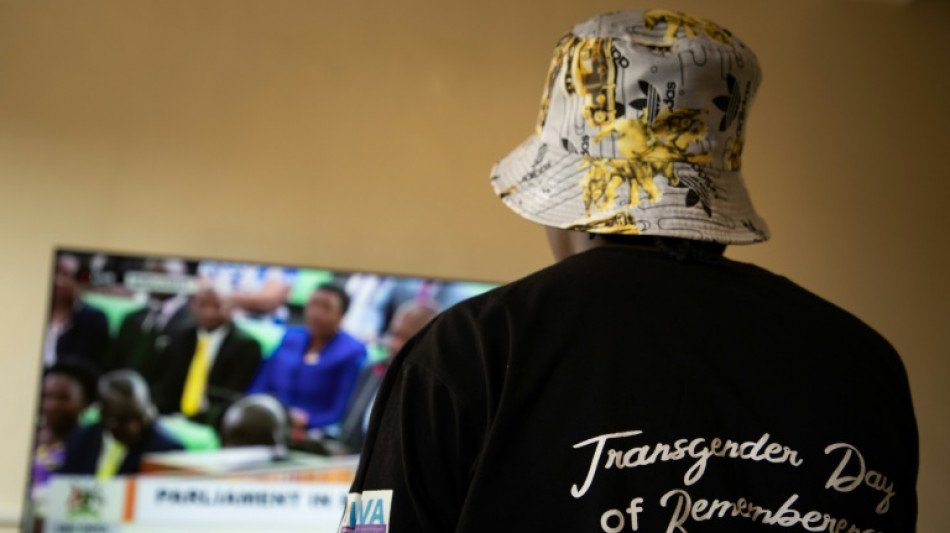
Uganda faces calls to reject 'appalling' anti-LGBTQ bill / Photo: STUART TIBAWESWA - AFP

 Texas Sports Betting Status: No Legal Options Amid Legislative Push for 2027 Referendum

 Geri Halliwell-Horner Embraces Queen Camilla at Commonwealth Writing Competition

 Meta Quest 3 and 3S Gain Access to Over 150 3D Movies

 Sarah Bajada Shares Message on Pregnancy Loss

 ALIX LASERS shareholders remove Michael Sobitsch as managing director in view of the circumstances

 Euroseas Q3 Net Profit Falls to $91.4 Million Amid Fleet Reduction

 Daily Horoscope November 20, 2026: Astrological Predictions for All Signs

 Tosca's 2026 Sustainability Report Makes the Case for Packaging as Critical Supply Chain Infrastructure
The United Nations and the United States led calls Wednesday for Uganda's President Yoweri Museveni to reject what has been labelled an "appalling" anti-gay bill.
Ugandan lawmakers approved the Anti-Homosexuality Act late on Tuesday after a chaotic near seven-hour session, ordering harsh penalties for anyone who engages in same-sex activity.
Homosexuality was already illegal in the conservative East African nation and it was not immediately clear what new penalties had been agreed, with reports some offenders could face life in prison or even the death penalty.
UN High Commissioner for Human Rights Volker Turk urged Museveni not to promulgate the bill into law.
"The passing of this discriminatory bill -– probably among the worst of its kind in the world –- is a deeply troubling development," he said in a statement.
"If signed into law by the president, it will render lesbian, gay and bisexual people in Uganda criminals simply for existing, for being who they are. It could provide carte blanche for the systematic violation of nearly all of their human rights and serve to incite people against each other."
- 'Grave assault' -
Amnesty International also appealed to Museveni to reject the "appalling" legislation, describing it as a "grave assault" on LGBTQ people.
"This ambiguous, vaguely worded law even criminalises those who 'promote' homosexuality," said Amnesty's east and southern Africa director, Tigere Chagutah.
Lawmakers amended significant portions of the original draft legislation with all but one speaking in favour of the bill.
MP Fox Odoi-Oywelowo, a member of Museveni's National Resistance Movement party who spoke against the bill, told AFP that offenders would face life imprisonment or even the death penalty for "aggravated" offences.
Amnesty said Museveni "must urgently veto this appalling legislation", saying it would "institutionalise discrimination, hatred, and prejudice" against the LGBTQ community.
The discussion about the bill in parliament has been laced with homophobic language and Museveni himself last week referred to gay people as "deviants".
Nevertheless, the 78-year-old veteran leader has consistently signalled he does not view the issue as a priority, and would prefer to maintain good relations with Western donors and investors.
- 'Deeply troubling' -
US Secretary of State Antony Blinken joined calls for the government to reconsider the legislation, saying on Twitter it would "undermine fundamental human rights of all Ugandans and could reverse gains in the fight against HIV/AIDS".
Britain's Africa minister Andrew Mitchell said he was "deeply disappointed" with the passage of the bill while Prime Minister Rishi Sunak's special envoy on LGBTQ rights, Nicholas Herbert, warned it risked increasing "discrimination and persecution of people across Uganda".
"While many countries, including a number on the African continent, are moving towards decriminalisation this is a deeply troubling step in the opposite direction," Herbert said on Twitter.
Gay sex is allowed or has been decriminalised in Angola, Botswana, Cape Verde, the Democratic Republic of Congo, Gabon, Ivory Coast, Lesotho, Madagascar, Mali, Rwanda, and the Seychelles.
Uganda is notorious for its intolerance of homosexuality, and the passage of the bill was welcomed by some.
"We are very happy as citizens of Uganda. Culturally we do not... accept homosexuality, lesbianism, LGBTQ. We cannot," said one local resident, 54-year-old Abdu Mukasa.
"We were created by God. God created man and woman. And we cannot accept one sex to go on the same sex."
Homosexuality was criminalised in Uganda under colonial-era laws but since independence from Britain in 1962 there has never been a conviction for consensual same-sex activity.
A court later struck down the law on a technicality, but it had already sparked international condemnation, with some Western nations freezing or redirecting millions of dollars of government aid in response.
Last week, police said they had arrested six men for "practising homosexuality" in the southern lakeside town of Jinja.
Another six men were arrested on the same charge on Sunday, according to police.
ho-strs/txw
O.Salvador--PC