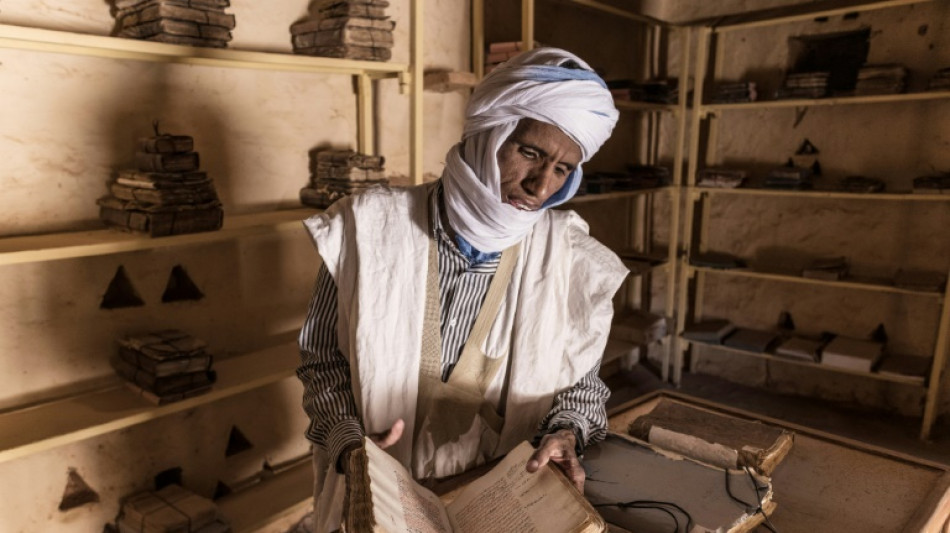
Time capsules: Mauritania's precious Chinguetti manuscripts / Photo: MARCO LONGARI - AFP

 Texas Sports Betting Status: No Legal Options Amid Legislative Push for 2027 Referendum

 Geri Halliwell-Horner Embraces Queen Camilla at Commonwealth Writing Competition

 Meta Quest 3 and 3S Gain Access to Over 150 3D Movies

 Sarah Bajada Shares Message on Pregnancy Loss

 ALIX LASERS shareholders remove Michael Sobitsch as managing director in view of the circumstances

 Euroseas Q3 Net Profit Falls to $91.4 Million Amid Fleet Reduction

 Daily Horoscope November 20, 2026: Astrological Predictions for All Signs

 Tosca's 2026 Sustainability Report Makes the Case for Packaging as Critical Supply Chain Infrastructure
Saif el Islam al Ahmed Mahmoud sat cross-legged on a sheepskin and gingerly turned the pages of an ancient manuscript.
"What would the world be without poetry?" he asked, using cotton gloves to handle the thin paper document, written in an ink concocted from charcoal and gum Arabic.
The manuscript is one of 700 that his family owns -- in turn, part of a priceless legacy of knowledge, art and philosophy stored in Chinguetti, a town in the heart of the Mauritanian Sahara.
Across the UNESCO-listed city are 13 privately-owned libraries holding around 6,000 Arabic manuscripts, many dating from the Late Middle Ages.
The documents are a time capsule of human culture and advancement, dwelling on themes ranging from Islam and astronomy to law, mathematics and poetry.
Most of the manuscripts are paper or parchment, although some texts are written on sheepskin.
Chinguetti's treasure derives from its position stradding a trade route linking the Western shores of the African continent to Mecca, the centre of the Muslim world.
It was also historically a route well travelled by pilgrims on the way to the holy city for the annual hajj pilgrimage.
The manuscripts were collected by local families, who have been their custodians for generations.
"We are preserving the memory of the world which once crisscrossed these ancient streets," said al Ahmed Mahmoud, with a theatrical gesture.
In Chinguetti's main square, Abdullah Habbot opened the doors of another library, which his family owns.
He said his family acquired its more than 1,400 documents thanks to the travellers who halted in the dusty city.
But the manuscripts are facing a modern threat: climate change is causing flash floods that threaten the old structures housing the documents.
If the librairies collapse, al Ahmed Mahmoud warned, "ancient memories will be erased, and we will all be poorer."
S.Pimentel--PC