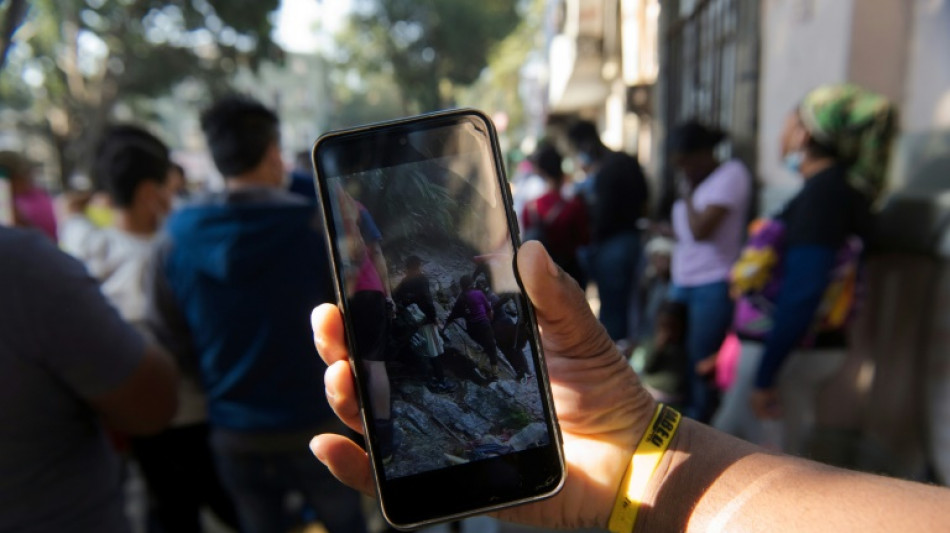
People smugglers use TikTok to promote their services / Photo: CLAUDIO CRUZ - AFP

 Voting opens in Alaska's annual Fat Bear Week

 MLS coach axed for telling female ref 'It's a man's game'

 US refuses to give Sudan's de facto leader visa for UN

 Man City hold Bayern to start Women's Champions League, Arsenal win late
 Trump threatens Iran with 'hell' but reveals fresh talks

 Trump signs security deal with Greenland, Denmark at UN

 Trump threatens Iran with 'hell' but unveils fresh talks

 Chile's Atacama Desert blossoms with life after El Nino rains

 Sri Lanka hands 220-year jail terms to 15 convicted of Easter bombings
 Typhoon Dujuan leaves 7 dead in Japan from landslides, flooding: media

 Ganna and Borghini lead Italy to mixed relay gold at cycling worlds

 Drug cocktail killed former child star Hayden Panettiere: coroner

 Moldova declares energy, water emergency

 French Holocaust denier jailed for eight months

 Oil prices slide, AI stock buzz fades

 Trump threatens to 'annihilate' Iran in bombastic UN speech
 Prada's skirts take centre stage as Milan Fashion Week begins

 Quoin Pharmaceuticals Announces FDA Fast Track Designation for QRX003 for the Treatment of Peeling Skin Syndrome
 Brazil's Flavio Bolsonaro turns scandal into poll gains

 Republican senator seeks probe of Trump Jr Russian-funded wedding

 Memoir by Diana's brother goes on sale after rocking UK monarchy

 Newcomers South Korea face holders Italy in Davis Cup finals

 Japan's Kojima sounds Marchand warning with Asian Games gold

 England rugby star Pollock signs new Northampton deal

 STARTRADER Expands Its Chinese Equity CFD Range with CXMT and Unitree Robotics

A photo posted to TikTok shows a group of people dressed in camouflage, hoping to blend into the shadowy vegetation dotting the nighttime landscape of the Mexican desert. The picture was not uploaded by social media influencers on an adventurous vacation -- it's an advertisement by people smugglers.
Technology-savvy criminals using the popular video-sharing app are posing a growing challenge to Mexican and US authorities fighting a regional migration crisis.
"Departing this weekend. People from Mexico interested in crossing to the United States, leave your messages," the TikTok post said.
Another account offering to smuggle irregular migrants through the violence-wracked Mexican border state of Tamaulipas shows a photo of minors in an inflatable boat on a river.
"We also make crossings with children and family," it said.
An AFP investigation found dozens of similar accounts around the region, including in Guatemala, Colombia and Ecuador.
And using the hashtag #pollero -- a slang term for a people smuggler -- one account offered "safe work" for drivers in the southwestern US state of Arizona for payment of up to $15,000.
"If you have a car and want to make easy money, write to me," said a message in English.
The advertising violates TikTok's official rules, which prohibit the "promotion and facilitation of criminal activities."
"Maintaining the safety of our community is a responsibility we take very seriously," a spokesman for the app told AFP.
"We do not tolerate content that promotes human exploitation, including human trafficking," he added.
According to TikTok, in the third quarter of 2022 the firm removed 82 percent of the videos linked to criminal practices on its own initiative.
Seeking to fend off calls for the app to be banned in the United States as long as it remains a Chinese company, TikTok chief executive Shou Zi Chew was due to testify before US lawmakers on Thursday.
He would deny that the app has, or would ever, share data with the Chinese government, according to his prepared remarks made available by the House Energy and Commerce Committee.
- Cyber police patrols -
In Mexico, authorities have formed specialized cells to counter the threat posed by people smugglers on social media.
In a room full of computers in Mexico City, dozens of experts from the government's Criminal Investigation Agency have been monitoring social media accounts since 2017.
A board lists people of interest and their online activities.
The unit has been involved in around 300 human trafficking investigations, said Rolando Rosas, head of the communications center at the Federal Ministerial Police, part of the Attorney General's Office.
In Mexico, "digital service companies are obliged to hand over information when there's a crime," he said, welcoming the good cooperation with social media platforms.
The unit's head, Benjamin Oviedo, said that his team intervenes, for example, when payment to a trafficker is agreed on or made through the internet.
But the advertisements are not always real.
"Many of the things that we find can sometimes be a fraud," said Rosas.
According to a report published by the International Organization for Migration (IOM) in February, TikTok is used by people smugglers as a way to promote successful cases of irregular crossings.
It warned that the crime opened the door to others, such as the sexual exploitation of minors.
The organization surveyed more than 500 migrants in transit, of whom nearly two-thirds said they had accessed a smartphone and the internet during the trip.
Transporting migrants by road, often in vans or crammed into the back of trucks, sometimes without ventilation, is one of the quickest but most dangerous methods used by people smugglers.
More than 7,600 migrants have died or disappeared in transit in the Americas since 2014, according to the IOM.
Of those, nearly 1,000 were the result of vehicle accidents or linked to hazardous transport, the United Nations agency says.
TikTok is also used by migrants to share advice with each other on how to survive the treacherous journey to the United States.
Andrea, 25, and her friend Beatriz, 29, who left Venezuela in October, used the app to find recommendations on traveling through danger zones such as the Darien Gap, an inhospitable jungle area straddling the Colombian-Panamanian border.
Now in Mexico, Andrea, who did not want to give her full name, pulled out her cellphone to show the profile of a young woman who has managed to reach the United States and put together a travel blog.
She gives recommendations of what to pack and which medicines to carry -- advice that is sometimes, but not always, useful, Beatriz said.
"Everyone's experience is very personal," she added.
A.P.Maia--PC