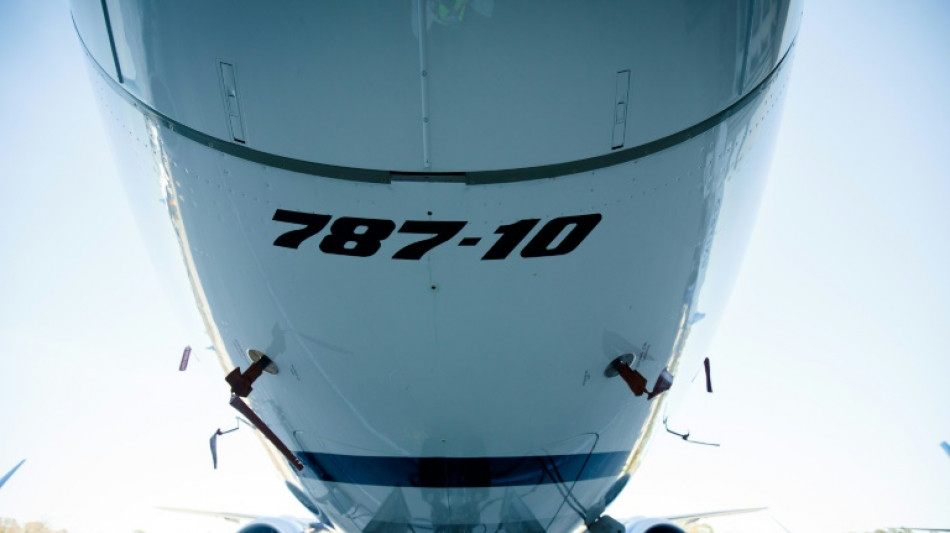
Room for one more? Saudi moves in on Gulf aviation market / Photo: Logan Cyrus - AFP/File

 Voting opens in Alaska's annual Fat Bear Week

 MLS coach axed for telling female ref 'It's a man's game'

 US refuses to give Sudan's de facto leader visa for UN

 Man City hold Bayern to start Women's Champions League, Arsenal win late

 Trump threatens Iran with 'hell' but reveals fresh talks

 Trump signs security deal with Greenland, Denmark at UN

 Trump threatens Iran with 'hell' but unveils fresh talks

 Chile's Atacama Desert blossoms with life after El Nino rains

 Sri Lanka hands 220-year jail terms to 15 convicted of Easter bombings

 Typhoon Dujuan leaves 7 dead in Japan from landslides, flooding: media

 Ganna and Borghini lead Italy to mixed relay gold at cycling worlds

 Drug cocktail killed former child star Hayden Panettiere: coroner

 Moldova declares energy, water emergency

 French Holocaust denier jailed for eight months

 Oil prices slide, AI stock buzz fades

 Trump threatens to 'annihilate' Iran in bombastic UN speech

 Prada's skirts take centre stage as Milan Fashion Week begins

 Quoin Pharmaceuticals Announces FDA Fast Track Designation for QRX003 for the Treatment of Peeling Skin Syndrome

 Brazil's Flavio Bolsonaro turns scandal into poll gains

 Republican senator seeks probe of Trump Jr Russian-funded wedding

 Memoir by Diana's brother goes on sale after rocking UK monarchy
 Newcomers South Korea face holders Italy in Davis Cup finals

 Japan's Kojima sounds Marchand warning with Asian Games gold

 England rugby star Pollock signs new Northampton deal

 STARTRADER Expands Its Chinese Equity CFD Range with CXMT and Unitree Robotics

Undeterred by a crowded Gulf market, Saudi Arabia is going all in on an aggressive aviation expansion, with a massive jet order and the launch of a new national carrier.
The project aligns with a bid to remake the once closed-off kingdom as a business and tourism magnet, but analysts say that even with official backing, its path to success is complicated.
This month Crown Prince Mohammed bin Salman, Saudi Arabia's de facto ruler, unveiled Riyadh Air, the new airline which is intended to transform the capital into "a gateway to the world", according to state media.
Two days later, officials said Riyadh Air and Saudia, the kingdom's existing flag-carrier based in Jeddah, would purchase 78 Boeing 787 Dreamliner jets.
The deal, which the White House valued at "nearly $37 billion" with options for up to 121 planes, constitutes the fifth largest by commercial value in Boeing's history.
Riyadh Air's chief executive, Tony Douglas, told AFP that the airline would serve the international, regional and domestic markets -- putting it in direct competition with Gulf heavyweights Emirates and Qatar Airways.
That raises hard questions about how Riyadh Air will grab market share, especially at a time when long-haul non-stop flights that avoid the Middle East altogether are on the rise, said independent aviation analyst Alex Macheras.
"Replicating and then building on the successful business models of Gulf airline neighbours is going to be tricky in a crowded market where passengers are spoilt for choice," Macheras said.
- New role for Riyadh -
Saudia, also known as Saudi Arabian Airlines, was founded in 1945, receiving its first jet as a gift from US President Franklin Roosevelt.
At the time, instead of Riyadh, foreigners were more likely to enter the kingdom via Jeddah on the Red Sea coast, which remains the "Gateway to Mecca", welcoming millions of Muslims performing the hajj and umrah pilgrimages each year.
Foreign embassies did not relocate to Riyadh, in central Saudi Arabia, until the 1980s.
These days, however, Riyadh is at the heart of Prince Mohammed's "Vision 2030" reform agenda intended to help transition the world's biggest crude oil exporter away from fossil fuels.
Officials talk it up as a rival to Gulf business hub Dubai, predicting that its current population of eight million will balloon to 15-20 million by 2030.
Last November, officials announced plans for a new airport in Riyadh that is set to accommodate 120 million travellers per year by 2030, up from roughly 35 million today.
The projected growth makes Saudia's current model -- in which it effectively has two hubs, Jeddah and Riyadh -- untenable, Saudi Finance Minister Mohammed al-Jadaan told AFP.
"Jeddah alone needs one airline to concentrate on it with the hajj and umrah... So you need an airline that is focused on Riyadh," Jadaan said.
The new airline and airport reflect a mentality of "if you build it, they will come", said Robert Mogielnicki of the Arab Gulf States Institute in Washington.
"The question of what the demand side of this equation looks like has yet to be settled, but the Saudis must be pretty confident to push ahead with such a massive aircraft order," he said.
- 'Late to the party' -
The convenient location of airports in the Middle East -- well-placed for flights to Europe, Asia and Africa -- has helped fuel their rise as major hubs.
The trade group Airports Council International predicts the region's airports will see 1.1 billion passengers by 2040, up from 405 million in 2019.
Apart from Riyadh Air, Saudi Arabia is also launching NEOM Airlines, to be based in the planned $500 billion futuristic megacity of the same name.
Klaus Goersch, the airline's CEO, wrote in a recent blog post that it "will be operational at the end of 2024" and that NEOM itself could eventually become "a global aviation hub".
Saudi Arabia's expansion strategy hinges partly on tapping its roughly 35 million-strong population, which officials see as a major advantage over less-populated rivals like the United Arab Emirates and Qatar.
But according to analyst Macheras, the Boeing order suggests Riyadh Air's vision is "long-haul driven, which is consistent with its goals of operating as a transit hub carrier".
Competitors are taking note.
"Riyadh Air will certainly eat up part of the market share in the region and the Asian markets in particular," said an official at Qatar Airways, requesting anonymity because he was not authorised to speak to the media.
"We are poised to face a tycoon-to-be."
Perhaps Riyadh Air's biggest advantage is its owner -- the deep-pocketed Saudi sovereign wealth fund, which Macheras said will "cushion what will inevitably be an incredibly capital-heavy first phase" ahead of inaugural flights in early 2025.
"It's clear the airline, although late to the party, thinks there is room for one more at the table," he said.
L.Carrico--PC