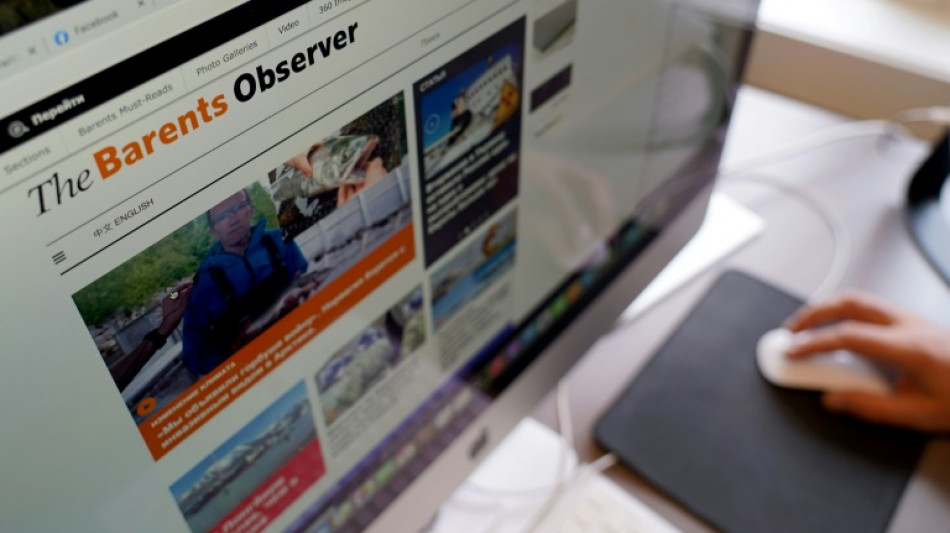
In the Arctic, Russians keep the free press flame alive / Photo: James BROOKS - AFP

 Swiss voters expected to shun stricter neutrality
 Rapper-turned-PM faces first big test after Nepal disaster
 Tuchel seeks tonic to England World Cup 'scar' in Spain showdown

 'Helps me cope': Catholic baptisms rise among French youth
 Colombians in Santa Marta stay inside after violence wracks the city
 Iran airlines cancel flights as US sanctions hit
 Meta launches camera-free AI glasses amid privacy pushback
 Australian PM says OpenAI hacked government health website

 Xi arrives in US to personal Trump welcome
 Morocco elects new parliament amid social frustration, youth discontent
 Scheffler and Burns to face Im and Lee in Presidents Cup opener
 Crushing wins for Lyon and Barca in women's Champions League
 Rio breaks record for rainiest September amid powerful El Nino
 At UN, tech chiefs urge caution in AI development
 Russian strikes kill seven in Ukraine, Zelensky vows winter campaign
 Venezuelan shot by ICE needs urgent medical care, mother tells AFP
 Zelensky says Putin using fighters from 47 countries in Ukraine war
 Klopp calls on Germany to 'rise above ourselves' as new era begins

 Russian strikes kill seven in Ukraine as Russia vows no 'pause' to war

 ArcPoint Expands Globally with Institutional Intelligence Platform for Modern Investors
 Ronaldo focussing on 'present' ahead of Wales test

 Outgoing UN chief makes final climate push at New York summit
 Grief and pain flow at hearing for Canadian suicide poison vendor
 Ireland boss Hallgrimsson says timing of Israel remarks 'not clever'
 Weinstein resentenced to 15 years in prison for 2006 sex assault
Exiled to a place far above the Arctic Circle, a group of Russian journalists are working with Norwegians to break through the strict state controls that have gripped the media in their homeland.
At the Barents Observer, an online newspaper that has become a leading provider of news from the Far North over the past two decades, the two local journalists are now in the minority.
Based in the town of Kirkenes, close to the Russian border, the news outlet opened its doors to reporters who have fled Russia after a clampdown on the press followed the invasion of Ukraine.
Wearing a Mickey Mouse T-shirt and a Michael Jackson-tattoo on his arm, Denis Zagore explains he left the Russian city of Murmansk in September.
"When the war started, in my podcasts for Barents Observer, I said dictator Putin, I said, not SMO (special military operation) or something like that," the 47-year-old journalist tells AFP.
"I started to understand it could be unsafe if I continued to do it in Murmansk," which lies 220 kilometres (137 miles) over the border.
"If you (want to) say Putin is a dictator and war is war, it's more safe here," he says.
- Blocked in Russia -
The Barents Observer now has three Russian reporters and a Russian trainee, and has started publishing more articles in Russian than English.
"We were already blocked in Russia and have been in tremendous trouble with the Russian censorship agency. So we said OK, they want to make more trouble for journalists, then we can make more trouble for them," editor Thomas Nielsen says.
"We don't care about Russian censorship laws. We are here for the freedom of speech and free journalism," the Norwegian declares.
On a shelf in his office, a doll with the words "Slava Ukraini" ("Glory to Ukraine") sits next to beer cans bearing an image of Russian President Vladimir Putin, antique telephones -- one of which has a "direct line to the Kremlin", Nielsen jokes -- and an "On air" sign.
Blocked since 2019, the publication is using a multitude of tricks to circumvent Russia's attempts to limit access: Mirror sites hosted on different addresses, access via VPN services, podcast formats and a presence on Youtube means tens of thousands views are maintained, according to Nielsen.
Coverage includes more general interest news like setbacks facing a marine park in Murmansk or invasions by pink salmon, as well as stories directly linked to the conflict in Ukraine.
"We have a lot of viewers, especially among young people in Russia, that get access and get information about what's happening with the war, with the repression in Russia, about who ends up in jail and so on," Nielsen adds.
"News articles that they don't get in their local or regional media at home."
- A Putin spider -
Russia has fallen to 164th place -- out of 180 -- in the annual Reporters Without Borders press freedom index, which Norway has topped for several years.
In early July, Elena Milashina, a Russian journalist with independent newspaper Novaya Gazeta was badly beaten in Chechnya.
Foreign media are also on the receiving end and Evan Gershkovich, a Wall Street Journal correspondent, has been in prison since March facing espionage charges.
"Every day we were sitting in our office and didn't know what was going to happen. Would the police suddenly storm into our office and take us?," says Elizaveta Vereykina, who had worked for the BBC in Moscow before joining the Barents Observer.
"It's hard to live in a society that absolutely despises everything about you," she says.
The numbers of Russian journalists in exile have grown in places such as Tbilisi, Yerevan, Vilnius Riga and Kirkenes.
Trainee Olesya Krivtsova is waiting for a work permit before she can begin contributing.
She too has a tattoo, on her right leg: an image of Russian President Vladimir Putin in the shape of a spider with the Orwellian inscription "Big Brother is watching you".
On the other ankle, she once wore an electronic bracelet.
Reported by university friends in Arkhangelsk for criticising the war on social networks, the young woman was placed under house arrest pending a trial for justifying terrorism and discrediting the Russian army -- charges punishable by up to 10 years in prison.
"In the end, I realised the injustice of what was happening, so I left," she explains
After ridding herself of the ankle bracelet, she travelled via Belarus and Lithuania before reaching Kirkenes.
"She said 'I want to change Russia and I want to do it through journalism'. We said: 'Ok, welcome'," notes Nielsen.
A.Motta--PC