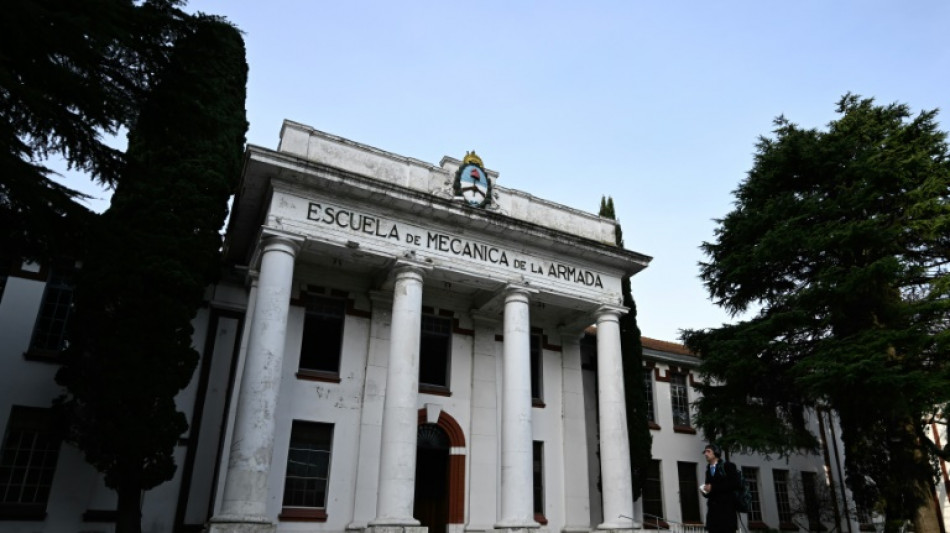
Argentina's ESMA torture center: hell becomes heritage / Photo: LUIS ROBAYO - AFP/File

 Fury to face British rival Joshua in Cardiff on December 11

 Streamex Converts Interest Into Capital as GLDY Investment Strategy Secures $1M+ Institutional Allocation

 STARTRADER Named Best Fintech Forex Broker at Forex Expo Dubai 2026
 Japan swimmer Ohashi, 17, shrugs off Covid to smash world record
 Shin Ohashi: Junk food-loving teen and new world record-holder
 Greek PM urges 'courage' in talks with UK over Parthenon Marbles
 'I was drowning': Iran Nobel winner exposes pain of separation from children

 Israel's US envoy says son fighting for life
 Olympic champion Yulo completes gymnastics gold collection at Asian Games
 England cannot imitate Spain's success, says Gordon

 Hungary detects invasive spotted lanternfly for first time in EU

 Ο Alex Bodi και ο καθηγητής Δρ. Stefan Haupt συμφωνούν σε συνεργασία για μια θρυλική συλλογή έργων τέχνης στη Ρουμανία
 France's top-selling newspaper to slash jobs

 Tigray rebels in 'full-blown' war with govt

 Alex Bodi och prof. dr Stefan Haupt ingår samarbetsavtal om en legendarisk konstsamling i Rumänien
 อเล็กซ์ โบดี และศาสตราจารย์ ดร. สเตฟาน ฮาปท์ ตกลงร่วมมือกันในการจัดตั้งคอลเลกชันศิลปะอันเป็นตำนานในโรมาเนีย
 Alex Bodi a prof. dr. Stefan Haupt se dohodli na spolupráci na legendární umělecké sbírce v Rumunsku
 알렉스 보디와 슈테판 하우프트 교수, 루마니아의 전설적인 미술품 컬렉션을 위한 협력 합의

 BaazEX Enters the Asian Trading Market With a New Approach to Online Forex Trading.
 Asian markets fall on US-China jitters as leaders meet
 Thais hail teen rocker Nene for 'America's Got Talent' win
 Zverev, Agassi defend 'spectacular' Laver Cup
 Eel-powered Japan whizz-kid, 11, dominates in historic Games debut

 Madagascar's Gen Z 'betrayed' after ushering in new rule
 As Moscow steps up attacks, Kyiv residents brace for harsh winter
The ESMA, the most notorious murder and torture center among hundreds operated by Argentina's 1976-83 military dictatorship, stands today as a reminder of the brutality humans are capable of.
Inscribed Tuesday on the UNESCO list of World Heritage sites, the center's four-letter acronym still manages to send a shudder down Argentine spines.
The ESMA is emblematic of a tragic period in the South American country's history that left an estimated 30,000 people killed or forcibly disappeared, according to rights groups.
Of those, about 5,000 entered the ESMA. Very few reemerged.
The ESMA, a former navy mechanical school, was the most active of the dictatorship's clandestine detention centers, and the most feared. Its name is an acronym for Escuela Superior de Mecanica de la Armada.
Here, prisoners were tortured, beaten, raped, kept in chains for months on end, hooded -- all in the hopes they would give up other people suspected of being "subversives."
Pregnant detainees had their babies taken and given to families with connections to the dictatorship. Several still don't know their true identities today.
And every week -- generally on a Wednesday -- detainees were rounded up for what they were told were "transfers" but were in fact so-called death flights during which prisoners were thrown out of planes over the River Plate -- both dead and alive.
"The worst of the state terrorism of the last military dictatorship in Argentina was expressed there," President Alberto Fernandez said after the announcement from a UNESCO World Heritage Convention in Saudi Arabia.
- Never forget -
The ESMA today is officially a "Space for Memory and for the Promotion and Defense of Human Rights" -- a reminder of a blemish on history that must never be repeated.
Photographs of hundreds of victims line the walls. Many were mere teens.
Former detainee Eduardo Giardino, on a visit to the museum he remembers as his personal hell from 32 years earlier, took a tour of "Capuchita" -- the attic where he was held from 1978 to 1980 in an individual cage.
"I asked the museum guides to leave me alone in 'Capuchita'," the 68-year-old told AFP. "I felt the need to lie down on the floor again, to relive it, but... as a free person."
Former soldiers attached to the ESMA and other such centers are still being tried today for crimes they committed there: in total, 1,159 have been convicted to date and another 366 cases are still open.
The ESMA is located in the middle of a vast park in Nunez, a peaceful suburb of the bustling capital.
From inside its walls, inmates remember hearing street noises, school bells ringing, and crowds clamoring at the Monumental Stadium which hosted the 1978 FIFA World Cup final between Argentina and the Netherlands. Normal life seemed so near yet so far away.
- 'It hurts' -
"The building is a... witness" to what happened. "Going through it hurts but it is healthy, because it does not allow us to distort history," said Ricardo Coquet, a 70-year-old survivor of torture.
"Having survived at ESMA is luck. The important thing now is to.. bear witness," he told AFP.
The ESMA's three-storey building was first opened in 1928 as a training center. An officers' mess that later served as the illegal detention center was constructed in 1948.
When the military grabbed power in 1976, the ESMA became the center of the military's most brutal operations against civilian activists or anyone suspected of a "subversive" allegiance.
The site was nearly lost: the post-dictatorship government of Carlos Menem wanted to destroy it in 1998 to erect a monument in its place, but widespread protests stopped him.
And in 2004, Menem's successor Nestor Kirchner announced it would become a memorial museum.
Some 150,000 people visit the ESMA every year, tourists and students alike, and partake in activities for reflection and debate about what happened there.
In its submission to UNESCO for the ESMA to be declared a heritage site, the Argentine government argued it was a "symbol of the genocide" that took place in the country.
"It is incontrovertible proof of the State terrorism that inflicted extreme criminal violence on society at large," said the proposal.
A.Seabra--PC