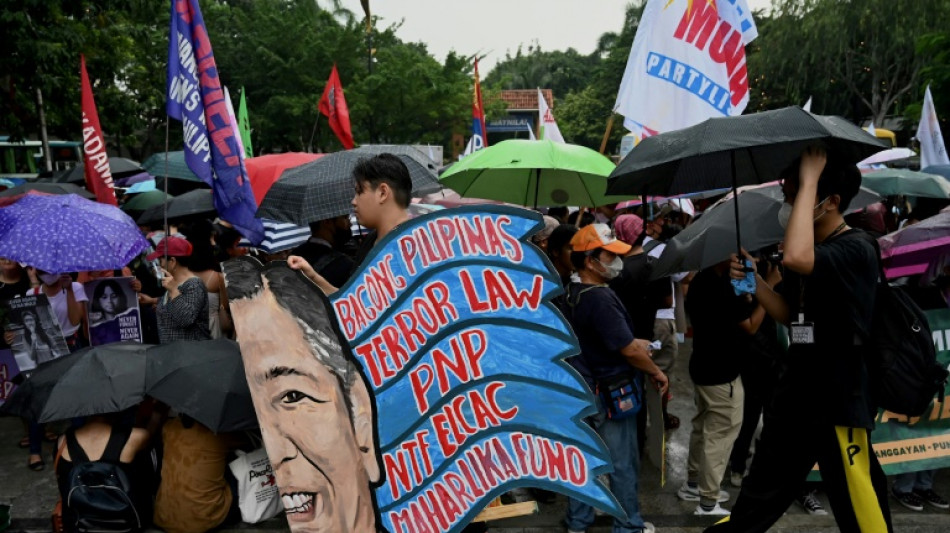
Filipino activists accuse Marcos of 'witch-hunt' / Photo: JAM STA ROSA - AFP

 Malaysia Sues Google for $146m Over Harmful Content

 Black Wind Turbine Blades Reduce Bird Deaths by 74% in Spain Study

 Brazil’s Landless Movement Partners with China to Build Affordable Tractors for Family Farms

 Raheem Sterling Receives Suspended Sentence After Lamborghini Crash

 Luxembourg Pay Rise Delayed as Regional and World Headlines Develop

 Audience to Choose the Set List at Luxembourg's First FAMIL Jukebox Night

 Twickenham Grounds Team Prepares Pitch for Six Matches in Three Days

 Black Friday Discounts Cut Prices on Two Top-Rated Wiper Blades

 Arizona Gun Regulation Battle Intensifies Under New Democratic Legislative Majority
Filipino activists accused President Ferdinand Marcos Jr's government Thursday of carrying out a "witch-hunt" against rights defenders as they held rallies for the 51st anniversary of the imposition of martial law.
Hundreds of people marched in Manila calling for the release of victims of forced disappearances and the abolishment of an anti-communist task force, set up by former president Rodrigo Duterte, that has been accused of targeting government critics.
Rights group Karapatan said the Marcos Jr administration was using the task force to "witch-hunt activists, human rights defenders and other dissenters", while enabling the military and police to "perpetuate repression reminiscent of the martial law era".
Marcos Jr's dictator father, Ferdinand Marcos, imposed martial law in 1972, unleashing his security forces on rivals, critics and dissidents.
Amnesty International estimates thousands of people were killed and tens of thousands tortured and imprisoned in the brutal crackdown.
Activists said rampant human rights abuses have continued under Marcos Jr, who has kept up Duterte's deadly war on drugs, as well as his National Task Force to End Local Communist Armed Conflict.
Rights groups say eight activists have been "disappeared" since Marcos Jr became president in June 2022.
There have been more than 400 drug-related killings during the same period, according to a monitoring group.
"It's like we're still living in the shadows of 1972. This regime doesn't care about human rights," Renato Reyes, secretary general of the leftist alliance Bayan, told protesters.
- 'Like martial law' -
The rallies come after the release on Tuesday of two environmental activists who had accused the military of abducting them.
Jonila Castro, 21, and Jhed Tamano, 22, had been working with coastal communities opposed to reclamation activities in Manila Bay when they disappeared on September 2 in Bataan province, near Manila.
Authorities rejected the allegation, saying the women were part of a communist insurgency seeking to overthrow the government and had sought their help after voluntarily leaving the movement.
Human Rights Watch senior researcher Carlos Conde told AFP some aspects of the country's human rights situation had worsened under Marcos Jr.
"What we're seeing is somebody... who likes to shove human rights as an issue aside," Conde said, adding one of the reasons could be "his family have a... nasty history as far as human rights is concerned."
Veteran human rights campaigner Cristina Palabay of Karapatan said she felt "more scared now" as the number of missing activists increased.
Palabay said she and other members of Karapatan faced "some sort of mortal danger far greater than before", citing increased threats, profiling and surveillance.
"This is actually like martial law... when people are just being picked up in the streets and justified as being held by authorities because they are suspected of being somebody," Palabay said.
X.Brito--PC