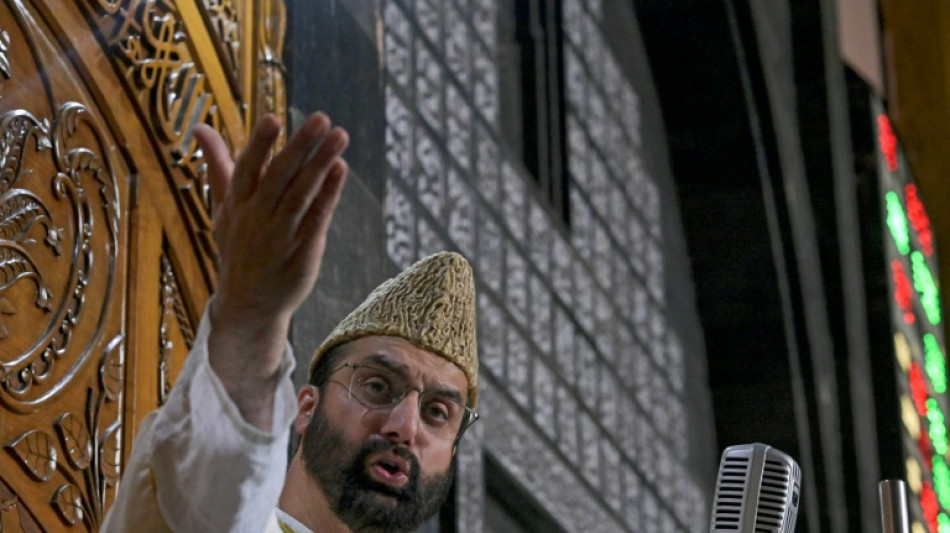
India frees Kashmir separatist leader after four years / Photo: TAUSEEF MUSTAFA - AFP

 Malaysia Sues Google for $146m Over Harmful Content

 Black Wind Turbine Blades Reduce Bird Deaths by 74% in Spain Study

 Brazil’s Landless Movement Partners with China to Build Affordable Tractors for Family Farms

 Twickenham Grounds Team Prepares Pitch for Six Matches in Three Days

 Luxembourg Pay Rise Delayed as Regional and World Headlines Develop

 Audience to Choose the Set List at Luxembourg's First FAMIL Jukebox Night

 Raheem Sterling Receives Suspended Sentence After Lamborghini Crash

 Black Friday Discounts Cut Prices on Two Top-Rated Wiper Blades

 Arizona Gun Regulation Battle Intensifies Under New Democratic Legislative Majority
The Indian government freed Kashmir's chief Muslim cleric and influential separatist leader Mirwaiz Umar Farooq on Friday after more than four years of house arrest.
The 50-year-old was detained along with other political leaders and thousands of residents when the government cancelled the Muslim-majority region's constitutional semi-autonomy and imposed federal rule in 2019.
A months-long internet shutdown followed as India bolstered its armed forces in the region to contain protests.
Most detainees were subsequently released, but the Mirwaiz remained unable to leave his residence, down the street from his Jamia Masjid mosque in Srinagar.
Thousands of worshippers gathered to see him lead Friday prayers for the first time in 218 weeks, with women showering him with sweets and religious slogans resounding around the 14th-century building.
Last week, a court asked authorities to explain his continued detention and he told the crowd that police informed him Thursday that officials had decided to release him.
"This period of my house arrest and separation from my people has been the most painful for me since my father's death," he said, breaking down.
The mosque has historically been a centre of separatist politics and anti-India protests.
"God willing, you might think our spirit is low. No, our spirit is high," the Mirwaiz said, calling the constitutional changes by Prime Minister Narendra Modi's Hindu nationalist government "unacceptable".
Modi "said about Ukraine that this is not the time for war. He is right," he added. "Disputes and disagreements should be resolved by talks rather than using power or unilateralism."
He called for the release of "numerous political prisoners".
Kashmir is divided between India and Pakistan, with both countries claiming the Himalayan territory in full and fighting two wars over it.
A violent insurgency beginning in 1989 killed tens of thousands of people, including Indian troops, militants and civilians.
New Delhi accuses Islamabad of supporting the rebels, which Pakistan denies.
Heavy security, including counter-insurgency police and commandos, were deployed around the mosque on Friday.
"Our beloved and our king of hope has returned to this mosque after so long," regular worshipper Bashir Ahmed told AFP after the prayers.
"How can I not be weeping with joy?"
Since the imposition of direct rule, authorities have curbed media freedoms and public protests.
Moves aimed at bringing "peace and prosperity" to the region also allowed Indians from elsewhere to buy land and claim government jobs in the territory, a policy denounced by critics as "settler colonialism".
Armed clashes between Indian soldiers and rebels demanding independence for Kashmir or its merger with Pakistan have significantly reduced.
But this month saw an uptick in violence leaving at least 14 dead, including eight security personnel.
E.Raimundo--PC