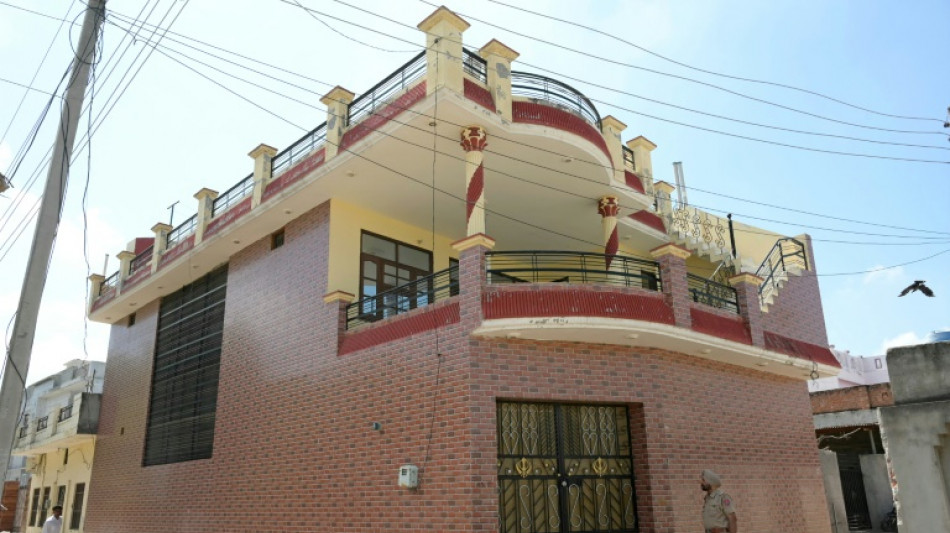
Blame and accusations in dead Sikh separatist's village / Photo: Narinder NANU - AFP

 Malaysia Sues Google for $146m Over Harmful Content

 Black Wind Turbine Blades Reduce Bird Deaths by 74% in Spain Study

 Brazil’s Landless Movement Partners with China to Build Affordable Tractors for Family Farms

 Twickenham Grounds Team Prepares Pitch for Six Matches in Three Days

 Luxembourg Pay Rise Delayed as Regional and World Headlines Develop

 Audience to Choose the Set List at Luxembourg's First FAMIL Jukebox Night

 Raheem Sterling Receives Suspended Sentence After Lamborghini Crash

 Black Friday Discounts Cut Prices on Two Top-Rated Wiper Blades

 Arizona Gun Regulation Battle Intensifies Under New Democratic Legislative Majority
A notice demanding Hardeep Singh Nijjar appear in court is still stuck on his house in Punjab, where the Sikh separatist's village neighbours believe Canada's accusation that India was responsible for his killing.
An activist for the creation of an independent Sikh homeland called Khalistan, Nijjar was wanted by Indian authorities for alleged terrorism and conspiracy to commit murder, and was shot dead by two masked assailants near Vancouver in June.
A raging diplomatic row erupted this week after Canadian Prime Minister Justin Trudeau said there were "credible reasons to believe that agents of the government of India were involved" in Nijjar's death.
New Delhi dismissed Trudeau's allegations as "absurd", tit-for-tat diplomatic expulsions followed, and India has stopped processing visa applications by Canadians.
But in Bharsingpura, Nijjar's sleepy but prosperous farming village in the Sikh-majority northern state of Punjab, Ottawa's charges find a receptive audience.
Himmat Singh, Nijjar's uncle, blamed agents of India's foreign intelligence service, the Research and Analysis Wing (RAW), for his nephew's killing.
"I believe this is the handiwork of the Indian government," the 79-year-old farmer told AFP. "Yes, the agents of RAW are involved in this.
"There is no way the prime minister of a country will make such an allegation without any proof," he added. "The Indian government can label anyone as a terrorist as they want."
Sikhism is a minority religion originating in northern India that traces its roots back to the 15th century and drew influences from both Hinduism and Islam.
The Khalistan campaign was largely considered a benign fringe movement until the early 1980s, when a charismatic Sikh fundamentalist launched a violent separatist insurgency.
It culminated with Indian forces storming the Golden Temple, the faith's holiest shrine in the city of Amritsar, where separatists had barricaded themselves.
India's prime minister Indira Gandhi was subsequently assassinated by two of her Sikh bodyguards.
The insurgency was eventually brought under control and the Khalistan movement's most vocal advocates are now among the large Sikh diaspora, particularly in Canada, Britain and Australia.
But memories of the violence -- in which thousands died in all -- still haunt India, which has outlawed the Khalistan movement and listed several associated groups as "terrorist organisations".
- 'Herein fail not' -
The court notice stuck above the doorbell of Nijjar's relatively large, firmly locked, two-storey house orders him to appear at a hearing in connection with an application filed by India's National Intelligence Agency to confiscate his property under India's anti-terrorism legislation.
"Herein fail not," it warns.
In one of his cases, Nijjar was accused of masterminding an attack on Kamaldeep Sharma, a Hindu priest in Bharsingpura who was shot three times by masked assailants in his temple in 2021.
He survived, and does not believe Nijjar -- who moved to Canada in the 1990s -- was responsible.
"I did not have enmity with anyone," said Sharma, an imposing figure in black overalls. "In fact, Nijjar's family has been helping me and paying for my treatment."
- Martyr status -
Dal Khalsa, a pro-Khalistan group based in the Sikh holy city of Amritsar, organised Nijjar's last rites at the Golden Temple, where he was accorded the status of a Sikh martyr and his family members were honoured.
Others commemorated as martyrs at the temple include Indira Gandhi's killers, whose portraits hang in its museum.
Dal Khalsa's secretary Kanwar Pal Singh claimed that Nijjar was "not the first one to be murdered extra-judicially".
"In the eyes of Sikhs, Indian agencies are prime suspects," he told AFP.
"India had requested Canada to hand over Nijjar. When they failed legally, they resorted to illegal means.
"If their hands are clean, India should join the investigation."
Back in Bharsingpura, village chief Ram Lal backed the Indian authorities.
"Nijjar believed in violence and violence cannot be a solution to any problem," he said.
"Canada is making wrong accusations. What proof do they have of Indian involvement?" he added. "The ties between the two countries are at stake because of this unnecessary controversy."
But farmer Amreek Singh believes there are questions to be answered.
"How can he carry out murders and bomb blasts in India when he was not even living here?" he asked.
A.Santos--PC