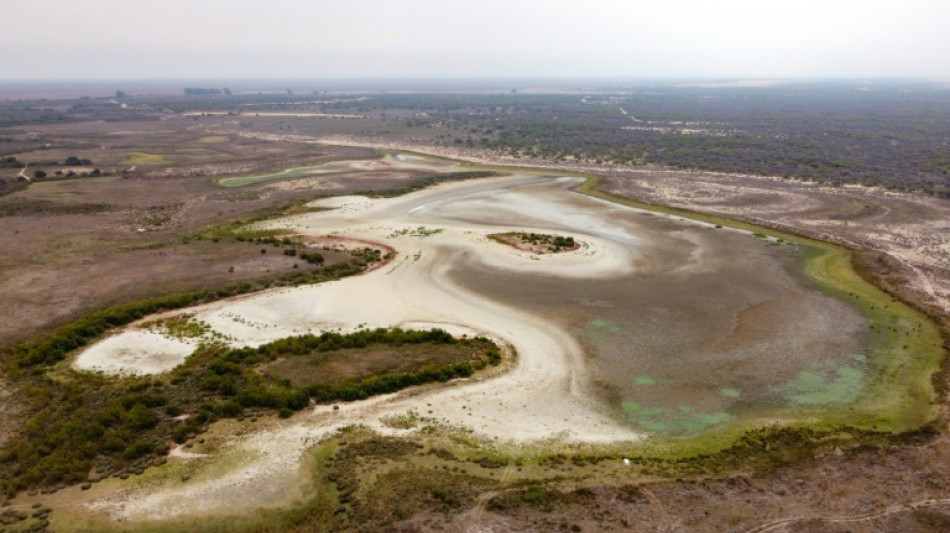
Spain farmers jailed for illegal water tapping at nature reserve / Photo: - - Spanish National Research Council (CSIC)/AFP

 Malaysia Sues Google for $146m Over Harmful Content

 Black Wind Turbine Blades Reduce Bird Deaths by 74% in Spain Study

 Brazil’s Landless Movement Partners with China to Build Affordable Tractors for Family Farms

 Twickenham Grounds Team Prepares Pitch for Six Matches in Three Days

 Luxembourg Pay Rise Delayed as Regional and World Headlines Develop

 Audience to Choose the Set List at Luxembourg's First FAMIL Jukebox Night

 Raheem Sterling Receives Suspended Sentence After Lamborghini Crash

 Black Friday Discounts Cut Prices on Two Top-Rated Wiper Blades

 Arizona Gun Regulation Battle Intensifies Under New Democratic Legislative Majority
Five siblings have been jailed for more than three years for illegally extracting water from an aqueduct feeding a UNESCO-listed Spanish nature reserve that is threatened by desertification, a court ruling showed.
The five farmers -- four men and a woman -- were found guilty of crimes against the environment and causing damage for "putting the ecosystem at serious risk" through the "systematic and extensive extraction" of water supplying Donana National Park, said the ruling dated September 18 that was seen by AFP on Friday.
One of Europe's largest fauna-rich wetlands, Donana is located in the southern Andalusia region.
If confirmed by a higher court, it would be the first ruling to involve a jail sentence for illegally tapping water from Donana, a site that has become a symbol of the growing scarcity of water in Spain sparking fierce political debate, El Pais newspaper said.
The siblings were found guilty of extracting 19 million cubic litres of water for their Hato Blanco Viejo ranch over a five-year period between 2008 and 2013, leaving the groundwater reserves in "poor condition" and causing permanent lagoons to become seasonal due to the lower water levels, it said.
The defendants, who have been slapped with more than a dozen fines for water-related issues since the last 1990s, must also pay 2.0 million euros ($2.1 million) in compensation to the Guadalquivir Water Authority, the public body responsible for local water management.
They have also been banned from cultivating crops for two years.
- Vote due on controversial water bill -
Donana, whose diverse ecosystem of lagoons, marshes, forests and dunes stretch across 100,000 hectares, is on the migratory route of millions of birds each year and is home to many rare species such as the Iberian lynx.
But the park has been struggling due to an ongoing drought and is also threatened by intensive agriculture in the area.
Despite warnings from UNESCO and the European Commission, Andalusia's right-wing regional government is pushing to extend irrigation rights near the park, with a draft law seeking to regularise berry farms that are currently irrigated by illegal wells.
The bill will be put to a vote in the coming weeks and if it passes, environmental groups warn it could legitimise 1,500 hectares (3,700 acres) of crops, jeopardising the future of this UNESCO-listed reserve that is threatened by desertification.
In that instance, Spain's left-wing government has pledged to appeal while UNESCO has warned that the law could see the park lost its status as a protected World Heritage site.
The draft bill played a key role in the political campaigning earlier this year ahead of local polls in May and a general election in July in a country where 80 percent of water resources are ploughed into agriculture,
Spain is the world's biggest exporter of olive oil and the European Union’s biggest producer of fruit and vegetables.
F.Moura--PC