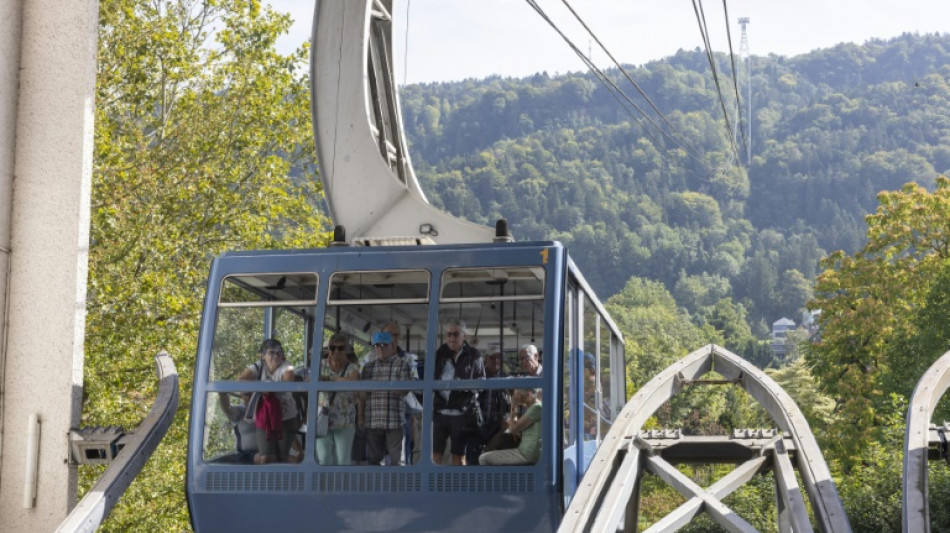
As planet gets warmer, ski gondola maker goes urban / Photo: ARND WIEGMANN - AFP

 Malaysia Sues Google for $146m Over Harmful Content

 Black Wind Turbine Blades Reduce Bird Deaths by 74% in Spain Study

 Brazil’s Landless Movement Partners with China to Build Affordable Tractors for Family Farms

 Twickenham Grounds Team Prepares Pitch for Six Matches in Three Days

 Luxembourg Pay Rise Delayed as Regional and World Headlines Develop

 Audience to Choose the Set List at Luxembourg's First FAMIL Jukebox Night

 Raheem Sterling Receives Suspended Sentence After Lamborghini Crash

 Black Friday Discounts Cut Prices on Two Top-Rated Wiper Blades

 Arizona Gun Regulation Battle Intensifies Under New Democratic Legislative Majority
Austrian company Doppelmayr is well known for making gondolas for ski resorts, but its workshop is increasingly building cable cars for congested cities as climate change has opened up new markets.
A growing number of urban areas are adopting the cleaner, space-saving mode of transport: Doppelmayr's cable cars now glide over London, Mexico City and La Paz.
Urban mobility currently accounts for 20 percent of sales for the world's biggest cable car maker as cities seek to decarbonise their public transport systems.
"We have evolved with our customers," said Reinhard Fitz, Doppelmayr's head of international business development.
The 130-year-old company, which built its first ski lift in 1937, has yet to see a drop in demand from mountain resorts, Fitz said.
"But climate change will of course cause demand to shift," he said.
- 'Innovative solution' -
Doppelmayr's urban business began to take off about 15 years ago.
Its biggest urban project to date -- holding the Guinness World Record for the largest public-transit cable-car system -- is a 33-kilometre (20.5-mile) network of 10 ropeway lines connecting Bolivia's capital La Paz with another metropolis, El Alto.
Its strongest market for urban mobility is Latin America, but the company is hoping to expand into Asia.
More than 80 cities and towns worldwide have already adopted aerial tramways, urban engineering expert Hanane Bengualou told AFP.
Costing less than seven million euros per kilometre, cable cars are three times cheaper than tramways, Bengualou said.
"It's an innovative solution that uses up very little land and is quick to deploy, as it doesn't require any major work (on site)," she said.
The Paris region is among Doppelmayr's newest customers, with a 4.5-kilometre (2.8-mile) ropeway project that will connect two suburbs, giving 20,000 residents access to the capital's subway system.
Scheduled to open in 2025, the "Cable C1" line will offer an 18-minute travel time between Villeneuve-Saint-Georges and Creteil.
"Cable transport is clean, quiet and regular," said Laurent Probst, director-general at Ile-de-France Mobilites, which oversees public transport in the Paris region.
The costs associated with cable cars are far lower and they can be quickly installed, making them the ideal solution for traffic-clogged regions, he said.
In addition, they can "cross obstacles" such as roads or train tracks, giving people a commute free of traffic jams, he added.
- 'Attached to conventional systems' -
Bengualou noted that cable cars also offer a cleaner option, as transport accounts for 35 percent of CO2 emissions in France.
However, opposition by residents and complex administrative procedures have obstructed their development, with France's third-biggest city, Lyon, being forced to abandon its project in 2022.
Since cities are less prone to strong winds than open mountain areas, lighter single-cable technology is usually good enough for urban areas, though population density and other obstacles bring challenges.
Policymakers are often unaware that cable cars -- still widely associated with ski resorts -- are an option for urban transport, Fitz said.
"We hope examples like the Paris region" will bring awareness, he said, adding that "people are still very attached to conventional systems".
O.Gaspar--PC