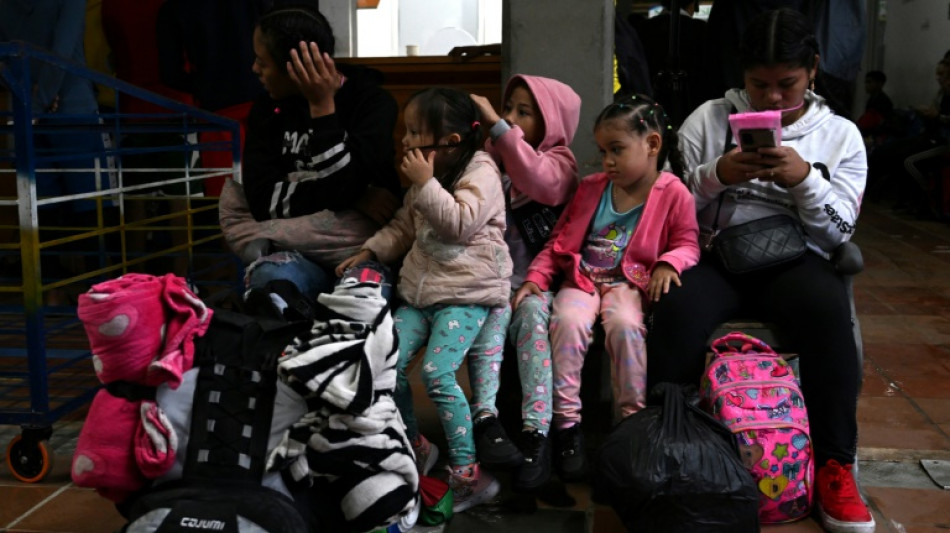
'We are penniless': migrants bled dry on path through Darien Gap / Photo: Raul ARBOLEDA - AFP

 Malaysia Sues Google for $146m Over Harmful Content

 Black Wind Turbine Blades Reduce Bird Deaths by 74% in Spain Study

 Brazil’s Landless Movement Partners with China to Build Affordable Tractors for Family Farms

 Twickenham Grounds Team Prepares Pitch for Six Matches in Three Days

 Luxembourg Pay Rise Delayed as Regional and World Headlines Develop

 Audience to Choose the Set List at Luxembourg's First FAMIL Jukebox Night

 Raheem Sterling Receives Suspended Sentence After Lamborghini Crash

 Black Friday Discounts Cut Prices on Two Top-Rated Wiper Blades

 Arizona Gun Regulation Battle Intensifies Under New Democratic Legislative Majority
At the start of the perilous jungle trek through the Darien Gap to Panama, uniformed workers on the Colombian side hand out colored wristbands to migrants, like bouncers at a nightclub, to indicate what "services" they have paid for.
The minimum of $170 gets you a guide for the treacherous journey from South America to Central America, as well as medical care and toilet access.
If you can't afford that, your wristband indicates you must wait until you have the money -- or manage to negotiate a group discount -- to move on from the camp set up by a self-styled "community organization" made up of residents of Acandi, a small town on the Colombian side of the infamous rainforest ordeal.
For $500, migrants can upgrade to a package that includes porters and boats to shorten the arduous walk.
Desperation to make the harrowing journey in the hope of a better life in the United States has become a cash cow for Acandi locals.
With a record 380,000 people crossing the Darien Gap in the first nine months of this year, observers say predatory business is booming and ultimately filling the pockets of Colombia's feared Gulf Clan cartel which dominates the region.
Already exhausted, traumatized and malnourished by the time they reach Acandi, the migrants -- many carrying babies and small children -- must shell out ever more cash as they get deeper into the jungle.
"Our plan is to keep moving, because you come with a dream. I swear we have given everything... we are penniless," said Ecuadorian Angelo Torres, 25, whose wife is four months pregnant. They are traveling with two children.
Some migrants spend weeks in Acandi gathering enough money to move on to the next camp on the route.
"This problem, as many call it, has become an opportunity for us to work. In Acandi, the main business is migrants," said resident Darwin Garcia, who works with the organization managing the sophisticated operation that also provides restaurants and shelter.
Every day, some 2,500 people fleeing violence and poverty across Latin America, and from some African and Asian nations, pass through the town to start the 266-kilometer (165-mile) journey through the Darien Gap.
- 'No one works for free'-
The organization says the fee it charges makes it possible to provide the space for migrants to pitch tents, access bathrooms and buy food, all while providing jobs to some 2,000 locals.
Colombia's defense ministry says the Gulf Clan is firmly behind the migrant business in the remote region from where it has long run one of the world's biggest cocaine trafficking operations.
Garcia, 46, insists neither he nor the organization have anything to do with the cartel, and complains about being "stigmatized."
"No one works for free," he added.
Garcia told AFP he is offering "a more humane, safer" passage through the jungle -- where migrants face snakes, injuries, swamps, and violent criminals seeking to take advantage of them.
"The truth is, that the only thing the Gulf Clan has told us is that if a migrant is robbed, killed or raped, the one responsible becomes a military target" and will be killed, he said.
"And they are."
Colombian military intelligence estimates the cartel's numbers at about 4,000.
Speaking on condition of anonymity, a Gulf Clan spokesman told AFP that "no one is being mistreated" in the region.
"We have nothing to do with the migration, we only provide them with a security service in the jungle," he said.
- 'Forced to transport cocaine' -
At the mention of the Gulf Clan, residents and migrants alike fall silent.
In remote villages of the region, the feared acronym AGC is daubed on the walls of shops, schools and restaurants, using another name for the clan -- the Gaitanist Self-Defense Forces of Colombia.
Mauricio Valencia, an expert with the Peace and Reconciliation Foundation (Pares) think tank, said the Gulf Clan carries out "criminal governance" in the region.
He said plummeting cocaine prices -- due to a glut in supply and the rise of other drugs -- had led the cartel to turn to migration to diversify its income.
"When migrants do not have enough money, they are often left to fend for themselves in the jungle and end up dying," said Valencia.
He said penniless migrants are also victims of sexual violence and exploitation as they are "forced to transport cocaine to enter Panama."
T.Batista--PC