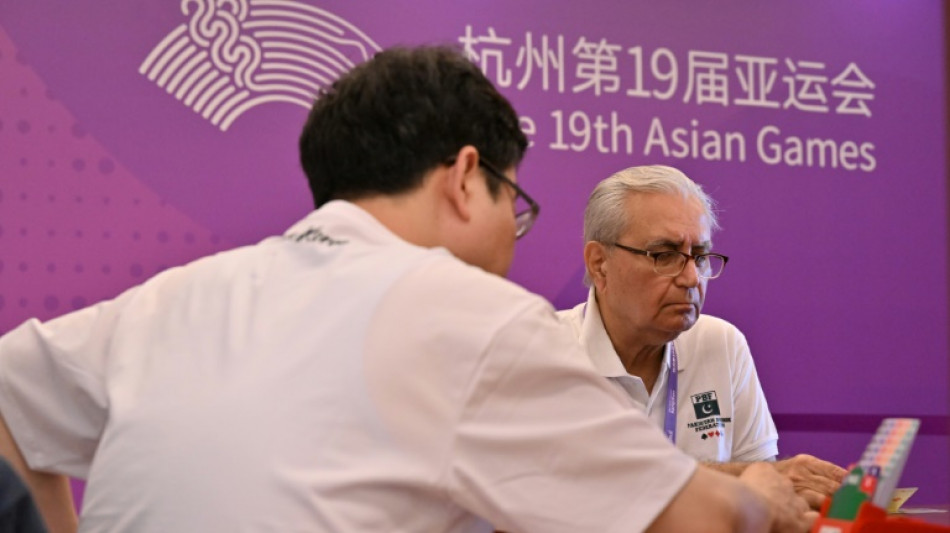
Asian Games card players bridge yawning generation gap / Photo: ADEK BERRY - AFP

 Malaysia Sues Google for $146m Over Harmful Content

 Black Wind Turbine Blades Reduce Bird Deaths by 74% in Spain Study

 Brazil’s Landless Movement Partners with China to Build Affordable Tractors for Family Farms

 Twickenham Grounds Team Prepares Pitch for Six Matches in Three Days

 Luxembourg Pay Rise Delayed as Regional and World Headlines Develop

 Audience to Choose the Set List at Luxembourg's First FAMIL Jukebox Night

 Raheem Sterling Receives Suspended Sentence After Lamborghini Crash

 Black Friday Discounts Cut Prices on Two Top-Rated Wiper Blades

 Arizona Gun Regulation Battle Intensifies Under New Democratic Legislative Majority
With some players in their 70s and opponents young enough to be their grandchildren, age is just a number for bridge competitors engaged in a battle of wits at the Asian Games.
Masood Mazhar was born in the final months of the Second World War and before the partition of India and Pakistan.
"My father used to play so I've been playing all my life," the 78-year-old, competing for Pakistan, told AFP in Hangzhou.
People have enjoyed variations of bridge for centuries, but the tactical card game is a relatively new discipline at the Asian Games, only becoming a medal event in 2018.
Players sit in fours at square tables, working in pairs to win as many "tricks" as they can in each round.
After all these decades, the game never gets old for Mazhar, who said he began entering competitions in the mid-1980s.
"You learn every day. Every board, you learn, you never get the same thing again ever," he said, referring to the hands of cards players get dealt each game.
"Everything is new every time -- it's an adventure."
Bridge is usually associated with older generations and the majority of players at the Games are over 40.
Taiwan's Chen Kuan-hsuan wants to change all that.
The 23-year-old played with her university's bridge club and at youth tournaments before graduating into the World Team Championships and now the Asian Games.
"I seek self-fulfilment through bridge competitions," she said.
She said in bridge players must "maintain good relations with your teammates and partner... and use logic and inference to complete each move and each calculation" -- a challenge she loves.
"I hope that by competing I can draw the attention of more young people, not just the ones who already play bridge," she said.
Mazhar believes the problem is that young people simply don't have time to get into bridge these days.
"If you really want to play good bridge, you have to give a lot of time, and that means you have to practise at least three to four hours a day," he said.
"And when they're in school, all their parents want is good grades, and going to university to get better grades, and so they're not encouraged and it may become very difficult," he said.
He admits that younger opponents have "more energy, more stamina", but that won't stop him from playing as long as he can.
"It's an addiction," he said.
"You want more and more all the time."
G.Machado--PC