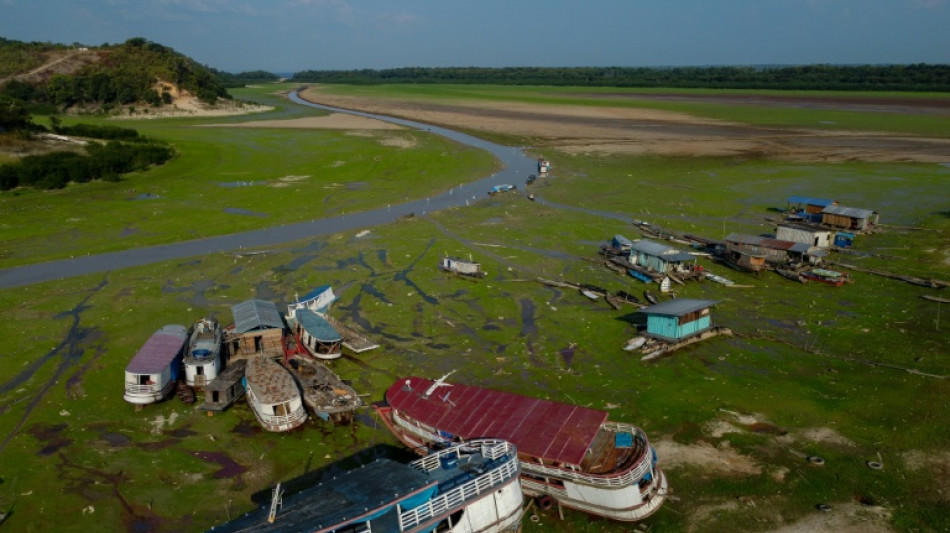
Drought drains Brazilian Amazon residents reliant on waterways / Photo: MICHAEL DANTAS - AFP

 Filmasia 2026: 16 Films Across Prague, Brno, and České Budějovice

 Kojey Radical Launches Burger Collaboration at Dallas Burger Joint in Shoreditch

 Kelly Stafford Reflects on Matthew's Lions Thanksgiving Era Ahead of Rams' Netflix Debut

 World Experiences First Six Consecutive Days Above 2C Preindustrial Threshold

 Luxembourg Housing Petition Passes Threshold for Parliamentary Consideration

 Raheem Sterling Receives Suspended Sentence After Lamborghini Crash

 Audience to Choose the Set List at Luxembourg's First FAMIL Jukebox Night

 Luxembourg Pay Rise Delayed as Regional and World Headlines Develop

Not far from the emblematic site where the black waters of the Rio Negro join the brown currents of the Solimoes, two chief tributaries of the Amazon, what once was a lake has given way to a vast stretch of cracked mud.
Now, the only water remaining in what had been the Lago de Aleixo is a narrow stream, a symbol of the drought that has gripped Brazil's Amazonas state and its jungle capital Manaus.
A man works to direct a canoe carrying a heavy refrigerator through this sluggish trickle, but his efforts are slow-going -- the water barely reaches up to his knees.
His immediate surroundings are sucked dry, even as the greenery of the planet's largest rainforest is visible all around.
Nearby, 62-year-old retiree Maria Auxiliadora da Silva must lean against the trunk of a downed tree to avoid sinking into the mud as she walks home carrying a heavy bag.
"We don't have anywhere to go, so we'll stay here until the water returns," she told AFP, glancing sadly at her wooden floating house that is now trapped in the sludge.
"Before, it held up well (floating in the lake)," she said of her home. "Now, it's all damaged."
Stranded boats dot the landscape.
One large two-story passenger vessel is clearly listing to one side. Its name is visible: the Victory of Jesus.
- 'Psychological effects' -
Graciete Abreu, a 47-year-old farmer, sells her vegetables at a market in the Colonia Santo Aleixo district, near the vanished lake, some 20 kilometers (12 miles) east of central Manaus.
She normally uses a small boat to transport goods from her farm on the banks of the Rio Negro, but with the drought, she now has to walk for several hours to cover the same distance.
"We took the canoe up to the spot where there is still water, we dragged it a little ways, and we ended up abandoning it to finish the journey on foot," Abreu explained.
But beyond the logistic struggles of the drought, Abreu is also concerned about the "psychological effects" on local residents from seeing the once-flowing landscape turn parched.
A similar scene is found at the Marina do Davi, a Manaus river port, where dozens of other boats have also run aground in the mud.
"I work in river transport, and most of my boats are unusable," 43-year-old businessman Raimundo Bernardo said.
Governor Wilson Lima on Friday declared a state of emergency in 55 areas around Amazonas, including Manaus.
And local authorities have also undertaken a series of measures aimed at reducing suffering caused by the drought, such as distributing some 50,000 meals to the state's nearly 4 million residents, many of whom are Indigenous.
The federal government plans to send emergency humanitarian aid such as "food, potable water, hygiene products and medications," Brazilian Environment Minister Marina Silva announced Thursday.
Low water levels have already killed thousands of fish and dozens of Amazon pink river dolphins.
The region is also dealing with the El Nino weather phenomenon, which can limit the formation of clouds, and therefore rain, even, as Silva explained, Brazil is already "vulnerable" to the intense effects of climate change.
F.Ferraz--PC