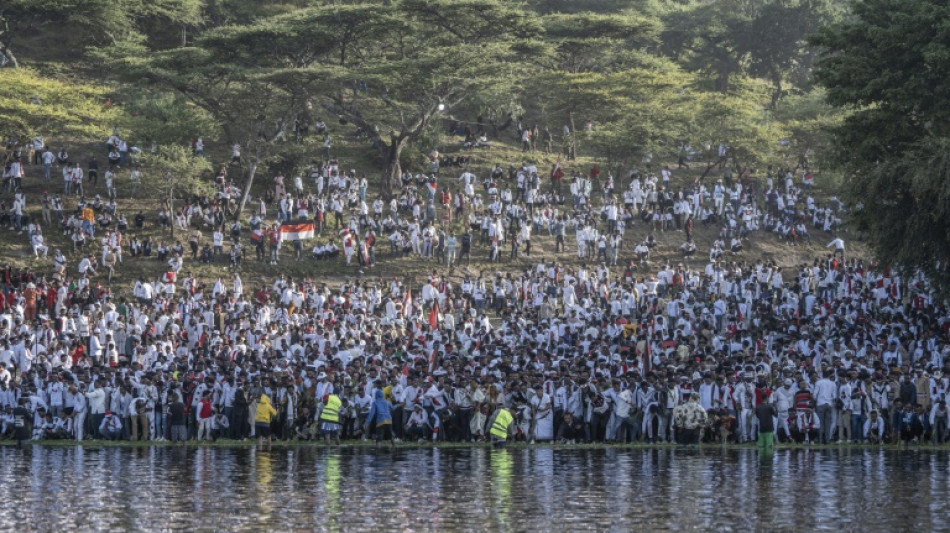
Ethiopia's Oromo people celebrate festival once denied / Photo: Amanuel Sileshi - AFP

 What's behind the Pakistani strikes on Afghanistan?
 Hundreds protest for return of Nobel peace laureate Machado to Venezuela
 Aubameyang to miss two months for Deportivo after knee surgery
 Newsom says Trump presidency 'as we know it' ends in November
 Stocks fall as oil prices rise and bonds back under pressure

 Russell leads Mercedes 1-2 in Azerbaijan GP practice
 Ukrainian kills priest, wounds four at Polish abbey
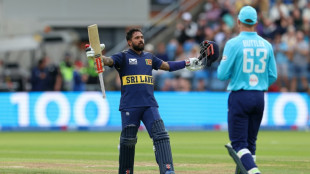 Sri Lanka captain Mendis hits century in 321-6 against England
 Oscar-winner Cotillard fears being moved by AI actor
 Agassi demands proper break for exhausted tennis stars
 Seixas 'crushes' teammates in training to draw Pogacar comparisons

 Trump welcomes Xi to White House, touting agreement on AI
 Stocks fall, oil prices rise as global bonds back under pressure

 UK man died putting women, children first in Mozambique jihadist siege: coroner
 Russell leads Mercedes 1-2 at Azerbaijan GP practice
 Alcaraz shrugs off pressure of packed calendar at 'joyful' Laver Cup

 Fury to face British rival Joshua in Cardiff on December 11

 Streamex Converts Interest Into Capital as GLDY Investment Strategy Secures $1M+ Institutional Allocation

 STARTRADER Named Best Fintech Forex Broker at Forex Expo Dubai 2026
 Japan swimmer Ohashi, 17, shrugs off Covid to smash world record
 Shin Ohashi: Junk food-loving teen and new world record-holder

 Greek PM urges 'courage' in talks with UK over Parthenon Marbles
 'I was drowning': Iran Nobel winner exposes pain of separation from children
 Israel's US envoy says son fighting for life

 Olympic champion Yulo completes gymnastics gold collection at Asian Games
Tens of thousands of Oromos gathered Sunday at a lake near the Ethiopian capital for a once-banned celebration that today doubles as a sounding board for political and ethnic demands.
Draped in traditional colours including the red, white and black of the Oromo flag, crowds descended on the shores of Lake Hora Arsadi, 50 kilometres (30 miles) southeast of Addis Ababa, for the annual Irreecha festival.
Representing around a third of Ethiopia's 120 million people, the Oromo are the largest of 80 distinct groups that make up the vast and ethnically-diverse nation in the Horn of Africa.
"The Oromo people come to the lake to give thanks to god for the change of the rainy season, of winter to spring," said Sabkebar Gezu, a 35-year-old small business owner.
To mark the passage of seasons, attendees old and young at Irreecha dip flowers into the lake and sprinkle themselves with the blessed water, amid traditional songs and dancing in colourful regalia.
The Oromo are almost equally divided between Christians and Muslims. Many refer to god as Waaqa, and some still practice local beliefs that revolve around this ancestral life-giving deity.
In recent decades, there has been a revival of Oromo identity long suppressed under successive waves of Ethiopian rulers and traditions like Irreecha, which was long banned, have re-emerged.
- 'Our strength' -
Tola Micha, wearing a tie striped in Oromo colours, remembered when Irreecha resumed in the late 1990s after the fall of the military-Marxist Derg regime in 1991.
In the beginning there were "a few hundred" in attendance: "Now we're in numbers, and I am proud of it," the 52-year-old said.
"Ireecha is our fist. It represents our strength."
Sabkebar said Irreecha was a "major" festival for his people but despite the celebrations, he did not forget there were "still many issues which remain unaddressed regarding the Oromo".
"The past generation has paid a sacrifice so that our generation can come here and celebrate it," he said.
Among the crowd, political chants peppered the lively singing and dancing.
"We are marginalised!" rose one refrain, while others spoke of a desire for greater respect as a people, and concerns over Oromos in prison.
Others cried for an end to the violent armed conflict raging in Oromia, a restive region and homeland of the Oromo.
Oromia is plagued by armed violence and anti-government insurgencies, and has witnessed ethnic massacres in recent years.
In 2018, Abiy Ahmed became the first Oromo to lead Ethiopia, and many anticipated greater representation and respect for a long-marginalised people.
But many Oromo have complained of continuing political and economic persecution even under the leadership of one of their own.
Many celebrating at Irreecha were at pains to avoid discussing the thornier issue of politics, but echoed wider concerns about Oromo identity and their place in Ethiopia.
"We can't say the question of the Oromo people is fully addressed, but it is better than before," said Kiya Tadessa, a 24-year-old NGO worker.
Ababa Korsa, a 30-year-old accountant, said the right to celebrate Irreecha "wasn't given to us freely and many shed their blood and sacrifice was paid".
"Even today, we cannot say we are fully liberated and there are many issues unaddressed," he said.
"However, it's partly better, to come here and celebrate our culture freely."
B.Godinho--PC