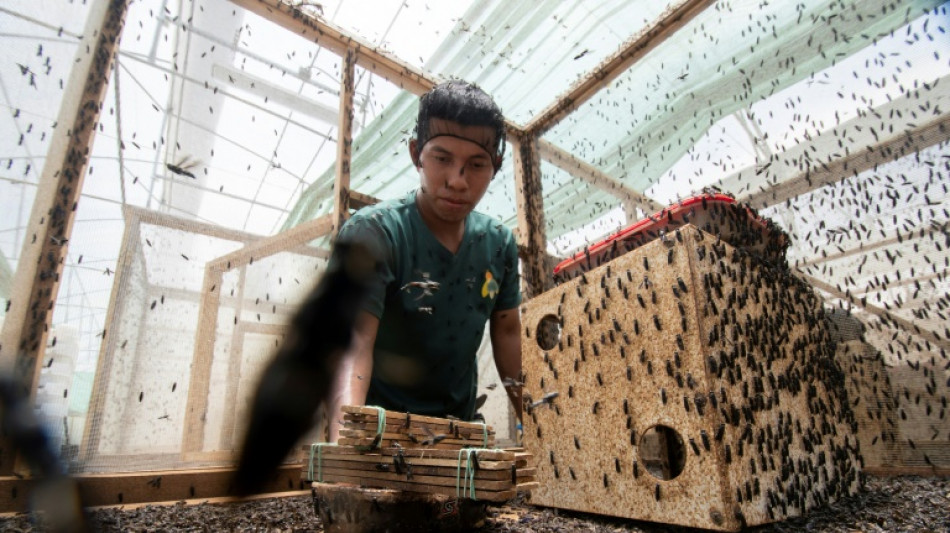
Fly larvae: Costa Rica's sustainable protein for animal feed / Photo: Ezequiel BECERRA - AFP

 UN approves resolution on dealing with rising sea levels

 Yalcouye makes dream debut as Ivory Coast beat Ghana in AFCON qualifier

 Chicago's White Sox and Cubs book MLB playoff berths

 Last-gasp Gakpo strike snatches Dutch draw to sour Klopp debut

 Global stocks mostly fall as oil prices and bond yields rise

 Israel's Netanyahu denounces enemies, allies in fiery UN speech

 Hollywood stars among arrests in NY anti-Netanyahu protest

 Losing start in AFCON qualifying for 78-year-old coach Le Roy

 Italy bans burqas in schools, caps numbers of foreign students per class

 Israel policies threaten 'life and existence' of Palestinians, Abbas says

 Paolini steers Italy past China in BJK

 Zidane admits emotion on eve of first game as France coach

 Breetzke and Maharaj sink Australia in first one-day international

 Zelensky broke confidentiality with North Korea POWs disclosure: South's president

 Former Liverpool star Carroll reveals he was sexually assaulted
 Dominican Republic calls for Haiti force to be strengthened

 Dolly Parton's nephew ordered to stay away from estate staff, properties

 Early exit for Philippine darling Eala at Singapore Open

 Hurricane Polo triggers huge waves in coastal Mexican city

 What happens if the US bans diesel exports

 Macklemore hits back with 'Free Palestine Tour' after Sheeran split
 Met Opera to give New Yorkers free tickets in affordability push

 Top ECB official to resign to take up IMF role

 Xi and Trump call for peace in lavish White House state visit

 Five up-and-coming players looking to make mark in Nations League

Raised in vertical farms and stuffed with fruit waste, fly larvae have been turned into animal feed, as a new Costa Rican venture in sustainability is demonstrating.
The Central American nation, one of the most biodiverse places on Earth, has put a lot of energy and creativity into the goal of becoming the greenest, most sustainable country in Latin America.
In Guapiles, a farming town just 60 kilometers (37 miles) north of the capital San Jose, an innovative company has turned the tables on the flies that have always buzzed annoyingly around the crops -- putting them to work.
The black soldier fly (Hermetia illucens) is native to tropical climates such as Costa Rica's, with its larvae incessantly gobbling up organic waste.
"It's a high-quality protein," Miguel Carmona, president of the company ProNuvo, told AFP.
So fly larvae can provide "healthier" proteins for animals and with less environmental impact than feed based on animal (beef or fish) or vegetable (soy) protein, the 52-year-old businessman explained.
The company's final products, in the form of dried larvae, protein powder or insect oil, are exported -- for now only to the United States, although one Costa Rican fishery is already using them in its tilapia farm in the north of the country.
- 'Sustainable business' -
The flies are raised in cages in a greenhouse at about 40 degrees Celsius (104 Fahrenheit) and in high humidity. They live for a week and lay about 500 eggs each before dying.
Four days later, the eggs hatch and the larvae begin to feed on organic waste from banana, mango and papaya plantations. Over the next 14 days, they gain 10,000 times their original weight, Carmona explained.
"These larvae are then converted into very rich proteins and oils and fats for animal feed," Gabriel Carmona, general manager of ProNuvo and Miguel's brother, told AFP.
Not even the waste goes to waste: the excrement deposited by the larvae makes an ideal fertilizer for the same fruit plantations.
"We are practicing a sustainable business," said Miguel Carmona.
- Fewer inputs -
"We are using waste from other industries to make a high-quality protein without having the environmental impacts that overfishing, soy and livestock have today," said the company president.
According to ProNuvo, the production of one ton of beef requires 30,000 square meters (7.5 acres) of land, and soybeans require 3,000 square meters. Vast areas are thus deforested, sharply reducing the numbers of carbon dioxide-absorbing trees.
Yet, the fly larvae farm requires only 300 square meters.
The same applies to water use. Production of a ton of beef protein requires 15.4 million liters of water (4.1 million gallons), while soybean crops require 1.6 million liters. The larvae consume barely 10,000 liters.
The production time for a ton of larvae protein is also substantially shorter: flies take 14 days, soybeans six months, and cows 36 months.
- 'Regional pioneers' -
The farm in Costa Rica is the first in Latin America to produce insect protein, according to Miguel Carmona.
"Pioneers of the region," he said proudly.
With food, grain and fertilizer prices increasing due to the war between Russia and Ukraine, other innovative projects are underway elsewhere.
There is work in Kenya and Uganda, for example, on using the black soldier fly in the production of organic fertilizers.
And in Europe, the larvae are being sold as a protein supplement for animals -- available to order online.
B.Godinho--PC