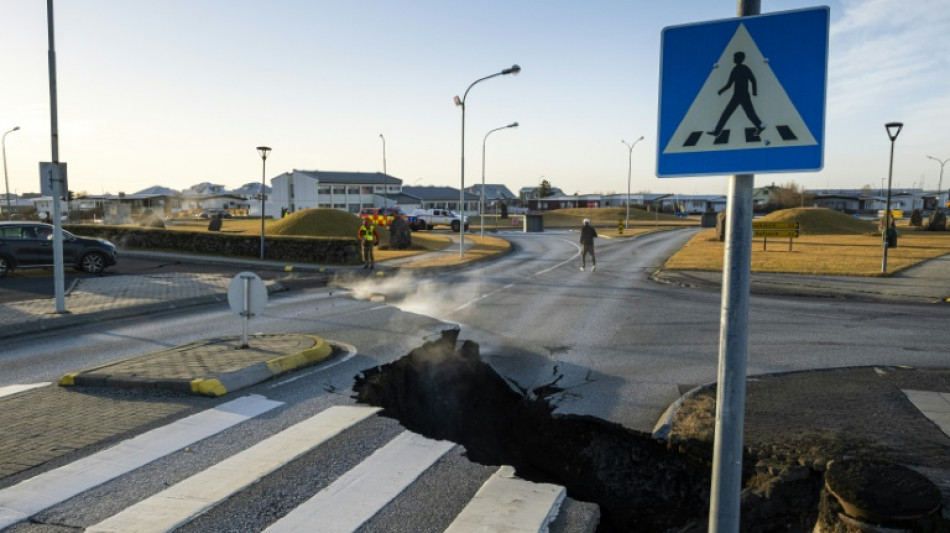
Years of uncertainty ahead for Iceland volcano town / Photo: Kjartan TORBJOERNSSON - AFP

 Many AAPI Candidates Win Seats in Orange County Local Elections

 Holly Ramsay and Adam Peaty Welcome Daughter Daphne June at Portland Hospital

 Honda and Toyota Recall 1.6 Million Vehicles Over Takata Airbag Risks

 Court Dismisses Fenech’s Bid to Revoke Theuma’s Pardon

 Fundraiser launched for Daniel Buttigieg after boat accident
 Egypt and Qatar Call for Gaza Ceasefire Implementation and Regional De-escalation
 INGLOT Malta offers Black Friday discounts of up to 60%

 Italian Village event in Malta raises funds for Puttinu Cares

 Malta launches second national AI strategy with 86 measures
After a barrage of earthquakes that herald an impending volcanic eruption, some evacuated residents of the Icelandic town of Grindavik wonder if they will ever return.
"There are going to be a lot of people who don't want to go there. My mother said 'I never want to go there again'," Eythor Reynisson, who was born and raised in Grindavik, told AFP.
The fishing port of 4,000 people on Iceland's south coast was evacuated on November 11 after magma shifting under the Earth's crust caused hundreds of earthquakes -- a warning of a likely volcanic eruption.
Thousands of smaller tremors have shaken the region since.
With massive crevices ripping roads apart and buildings' concrete foundations shattered, the once picturesque Grindavik now resembles a warzone.
The damage to the town hall will take months to repair.
- Long term threat -
Even if the magma flow stops and no eruption occurs, "there is the issue of whether one should live in a town like this," Freysteinn Sigmundsson, a geophysicist at the University of Iceland, told AFP.
The Reykjanes peninsula had not experienced an eruption for eight centuries until 2021.
Since then, three eruptions have struck -- all in remote uninhabited areas -- and volcanologists believe this may be the start of a new era of activity in the region.
Sigmundsson warned that "a difficult period of uncertainty" lies ahead, as eruptions could happen in coming years.
That has left residents wondering whether it is worth rebuilding their homes.
Sigmundsson said that for the region to be deemed safe, the current activity would first need to cease.
"There is a possibility that the activity will move to another area. And then it could be acceptable to go back to Grindavik," he said.
- 'Strong community' -
Despite the conditions, a resilient community spirit was evident as residents this week queued to enter Grindavik to collect belongings they left in their hurried evacuation.
Residents embraced each other and shared moments of laughter.
"I am really emotional. That's basically how I am feeling right now," Johannes Johannesson told AFP.
For some, living around volcanoes comes with the territory.
"We are a strong community, so I think it's possible to build it up again," Reynisson said.
Iceland is home to 33 active volcano systems, the highest number in Europe. Towns have been hit before.
In 1973, a fissure erupted just 150 metres (yards) from the town centre on the island of Heimaey, surprising locals at dawn.
A third of homes were destroyed and the 5,300 residents were evacuated. One person died.
In Grindavik, steam fills the air from burst hot water pipes and the electricity grid struggles to keep operating at night becuase of the infrastructure damage.
Locals are now seeking accommodation in hotels, with friends and family, and at emergency shelters while they wait for life to return to normal.
Authorities have organised occasional trips into the port town, escorting those with homes in the most perilous parts to rescue everything from cherished pets to photo albums, furniture and clothing.
But the operations proceed with utmost caution: on Tuesday the village was quickly emptied as sulfur dioxide measurements indicated the magma was moving closer to the surface.
"There was panic," Reynisson acknowledged.
- Today or in a month -
For almost a week, Iceland has been on tenterhooks, prepared for an eruption at any moment.
"There is still a flow of new magma into this crack and it is widening," Sigmundsson explained.
As long as there is an inflow of magma into the crack, the likelihood of an eruption remains high.
"We need to be prepared for an eruption happening today or within the coming week or even up to a month," the researcher added.
The most likely place for an eruption "is from the town of Grindavik northwards," Sigmundsson said.
For residents, this means an extended and anxiety-filled time over the weeks to come.
"Plans now are to try to manage. Try to just get the family into a routine and keep on going," Johannesson said.
E.Paulino--PC