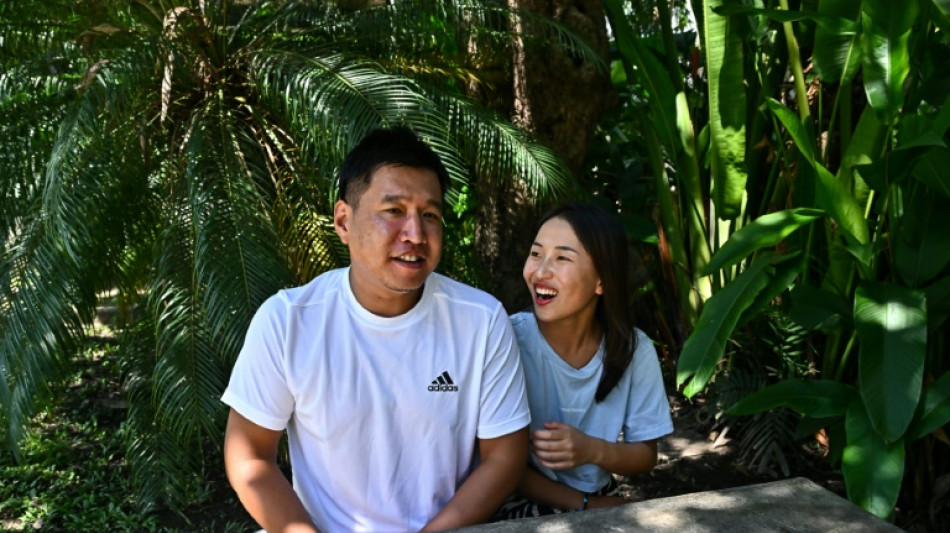
Freedom and dignity: Millennial Chinese leave China for Thailand / Photo: Lillian SUWANRUMPHA - AFP

 Calgary builder draws on decades of DIY work to increase Ford engine power

 Record-setting Hemi Plymouth Superbird heads to auction

 Calgary dancer describes stripping as a career built on independence and community

 Rohit Sharma Reappointed Mumbai Indians Captain for IPL 2027 with Focus on Team Spirit

 Calgary budget hearing delayed during debate over Tourette syndrome accommodation

 Business phone systems gain AI tools, but human oversight remains essential

 Huawei outlines 2030 network plans at Africa Tech Festival

 Governments and courts tighten restrictions on camera-equipped smart glasses

 South Africa’s sovereign satellite plan remains stalled despite higher cost

 EasyEquities faces pressure for clearer answers after security outage

 US patent disputes involving Korean chipmakers reach record level

 SK hynix doubles daily share purchases after steep stock decline

 Former soldier stopped with blank round at Incheon Airport

 Korea Post breach exposes data of at least 113,855 customers

 Many AAPI Candidates Win Seats in Orange County Local Elections

 Holly Ramsay and Adam Peaty Welcome Daughter Daphne June at Portland Hospital

 Honda and Toyota Recall 1.6 Million Vehicles Over Takata Airbag Risks

 Court Dismisses Fenech’s Bid to Revoke Theuma’s Pardon
Hitting tennis balls across a tree-lined court in Thailand's mountainous north, Connie Chen's weekly private training session is a luxury the Chinese national could barely afford when she lived in Shanghai.
China implemented some of the world's toughest Covid restrictions during the pandemic, putting hundreds of millions of people under prolonged lockdowns. In the aftermath, younger citizens -- exhausted by gruelling and unrewarding jobs -- are taking flight to escape abroad.
With a relatively easy process for one-year study visas, a slower pace of living and cheap living costs, Thailand's second-largest city Chiang Mai has become a popular destination.
"During the pandemic, the desire for freedom became stronger," Chen, a 26-year-old former bank worker, told AFP.
In China's financial capital Shanghai -- hit by some of the strictest pandemic lockdowns -- Chen had a stable, well-paid job, but was unhappy with the career path that lay ahead of her.
After the pandemic, Chen knew something had to change.
"Even if I kept doing this job for the rest of my life, it would just be like this," she said.
"But life is so short that I want to try something different."
Chen is emblematic of many of her generation: unlike their parents who benefited from China's then-booming economy, younger Chinese are burdened by a weak economy.
Prospects for promotion are few and competition is ferocious, leading many to burn out.
Chen researched foreign language programmes, choosing Thailand where she and her husband, Gordon Lin, moved in May under a one-year education visa.
And now they are determined to live abroad long-term.
"I feel there are a lot of opportunities outside and I feel hope," she said.
The Covid lockdowns in Shanghai led to rare street protests that quickly escalated into demonstrations across other major cities in China, prompting a crackdown by the nation's communist rulers.
The people interviewed for this story were reluctant to discuss politics, but all insisted their moves abroad were motivated by wanting a different lifestyle.
- A decent, dignified life -
The surging desire to leave China can be seen in patterns on WeChat, the Chinese messaging app.
Searches for "emigration" have spiked, hitting 510 million in one day in October, according to Chinese-language media, while in late January "immigrating Thailand" was searched more than 300,000 times in a single day.
Thailand is seen as easier than Europe or North America, with the kingdom offering several types of long-term visas, including a one-year language course -- costing roughly $700 to $1,800.
"I think there's a sudden increase of desire for leaving China," said social anthropologist Xiang Biao, from Germany's Max Planck Institute for Social Anthropology.
Thailand has come to be regarded by many Chinese as a stepping stone country, he said, ideal to experiment with living abroad.
But compared to migration in the 1990s and 2000s, when many kept connections with China for business, Xiang said there was a new trend of people wanting to totally uproot themselves.
He added while this group were educated they were not necessarily part of the elite or wealthy.
"They are cosmopolitan, open-minded and they cherish a basic sense of freedom -- not necessarily political freedom, but they want to live a life that they feel is decent and is dignified," he said.
And unlike previous generations, they are not seeking to make their fortune abroad.
"It is really thinking of the question of what kind of life they want, what kind of adults they want to become," he said.
- 'Just do it first' -
Back at the tennis court in Chiang Mai, Chen's husband Lin cheers her on.
The former e-commerce employee had planned to work hard, save and then retire early. But he felt increasingly suffocated by the identikit mindset surrounding him.
"It's all about going to a good university, finding a good job, being a civil servant," the 32-year-old said.
Chen and Lin have only been in Thailand for a few months, living off savings while they consider their next move.
But for Yin Wenhui it is time to go.
The 31-year-old arrived during the pandemic, stranded after China shut its borders, but after a few months he didn't want to return to face relentless pressure from family and peers to devote himself utterly to work.
"I feel more free here. The pace was too fast in China, I didn't have the freedom to do things I wanted to," he told AFP.
Now instead of obsessing about work he runs a Chiang Mai hostel with friends, goes to the gym daily and has learned to cook. Fulfilling a childhood dream, he was also learning to play the guitar -- something his parents frowned upon.
"Here I have more time to think, think about what kind of life I want," he said.
But now the honeymoon is over for him -- he has grown frustrated by the slow pace of life and is ready for the next stage.
"I want to go to a developed country, as it will be better than China or Chiang Mai on culture, work and also salary," he said.
E.Ramalho--PC