Stephen Breyer: pragmatic pillar of US Supreme Court

 Germans vote in elections threatening fresh blow to Merz

 US fears rapid escalation in Mideast after Houthis attack Riyadh

 Japan triathlete Hojo wins first gold of Asian Games

 IOC president impressed by 'beautiful' Asian Games wooden huts

 First Asian Games gold goes to Japan as China's 13-year-old Yu lights up pool

 Data centre command hub keeps AI up and running

 Pope Leo in France: the issues on the table

 Packing for a pope: behind the scenes on foreign trips

 Republicans find transgender issues a powerful political weapon in midterm campaigning

 German state elections threaten new shock waves for Merz

 Chile's Bachelet quits race to be next UN chief

 Raphinha treble fires perfect Barca to win at Sevilla

 Thiam makes winning heptathlon return at Decastar meet

 Czechs beat USA to qualify for Davis Cup finals

 Dortmund sink Stuttgart to climb to Bundesliga summit

 Trump says will not tolerate attempts to slow AI growth

 'It has to stop': runners protest women's murders in S.Africa district

 Fire erupts near Riyadh airport as Houthis claim strikes

 Cuba works to restore power after another blackout

 England thrash Sri Lanka again to return to top of T20 rankings

 Arsenal thrashed by Brighton, sorry Spurs lose again

 South Korea, Austria qualify for Davis Cup finals

 Seare shocks Ingebrigtsen to win world 5km gold

 Brigitte Bardot widower slams sale of star's belongings

 Aston Villa compound Tottenham's misery despite late rally

Stephen Breyer, the oldest justice on the US Supreme Court and the senior member of the bench's liberal-leaning wing, boasts a record of pragmatism in the hundreds of opinions he has authored in his long career.
The bespectacled California native, aged 83, was nominated to the nation's highest court by Democratic former president Bill Clinton, and US media reported Wednesday that he plans to retire at the end of the current term in June.
He has spent more than 25 years on the nine-member bench, which towards the end of his tenure has firmly leaned to the right of the political spectrum.
But being in the minority has not dimmed his jovial nature or passion for the work of the court. Breyer has insisted in his rulings on assessing real-world implications when deciding cases, rejecting the strict reading of the Constitution favored by some of his peers.
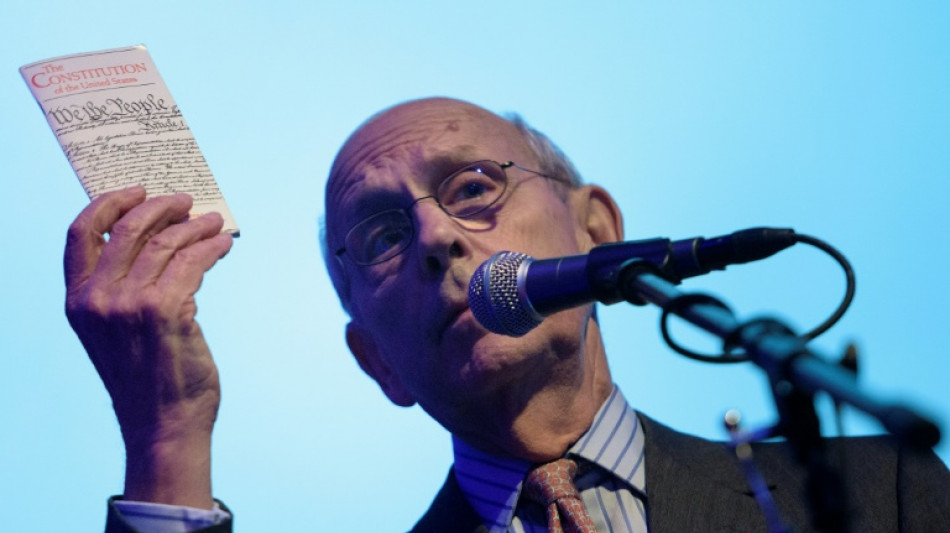
Breyer -- who carries an annotated copy of the Constitution with him in his jacket pocket -- is a fierce opponent of the death penalty, and has ruled in favor of abortion rights, same-sex marriage and environmental protection.
He has bristled at the notion of partisanship on the court.
"My experience of more than 30 years as a judge has shown me that, once men and women take the judicial oath, they take the oath to heart," he said in a 2021 lecture at Harvard Law School, his alma mater.
"They are loyal to the rule of law, not to the political party that helped to secure their appointment."
- From Harvard to high court -
Born on August 15, 1938 in San Francisco, Breyer was educated at Stanford, Oxford and Harvard -- a prestigious academic career that challenged his keen intellect.
He began his legal career in 1964 as a clerk to then-Supreme Court justice Arthur Goldberg and then spent time working in the Justice Department on antitrust matters, before serving as an assistant special prosecutor on Watergate in 1973.
He taught at Harvard University until 1980, when he got the nod from then-president Jimmy Carter to serve on the federal court of appeals in Boston, where he remained for more than a decade, eventually becoming its chief judge.
Breyer was initially considered for a Supreme Court spot in 1993, but his candidacy was marred by a revelation that he had failed to pay taxes for a part-time housekeeper.
A year later, he became Clinton's second nominee to the high court, after Ruth Bader Ginsburg. The pair would end up shoring up the liberal-progressive wing of the court for more than two decades.
- 'Not my job' -
Upon Joe Biden's arrival in the Oval Office, Breyer found himself drawn into a perennial discussion when the White House changes hands -- should older justices retire when a president of their own political persuasion takes office?
Biden's predecessor Donald Trump had appointed three justices to the Supreme Court, sealing a 6-3 right-leaning majority.
But Breyer has repeatedly decried injecting politics into the court, and did not answer the call from liberals to leave his lifetime appointment to ensure a like-minded replacement.
"If the public sees judges as politicians in robes, its confidence in the courts, and in the rule of law itself, can only diminish, diminishing the court's power," he said in 2021.
In an interview with AFP in 2016, Breyer -- who is a Francophile and speaks fluent French -- refused even to say what qualities an ideal candidate for the court would possess.
"I can't suggest who the president should appoint. It's not my job," Breyer said.
"Asking me a question about who should be appointed or how that process works is like asking for the recipe for chicken a la king from the point of view of the chicken," he quipped.
Breyer is married to psychologist Joanna Hare, a member of the British aristocracy. They have three children.
P.Sousa--PC
