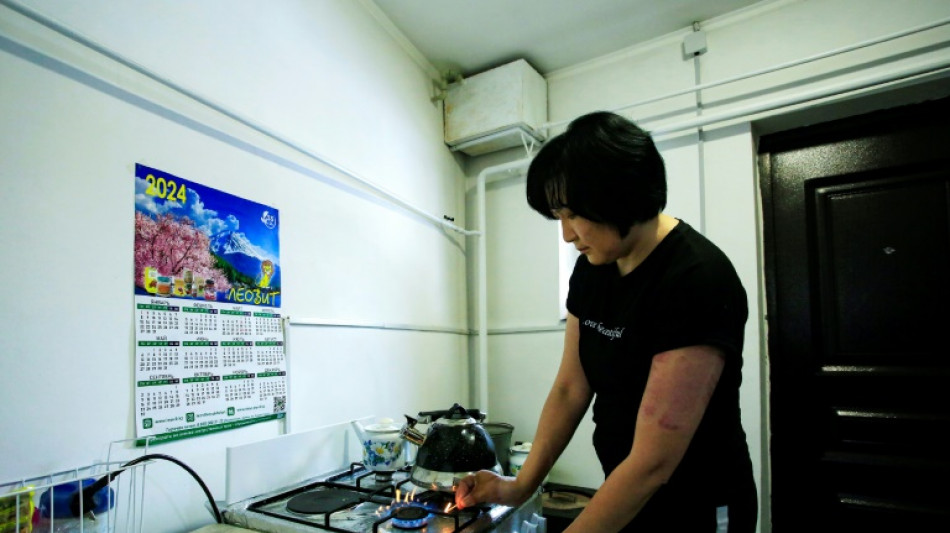
Kazakh influencers, rights groups denounce domestic violence 'epidemic' / Photo: Ruslan PRYANIKOV - AFP

 Assefa seeks 'better than my best' at Berlin marathon

 US court refuses to overturn Pentagon ban on Anthropic

 Verstappen and Norris blame slow cars as Mercedes tops qualifying

 Crowds cheer pope in Paris after AI 'paradise of machines' warning

 Teen swimmer makes Games history as Thai, Chinese sprinters win gold
 Man City found guilty of 114 Premier League charges - reports

 Concerns over 'missing' UK explorer Ranulph Fiennes

 Suspected Paris killer of Argentine rugby star begs forgiveness

 Oil prices fall on cautious hopes for US-Iran progress

 Noskova, Muchova take Czech Republic into BJK Cup final

 Thai sprinter Puripol breaks own Asian Games record to win 100m gold
 Russell takes pole for Azerbaijan GP, Antonelli crashes out

 Williams boss hails Chadwick as F1 inspiration for women

 World No.1 Sinner delays return with China Open withdrawal

 South Lebanon children return to school destroyed by Israel strike

 Jewish group urges Berlin far-left vote winners to tackle antisemitism

 European stock markets climb as oil prices drop

 Trump accuser E. Jean Carroll finally has her damages

 Germany's Havertz, Musiala ruled out of Greece match with injury

 Ireland's Gaza stance spills from Eurovision into football

 Welcome aboard the Costa Serena, the Asian Games floating hotel

 Asian markets mixed after recent oil surge
 Cash for nature protection: hotelier's offer to Principe islanders

 US miner KoBold bets on AI to gain edge in DR Congo mineral hunt

 Internet disrupted in Ethiopia as conflict rages

After miraculously surviving her ex-husband's attempt to kill her, Indira Tergeubayeva has been fighting to be recognised as a victim in her native Kazakhstan.
"My ex-husband had been stalking me for two years, threatening to kill me," the accountant, 42, told AFP in Almaty.
"On December 22, 2022, he came to the shop where I work, doused me with petrol, and set me on fire," she recounted.
Despite being left with horrific injuries, police refused to investigate her abuser because he died in the attack.
More than 80 femicides are officially recorded each year in Kazakhstan, where domestic violence is not included in the criminal code.
In a society deeply entrenched with patriarchal attitudes, the United Nations estimates that the unofficial figure could be as high as 400.
Tergeubayeva suffered third-degree burns and underwent several skin grafts on her face and hands. Several of her fingers remain dislocated.
Her ex-husband will never stand trial, but she wants an explanation from the police.
"We have laws in Kazakhstan, but they don't work for everyone," she said.
- Turning point -
Rights groups say women in Kazakhstan feel pressured to drop accusations or reconcile with their abusers.
According to the interior ministry, of more than 100,000 reports received each year "60 percent of victims refuse to lodge a complaint".
For Tergeubayeva and many others, proving their abuse in court is often an uphill battle.
"The Kazakh police still don't recognise me as a victim," she said, her voice bitter.
"I've filed complaints everywhere, but the police didn't do their job, nobody defended me," added Tergeubayeva, who suspects that her ex-husband made deals with the police to avoid punishment.
"We've had women commit suicide too. The police don't take us seriously. 'Tomorrow you'll be reconciled,' they say."
Cases of domestic violence are often glossed over by traditional media in Kazakhstan, where public debate is tightly controlled, but survivors and activists are increasingly speaking out on social media.
Last year, the death of Saltanat Nukenova, 31, killed by her husband in a restaurant in the capital Astana, sparked widespread outrage online.
The perpetrator, former economy minister Kuandyk Bishimbayev, was charged with "particularly cruel murder" and "torture".
In the aftermath, an online petition calling for tougher legislation garnered more than 150,000 signatures in just a few days, a record in Kazakhstan.
- 'Epidemic of domestic violence' -
Influencers have also taken to social media to denounce what they call an "epidemic of domestic violence".
A beauty products shop with over 90,000 followers on Instagram produced a viral video with an ironic "tutorial" advising how to conceal the marks of beatings with make-up.
Following the backlash, Kazakh President Kassym-Jomart Tokayev promised legislation to criminalise domestic violence and authorities launched a public awareness campaign.
Cinema has also taken up the issue. At the end of the year, the Kazakh horror film "Dastur" recorded unprecedented box-office success.
It tells the story of a young girl forced to marry her rapist, the son of an influential landowner.
The police have announced an increase in arrests, and parliament is working on legislation to tackle the issue.
But as Tergeubayeva's case shows, a complaint does not guarantee an investigation. She said the problem of domestic violence is compounded by endemic corruption.
For human rights lawyer Galym Nurpeisov, this awakening is still in its infancy, and there is no guarantee that it will withstand society's male-dominated culture.
"A woman in Kazakhstan cannot openly express her opinion," he told AFP.
"Increasing criminal liability for domestic violence will not solve this problem."
E.Ramalho--PC