
-
 Spotting AI writing: how reliable are the detectors?
-
Russia not preparing for conflict with Europe, Putin says
-
 French youth await pope after AI 'paradise of machines' warning
-
Trump's photo of Xi greeting carries signs of AI
-
 Man City found guilty of Premier League charges, set to appeal: reports
-
Six missing after building blast in historic Athens district

-
 Embolo follows Xhaka out of Swiss squad over fake Covid documents
-
Millions in US northeast brace for powerful storm

-
 Trump, Xi inspect founding documents of US democracy to close summit
-
Assefa seeks 'better than my best' at Berlin marathon

-
 'Bottle Claus': Kipchoge's 'hero' helping runners chase Berlin marathon glory
-
US court refuses to overturn Pentagon ban on Anthropic

-
 Olympic medallist Samba-Mayela handed provisional doping ban
-
Verstappen and Norris blame slow cars as Mercedes tops qualifying

-
 First US trial against TikTok to open Monday
-
Crowds cheer pope in Paris after AI 'paradise of machines' warning

-
 Palmer misses 'too many' England games, says Tuchel
-
Teen swimmer makes Games history as Thai, Chinese sprinters win gold

-
 UN refugees chief warns conditions in W.Sahara 'deteriorating'
-
Man City found guilty of 114 Premier League charges - reports

-
 Antonelli 'mad' about crash in Azerbaijan qualifying
-
Concerns over 'missing' UK explorer Ranulph Fiennes

-
 'Perfect lap' gives Russell pole for Azerbaijan GP as Antonelli crashes out
-
Suspected Paris killer of Argentine rugby star begs forgiveness

-
 UN Security Council condemns Houthi attacks on Saudi Arabia
-
Oil prices fall on cautious hopes for US-Iran progress
-
 China swimmer makes Asian Games history as Thai wins 100m sprint
-
Noskova, Muchova take Czech Republic into BJK Cup final

-
 Top French literary prize drops best-selling novel over AI claims
-
Thai sprinter Puripol breaks own Asian Games record to win 100m gold

-
 US 'must choose' whether to end war: Iran president
-
Russell takes pole for Azerbaijan GP, Antonelli crashes out

-
 Pope warns against losing humanity in AI-driven 'paradise of machines'
-
Williams boss hails Chadwick as F1 inspiration for women
-
 Pope warns against losing humanity in 'paradise of machines'
-
World No.1 Sinner delays return with China Open withdrawal

-
 From FBI warning to literary acclaim: the Russian journalist who took on Putin
-
South Lebanon children return to school destroyed by Israel strike

-
 China swimmer in Asian Games first as North Korea lifters reign
-
Jewish group urges Berlin far-left vote winners to tackle antisemitism

-
 French literary prize removes novel from longlist after AI claims
-
European stock markets climb as oil prices drop
-
 China's Zhang wins record seventh Asian Games swimming gold
-
Trump accuser E. Jean Carroll finally has her damages

-
 Verstappen edges Russell in final practice in Azerbaijan
-
Germany's Havertz, Musiala ruled out of Greece match with injury

-
 English, Spanish, Italian, German football leagues call for FIFA reform
-
Ireland's Gaza stance spills from Eurovision into football

-
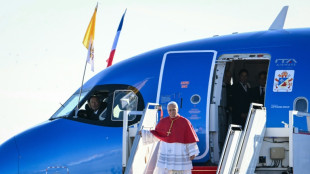 Pope arrives in France on first official visit in 18 years
-
Welcome aboard the Costa Serena, the Asian Games floating hotel

EU curbs kick in to make big tech play by its market rules
The EU's landmark curbs on how tech titans do business online kick in from Thursday, but just how far Brussels succeeds in bringing the giants to heel will hinge on bitter battles that lie ahead.
Wielding a tough new legal arsenal, Brussels is determined to force a change in behaviour by the world's biggest tech firms, to create a more competitive online field that allows smaller players to flourish.
The bloc's Digital Markets Act (DMA) ushers in a long list of do's and don'ts for six so-called "gatekeepers" designated by the European Union: Apple, Amazon, Google owner Alphabet, TikTok parent ByteDance, Meta and Microsoft.
"What we need right here from gatekeepers is changing behaviour," the bloc's competition commissioner Margrethe Vestager had told AFP.
The big six will have to tell Brussels about any buyout, as well as provide European users with more choices when they pick web browsers or search engines.
Users should also soon be able to send messages between apps, for example from Meta's WhatsApp to services such as Signal or Telegram.
The six giants must file compliance reports with the European Commission by the end of Thursday and adhere to all rules when the clock strikes midnight (2300 GMT) in Brussels.
But experts warn enforcement will be difficult, and the EU already faces a slew of legal challenges.
"Getting big tech to comply with these new rules will be an enormous task," Bram Vranken, researcher at Corporate Europe Observatory, told AFP.
"Even now, almost eight years after the adoption of the GDPR" -- the EU's mammoth data protection law -- "the EU is still struggling in getting Facebook to respect the privacy of millions of people in Europe," Vranken added.
Brussels slapped a 1.2-billion-euro ($1.3 billion) fine on Meta over data privacy violations last year.
On Monday, the EU hit Apple with a more than 1.8-billion-euro fine for violating antitrust rules by preventing European users from accessing information about alternative, cheaper music streaming services.
Apple is already at the centre of a feud after Epic Games said the company halted the Fortnite-maker's effort to develop a competing app store for its offerings.
The commission, the bloc's powerful competition regulator, has asked Apple for more details and is evaluating whether the iPhone-maker violated any laws.
- 'Pick and choose' cases -
When it comes to DMA enforcement, an EU official admitted that limited resources meant the commission would have to "pick and choose" which cases to pursue.
The commission would not comment on the claim.
Senior officials acknowledge instant compliance may not be realistic.
"We will see some compliance, full compliance by some companies. But I do think that there will be non-compliance cases," Vestager said.
She added that Brussels would not shy away from tougher action.
The commission can slap fines of up to 10 percent on a company's worldwide turnover for a violation. That can rise to 20 percent for repeat offenders.
In extreme cases, Brussels can demand the break up of companies.
"The commission will not hesitate to fully enforce the new rules using the entire toolbox at its disposal," spokesperson Johannes Bahrke told reporters.
The EU's 27 countries have been pushing the commission to focus resources on enforcement, and at least nine major laws covering the digital space have been created since 2019.
Analysts have advised the EU to be realistic about the resources enforcement will require.
- EU 'building up' -
The sheer volume of new laws, "creates a risk that the Commission and national enforcers will lack the resources to implement them properly," Zach Meyers, of the Centre for European Reform think tank, wrote in a February report.
Vestager has said the commission is "building up" capacity -- but also acknowledged officials would need to prioritise cases.
Currently, the commission has 80 staff members working on the DMA, a spokesperson said, while there are 123 full-time employees focused on enforcing the Digital Services Act (DSA), a content moderation law.
On the corporate side, Meta and TikTok said last year they each had more than 1,000 people working on DSA implementation at the time.
Google says that, on the DMA alone, "thousands of engineers" are working on compliance.
But competition expert Fiona Scott Morton tempered the concerns about enforcement, arguing that is "always an issue" -- and that the DMA was created with that in mind.
"The law is set up to try to combat that -- by putting the burden on the firms themselves for both complying and explaining how they're complying and proving that they have complied," the Bruegel think tank senior fellow told AFP.
H.Portela--PC