The many chilling myths of Prague's 'lunatic graveyard' / Photo: Michal Cizek - AFP

 Wall Street stocks rise, greeting optimism over possible US-Iran deal
 NFL players chief raises concerns over pitch for Maracana game

 Daytime Russian attacks kill seven in Kyiv
 Spotting AI writing: how reliable are the detectors?
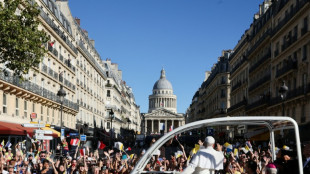
 French youth await pope after AI 'paradise of machines' warning
 Man City found guilty of Premier League charges, set to appeal: reports
 Embolo follows Xhaka out of Swiss squad over fake Covid documents
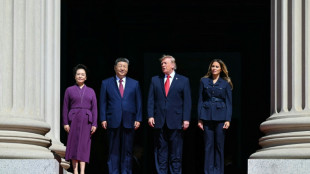 Trump, Xi inspect founding documents of US democracy to close summit

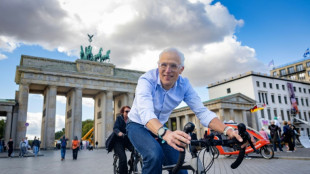 'Bottle Claus': Kipchoge's 'hero' helping runners chase Berlin marathon glory

 Olympic medallist Samba-Mayela handed provisional doping ban
 First US trial against TikTok to open Monday
 Palmer misses 'too many' England games, says Tuchel

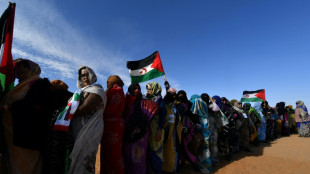 UN refugees chief warns conditions in W.Sahara 'deteriorating'
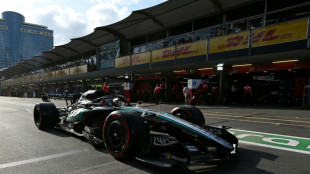 Antonelli 'mad' about crash in Azerbaijan qualifying
 'Perfect lap' gives Russell pole for Azerbaijan GP as Antonelli crashes out
 UN Security Council condemns Houthi attacks on Saudi Arabia

 China swimmer makes Asian Games history as Thai wins 100m sprint

 Top French literary prize drops best-selling novel over AI claims

 US 'must choose' whether to end war: Iran president
 Pope warns against losing humanity in AI-driven 'paradise of machines'
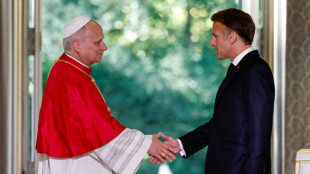 Pope warns against losing humanity in 'paradise of machines'

 From FBI warning to literary acclaim: the Russian journalist who took on Putin

 China swimmer in Asian Games first as North Korea lifters reign
 French literary prize removes novel from longlist after AI claims

 China's Zhang wins record seventh Asian Games swimming gold
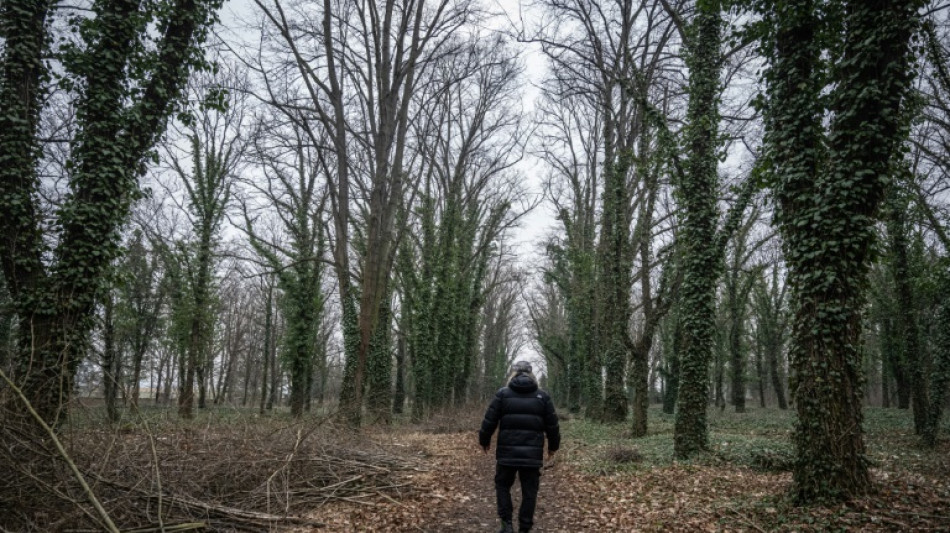
It was the setting of the chilling graveyard scene in "Amadeus", may have held the bones of Gavrilo Princip -- the man who started World War I -- and Margaret Thatcher paid a mysterious visit there when she was British prime minister.
An overgrown "lunatic graveyard" on the outskirts of Prague has become the Czech capital's strangest attraction, drawing ghost hunters, scandal seekers and Satanists and other less than welcome visitors lured by the supposedly strange energy of "Europe's scariest cemetery".
Around 4,200 people were laid to rest in the graveyard of the immense Bohnice psychiatric hospital, many without headstones.
"It's a different kind of cemetery," said Jiri Vitek, a former firefighter and deputy mayor of the local area who had become its de facto caretaker.
"The graveyard served standard psychiatric patients -- schizophrenics, alcoholics, addicts, but also people you would not want to meet -- arsonists, paedophiles, murderers," he told AFP.
Vitek said Gavrilo Princip, the Bosnian-Serb student who shot Archduke Franz Ferdinand and his wife in Sarajevo in 1914, triggering the Great War, may have been interred there before a shrine was created for him in his homeland.
Princip was the only prisoner in the Theresienstadt fortress north of Prague. A secret funeral took place in the cemetery supervised by prison guards three days after his death.
Vitek said the remote graveyard was the perfect place for Princip: "Where else would Austria bury its worst criminal?"
- Mozart burial -
The first person to be buried in Bohnice was an 11-year-old boy who died of tuberculosis in September 1909.
At that time, the hospital was the largest of its kind in the sprawling Austro-Hungarian empire -- a veritable village with a church, laundry and a bakery.
"The patients worked in the fields, grew vegetables and worked in workshops," hospital spokeswoman Alzbeta Remrova told AFP.
When World War I hit, the burials included Austrian soldiers hospitalised with mental illnesses and psychiatric patients from Italy, evacuated to Prague.
Most died during a typhoid epidemic between 1916 and 1918, said Vitek.
The graveyard closed in 1951 and was left to looters and neglect for six decades, with its chapel bowing to time and ivy.
But its haunting atmosphere drew director Milos Forman there to film the heartbreaking burial scene in his Oscar-winning 1984 movie "Amadeus", with the great composer Mozart thrown into a pauper's grave, his body covered in quicklime.
- Thatcher's pilot -
Vitek said that British Prime Minister Margaret Thatcher paid a mysterious visit to the graveyard in 1990 to reportedly bring home the remains of a British pilot shot down at the end of World War II.
Nobody knew where the grave was, Vitek said, until a local vagrant identified it in exchange for a crate of rum.
Over the years the graveyard has become a focus of dark fantasy -- a place where local youths tried to scare each other and test their courage -- especially its southwestern corner, which was reserved for criminals.
Some say it feels colder there than in the rest of the graveyard, blaming all that negative energy. But Vitek laughs this off.
"Non-believers were not buried in coffins, but in bags sanitised with lime. It's the hardened lime that generates the cold," he said.
In the 1980s, police busted a Satanic ritual in the cemetery.
More down-to-earth locals used it as a rubbish dump, and this is how Jiri Vitek found it in 2011 as he walked his dog.
"It was full of old fridges, washing machines, sofas and debris. So I started to clean it up," Vitek said.
He has gradually started to organise guided tours of the cemetery, has been working on a book and plans a revamp of the local chapel and memorial.
"As a firefighter I saved the living for 15 years. Now for the past 12 years, I've been saving the dead."
G.M.Castelo--PC