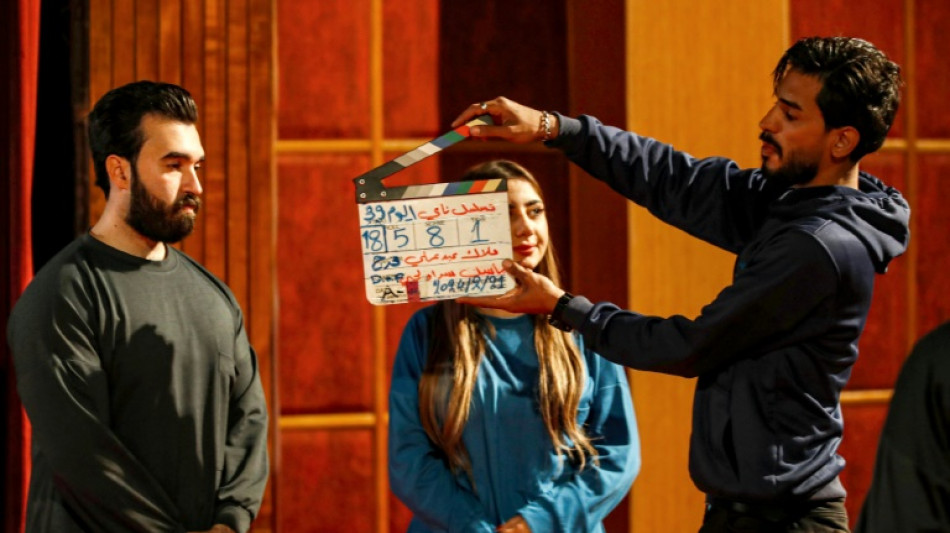
Revived TV drama breaks Iraq's taboos / Photo: AHMAD AL-RUBAYE - AFP

 Wall Street stocks rise, greeting optimism over possible US-Iran deal
 NFL players chief raises concerns over pitch for Maracana game
 Daytime Russian attacks kill seven in Kyiv
 Spotting AI writing: how reliable are the detectors?
 French youth await pope after AI 'paradise of machines' warning
 Man City found guilty of Premier League charges, set to appeal: reports
 Embolo follows Xhaka out of Swiss squad over fake Covid documents
 Trump, Xi inspect founding documents of US democracy to close summit

 'Bottle Claus': Kipchoge's 'hero' helping runners chase Berlin marathon glory

 Olympic medallist Samba-Mayela handed provisional doping ban
 First US trial against TikTok to open Monday
 Palmer misses 'too many' England games, says Tuchel

 UN refugees chief warns conditions in W.Sahara 'deteriorating'
 Antonelli 'mad' about crash in Azerbaijan qualifying
 'Perfect lap' gives Russell pole for Azerbaijan GP as Antonelli crashes out
 UN Security Council condemns Houthi attacks on Saudi Arabia
 China swimmer makes Asian Games history as Thai wins 100m sprint

 Top French literary prize drops best-selling novel over AI claims

 US 'must choose' whether to end war: Iran president

 Pope warns against losing humanity in AI-driven 'paradise of machines'
 Pope warns against losing humanity in 'paradise of machines'

 From FBI warning to literary acclaim: the Russian journalist who took on Putin
 China swimmer in Asian Games first as North Korea lifters reign
 French literary prize removes novel from longlist after AI claims
 China's Zhang wins record seventh Asian Games swimming gold
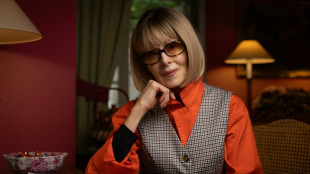
After a 27-year hiatus, an Iraqi TV programme banned by Saddam Hussein for its gritty depiction of life under sanctions has returned to portray drug lords thriving in the war-scarred country.
Television viewership in the Middle East traditionally peaks during the Muslim holy month of Ramadan, when the faithful tune in to their favourite shows after breaking their daily fast at sunset.
This Ramadan, a revived "Wahiba's World" is one of several Iraqi shows focusing on social issues such as drug addiction, crime, divorce and unemployment.
It delves into "issues troubling our society as a consequence of war and chaos," the programme's director Samer Hikmat told AFP.
Iraqis have suffered through decades of turmoil since the Iran-Iraq War in the 1980s and former dictator Saddam's invasion of Kuwait in 1990, which triggered harsh economic sanctions.
They were followed by a US-led invasion in 2003, civil war, sectarian violence and the jihadist proto-state of the Islamic State group, which was only defeated in late 2017.
The oil-rich country of 43 million, still recovering from those conflicts, is now plagued by endemic corruption and clientelism, a weak economy, poor public services and high unemployment.
- 'Drug-fuelled wealth' -
Decades of instability have created "a class of people who have profited from the chaos," Hikmat said, pointing in particular at newly wealthy drug dealers.
"Young people fall victim to this dark path."
Iraq, traditionally mainly a transit country for drugs, has faced an explosion in narcotics use in recent years, mainly of the amphetamine-like stimulant captagon and crystal meth.
The first series of "Wahiba's World", released in 1997, told the story of Wahiba, a nurse who makes every effort to help her neighbours amid the crippling international sanctions that plunged many Iraqis into poverty and crime.
Seventeen minutes into the broadcast of the first episode, authorities banned the programme, fearing it could incite people against the regime.
A year later, the show received a regional prize and authorities allowed it to be aired, but only at midday, considered a dead time slot.
This year, the show began airing on the first day of Ramadan during prime time on the Iraqi local private channel UTV.
Several actors had died during the long hiatus, but many others reprised their roles. In the revival, Wahiba plays a supporting part to her granddaughter and namesake, a psychiatrist, as the main character.
In a busy industrial area in Baghdad's centre, in the same garage where scenes from the first series were shot, director Hikmat filmed a segment in which drug lord Alaa threatens to behead a member of his gang.
Actor Zuhair Rashid, who portrays the drug dealer Alaa, said the programme showed the grim reality of "drug-fuelled wealth, its consequences and tragic endings".
- 'Sensitive issues' –
Despite these efforts, Iraq's worn-out entertainment industry is still far from gaining recognition in a region where Syrian and Egyptian programmes have long held the top spot.
After the rise of IS, Iraq's drama shows, which only air on local television, have focused chiefly on telling stories of the jihadists' brutal rule and the war to defeat them.
But critic Mehdi Abbas said there is a noticeable trend this Ramadan, with "the majority of this year's shows tackling issues that are a threat to society".
Another new show, titled "Nay" -- flute in Arabic -- addresses unemployment, especially among art students, and the growing gap between rich and poor.
Actress Suzanne Salehi, who stars in it, said the programme recounts the "yearning for an opportunity" of youth.
"Separation", another Iraqi show, is based on real divorce stories that writer Hassaballah Yehya followed in court, reflecting increasing break-up rates in the country.
It also tackles child marriage, which is not uncommon in Iraq, especially in rural areas. The legal age of marriage in Iraq is 18, but it can be lowered to 15 in cases of parental or judicial consent.
"People usually avoid sensitive issues," Yehya said, adding that "we're trying to break taboos."
G.M.Castelo--PC