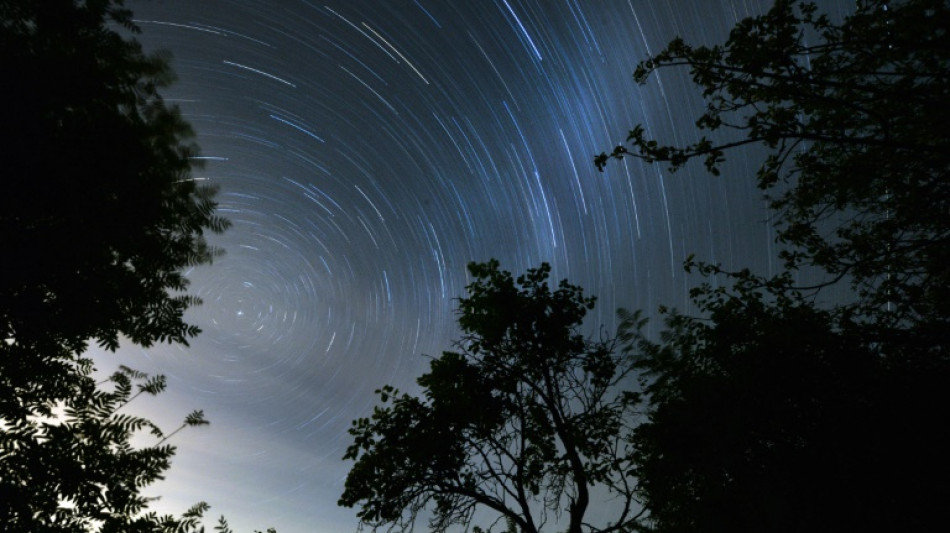
Huge star explosion to appear in sky in once-in-a-lifetime event / Photo: VYACHESLAV OSELEDKO - AFP/File

 Lula bans sports betting days ahead of Brazil's election

 Guatemala ensures survival of vulnerable 'fossil' fish

 Mancini finds positives in Italy loss, accepts fans' jeers

 Alcaraz helps Europe into Laver Cup lead

 Six missing after building collapses in historic Athens district

 Mbappe scores but suffers knee injury as Zidane gets debut France win

 Mancini's Italy return spoiled by Belgium defeat

 Rodri confident in Man City innocence despite reported charges

 Jay-Z rape accuser says she made 'false accusations'

 Senegal draw first match under Vieira and Nigeria survive scare

 Trump, Xi end summit long on pomp, but short on progress

 Russia not preparing for conflict with Europe, Putin says

 Trump's photo of Xi greeting carries signs of AI

 Six missing after building blast in historic Athens district

 Millions in US northeast brace for powerful storm

 Assefa seeks 'better than my best' at Berlin marathon

 US court refuses to overturn Pentagon ban on Anthropic

 Verstappen and Norris blame slow cars as Mercedes tops qualifying

 Crowds cheer pope in Paris after AI 'paradise of machines' warning

 Teen swimmer makes Games history as Thai, Chinese sprinters win gold

 Man City found guilty of 114 Premier League charges - reports

 Concerns over 'missing' UK explorer Ranulph Fiennes

 Suspected Paris killer of Argentine rugby star begs forgiveness

 Oil prices fall on cautious hopes for US-Iran progress

 Noskova, Muchova take Czech Republic into BJK Cup final

Sometime between now and September, a massive explosion 3,000 light years from Earth will flare up in the night sky, giving amateur astronomers a once-in-a-lifetime chance to witness this space oddity.
The binary star system in the constellation Corona Borealis -- "northern crown" -- is normally too dim to see with the naked eye.
But every 80 years or so, exchanges between its two stars, which are locked in a deadly embrace, spark a runaway nuclear explosion.
The light from the blast travels through the cosmos and makes it appear as if a new star -- as bright as the North Star, according to NASA -- has suddenly just popped up in our night sky for a few days.
It will be at least the third time that humans have witnessed this event, which was first discovered by Irish polymath John Birmingham in 1866, then reappeared in 1946.
The appropriately named Sumner Starrfield, an astronomer at Arizona State University, told AFP he was very excited to see the nova's "outburst".
After all, he has worked on T Coronae Borealis -- also known as the "Blaze Star" -- on and off since the 1960s.
Starrfield is currently rushing to finish a scientific paper predicting what astronomers will find out about the recurring nova whenever it shows up in the next five months.
"I could be today... but I hope it's not," he said with a laugh.
- The white dwarf and red giant -
There are only around 10 recurring novas in the Milky Way and surrounding galaxies, Starrfield explained.
Normal novas explode "maybe every 100,000 years," he said. But recurrent novas repeat their outbursts on a human timeline because of a peculiar relationship between their two stars.
One is a cool dying star called a red giant, which has burnt through its hydrogen and has hugely expanded -- a fate that is awaiting our own Sun in around five billion years.
The other is a white dwarf, a later stage in the death of a star, after all the atmosphere has blown away and only the incredibly dense core remains.
Their size disparity is so huge that it takes T Coronae Borealis's white dwarf 227 days to orbit its red giant, Starrfield said.
The two are so close that matter being ejected by the red giant collects near the surface of the white dwarf.
Once the mass roughly of Earth has built up on the white dwarf -- which takes around 80 years -- it heats up enough to kickstart a runaway thermonuclear reaction, Starrfield said.
This ends up in a "big explosion and within a few seconds the temperature goes up 100-200 million degrees" Celsius, said Joachim Krautter, a retired German astronomer who has studied the nova.
The James Webb space telescope will be just one of the many eyes that turn towards the outburst of T Coronae Borealis once it begins, Krautter told AFP.
But you do not need such advanced technology to witness this rare event -- whenever it may happen.
"You simply have to go out and look in the direction of the Corona Borealis," Krautter said.
Some lucky sky gazers are already preparing for the year's biggest astronomic event on Monday, when a rare total solar eclipse will occur across a strip of the United States.
A.Motta--PC