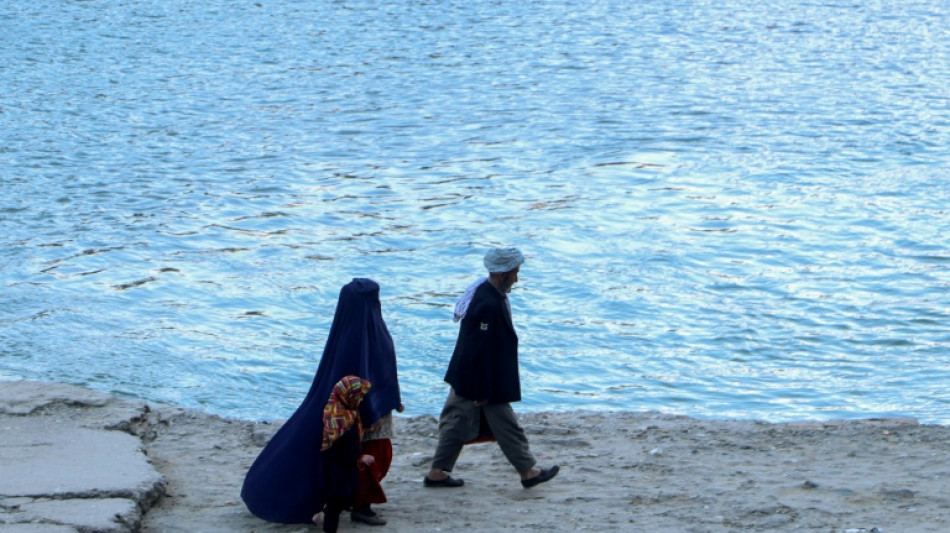
Afghan women struggle under male guardian rules / Photo: OMER ABRAR - AFP

 Ahead of Paris mass, pope urges life together in 'dignity and peace'

 Austria 'ghetto' language classes leave children to repeat school

 S.African women runners arm themselves after string of killings

 'I felt embarrassed': Japan eSports whizz-kid, 11, wins Games gold
 Indonesia fires threatens critically-endangered orangutan: IUCN

 Bangkok declares flood disaster across city

 'World records not enough': North Korea weightlifters target Olympic gold rush

 Iran proposes Hormuz plan, Trump reportedly refuses

 El Nino rewrites the menu in the world's top restaurants

 Pope to hold giant mass on Champs-Elysees

 TikTok to pay Alabama $100 mn under pre-trial settlement

 Internationals take 7-3 Presidents Cup lead after foursomes sweep

 Brazil team returns to Colombian site of doomed jet crash

 Mbappe injured as Zidane wins on France debut, Italy lose on Mancini return

 Senegal draw in Vieira debut, Nigeria survive scare as Cape Verde crash

 U2 performs surprise 50th anniversary gigs in Dublin

 Pope calls worshippers 'saints of France' after AI warning

 US court sides with Pentagon in Anthropic AI ban

 Wall Street stocks rise, greeting optimism over possible US-Iran deal

 NFL players chief raises concerns over pitch for Maracana game

 Daytime Russian attacks kill seven in Kyiv

 Spotting AI writing: how reliable are the detectors?

 French youth await pope after AI 'paradise of machines' warning

 Man City found guilty of Premier League charges, set to appeal: reports

 Embolo follows Xhaka out of Swiss squad over fake Covid documents
Since the Taliban returned to power, Afghan women have been barred from going on long trips, travelling by plane or entering government buildings unless they are accompanied by a man.
Under the Taliban government's austere interpretation of Islamic law, the "mahram" practice long rooted in Afghan society has become compulsory.
On a recent visit to their former university in Kabul, Mariam and a female friend were stopped from entering the building to collect a transcript.
"At the entrance, the Taliban told us that we needed a mahram," said Mariam, whose name has been changed to protect her identity like other women AFP interviewed.
"But my brother was at work, my friend's brother wasn't old enough and her father had died," she said.
"I saw a guy on the street and he agreed to help us," she said. "We had the courage to pass him off as our brother" to get in.
Under Islam, a mahram is a close male relative -- typically a husband, brother, father, son, grandfather or uncle -- with whom a woman is not obliged to wear hijab, and who acts as her guardian and protector.
In Afghanistan, strict rules define what women are allowed to do, with their proponents claiming they guarantee both the women's, and their whole family's, honour.
The Taliban authorities, in power since 2021, have responded to international criticism by saying that Afghanistan's laws follow Islam and guarantee all citizens' rights under sharia.
"Unfortunately, outside circles have their own sensitivities and present incorrect interpretations based on envy and prejudice," Taliban government spokesman Zabihullah Mujahid told AFP.
"They should respect and value Islamic laws."
- 'Go home' -
In a country where more than 40 years of conflict have left millions of widows, it can be a challenge for many women to actually find a mahram.
"A lot of women don't have a man at home," said Shirin, 25, who is studying for a master's degree online after being banned by the authorities from university.
"Their husband has died, or their son is too young and they find themselves head of the family. How can they have a mahram?"
Travelling without a mahram can result in arrest, with rigorous inspections, particularly at checkpoints in towns and rural areas, several Afghan women told AFP.
Last year, Shirin said Taliban authorities broke up a picnic outing because she and other women members of her family were in a minibus driven by their cousin -- the only man, and not a mahram.
One of the men grabbed Shirin's cousin by the collar and told the women, who were in tears, to "go home".
In December 2021, the Taliban government made it compulsory for any woman travelling on any journey longer than 72 kilometres (45 miles) to be accompanied by a mahram.
Then in March 2022, it banned them from flying alone on both domestic and international flights, complicating departures for some women offered scholarships to study at universities abroad.
Mahram customs have fallen out of practice in much of the Muslim world and are enforced by few governments.
But as Afghanistan is "governed by an ideological regime, the Koran and sharia are the backbone of its power", said Islam specialist and author Slimane Zeghidour, and it "applies all prescriptions, even the most rigorous and anachronistic ones".
Saudi Arabia, until recently one of world's most repressive countries on women's rights, now allows women to make the pilgrimage to Mecca without a guardian.
But Afghan women are still barred from doing so.
UN agency worker Spojmay told AFP her 80-year-old widowed mother dreams of fulfilling the Hajj, one of the pillars of Islam, before she dies.
"The travel agency has just confirmed that she can't go abroad without a mahram," Spojmay said, also using a pseudonym for fear of retribution.
Despite earning a decent wage, the 37-year-old herself has had trouble renting an apartment without a mahram, as her father has died and her brothers live abroad.
On the lease, "I put my father's photo, and for his fingerprint, I used my sister's", she said.
The Taliban authorities would "beat me up and throw me in prison if they found out", she added.
- 'Humiliating' -
While women are already excluded from secondary schools, universities, certain jobs, parks and gyms, the mahram policy "is really limiting women to home and indoors" and is "incredibly humiliating", said Sahar Fetrat, of Human Rights Watch.
Khadija, 25, a consultant for women entrepreneurs, noted that in Kabul "the situation is different from the provinces: you can go shopping" without a mahram in the capital.
The practice is, however, strictly enforced in more conservative rural areas.
For 18 months, Khadija made house calls in Kabul with her sister for a vaccination programme, and "had to take a mahram".
Because of the rules, charities and UN agencies pay their female employees an extra salary for the mahram, sometimes up to $40 a day.
Khadija's 32-year-old brother, Ahmad, is the sole mahram for his mother and four sisters -- bringing many complications.
"I am the only man of the house," he said. "But I have my own job too, I also have places to be."
G.Teles--PC