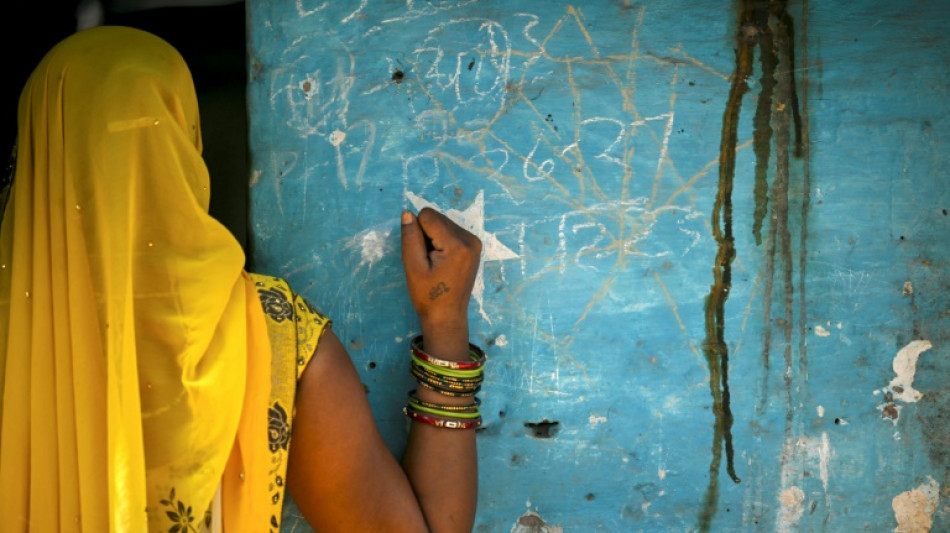
'Hindu nation': Religion trumps caste in India vote / Photo: Money SHARMA - AFP

 'Invincible' 223cm teen basketball player stars as China win bronze
 Tenth woman found dead in South Africa's string of killings
 Japan schoolboy, 11, wins gold while empty seats blight Asian Games
 Japan organisers 'not satisfied' as empty seats blight Asian Games

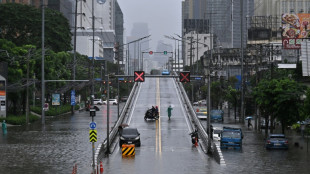
 Canals full, roads submerged as Bangkok declares flood disaster

 China, US to open AI 'communication channel' after summit
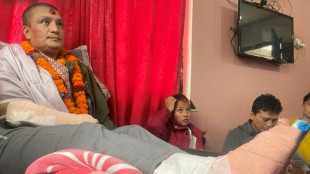 Nepal tunnel survivor wants to help post-flood rebuild
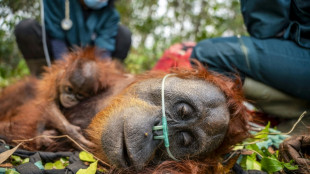
 New China sprint star, 17, vows 'no limits' after Asian Games gold
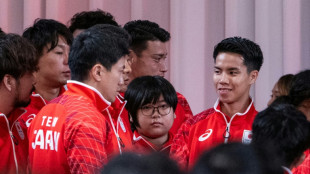 Japanese 11-year-old wins Asian Games eSports gold

 TikTok agrees to teen limits in US settlement following Meta
 Venezuela's oil cradle pins hopes on US energy deals

 US, China buy time with trade truce as pressure builds

 'Leo, Leo': Young Catholics give pope rockstar welcome in France

 Lula bans sports betting days ahead of Brazil's election

 Guatemala ensures survival of vulnerable 'fossil' fish
 Mancini finds positives in Italy loss, accepts fans' jeers

 Alcaraz helps Europe into Laver Cup lead

 Six missing after building collapses in historic Athens district
 Mbappe scores but suffers knee injury as Zidane gets debut France win

 Mancini's Italy return spoiled by Belgium defeat

 Rodri confident in Man City innocence despite reported charges

 Jay-Z rape accuser says she made 'false accusations'

 Senegal draw first match under Vieira and Nigeria survive scare

 Trump, Xi end summit long on pomp, but short on progress

 Russia not preparing for conflict with Europe, Putin says

Born at the bottom of the Hindu faith's rigid caste system, voters like Anil Sonkar will determine whether Indian Prime Minister Narendra Modi returns to power next month.
More than two-thirds of India's 1.4 billion people are estimated to be on the lower rungs of a millennia-old social hierarchy that divides Hindus by function and social standing.
Politicians of all stripes have courted lower caste Indians with affirmative action programmes, job guarantees and special subsidies to mitigate long-standing discrimination and disadvantage.
But Modi's Hindu-nationalist Bharatiya Janata Party (BJP) has established itself as India's dominant political force with a different pitch: think of your religion first, and caste second.
"There are no economic opportunities and business has never been so bad for me," said Sonkar, a 55-year-old fishmonger and a member of the Dalit castes, once disparagingly known as "untouchables".
"But under this government, we feel safe and proud as Hindus," he told AFP in the tourist city of Agra, home of the Taj Mahal. "That is why, despite everything, I voted for Modi."
Modi's party is expected to easily win this year's national election once it concludes in June, in large part due to his government's positioning of the Hindu faith at the centre of its politics.
His government has been accused in turn of marginalising the country's 200-million-plus Muslims, leaving many among them fearful for their futures in India.
But its strategy of appealing to pan-Hindu unity, and directing the faith's internal frictions outwards, has reaped political dividends.
"The BJP's base among the marginalised has grown over every election since 2014," political scientist and author Sudha Pai told AFP.
The party, she added, had successfully forged a new pan-Hindu political coalition by showing respect to the "cultural symbols, icons and history" of low-caste voters, and in the process furthering its goal of building a "Hindu nation".
- Station in life -
Caste remains a crucial determinant of one's station in life at birth, with higher castes the beneficiaries of ingrained cultural privileges, lower castes suffering entrenched discrimination, and a rigid divide between both.
Modi himself belongs to a low caste, but the elite worlds of politics, business and culture are largely dominated by high-caste Indians.
Less than six percent of Indians married outside their caste, according to the country's most recent census in 2011.
Modi's political coalition has managed to bridge this internal divide by trumpeting a vision of a resurgent and assertive Hindu faith.
The prime minister began the year by inaugurating a grand temple to the Hindu deity Ram, built on the site of a centuries-old mosque razed by Hindu zealots decades earlier.
Construction of the temple fulfilled a long-standing demand of Hindu activists and was widely celebrated by Hindu voters, whatever their caste group.
Modi's rise also coincided with the declining fortunes of caste-based political parties that had dominated politics for decades in Uttar Pradesh, India's most populous state with more people than Nigeria and its most important electoral battleground.
Many in the state accused these parties of directing welfare programmes and other benefits of political power to their own caste groups, a situation they say changed when Modi came to power and made them available for all disadvantaged voters.
"The soles of my slippers wore off as I ran around trying to get a card for free rations," homemaker Munni Devi, 62, told AFP at a BJP campaign rally over the din of frenzied drum beats and music.
"But Modi gave me one immediately after coming to power," she told AFP.
- 'Demons of those contradictions' -
The BJP has been able to unite a broad array of caste groups into a single bloc of support, but caste discrimination remains a fact of life both in politics and society at large.
Despite Modi's own low-caste origins, the senior ranks of his ministry, party and civil service remain overwhelmingly dominated by upper-caste functionaries.
"Our lawmaker is from our caste and from the BJP," said farmer Patiram Kushwaha, a Modi supporter reconsidering his allegiance.
"He cannot do anything for us because those sitting at the top don't listen to him."
More than two dozen opposition parties in this year's poll have campaigned on a joint pledge to address the structural causes of discrimination by staging a caste-based national census and redirecting resources to the most disadvantaged.
Analysts nonetheless expect Modi to triumph convincingly over the opposition bloc, but Neelanjan Sircar, of the Centre for Policy Research think-tank in New Delhi, said the BJP faced a monumental challenge in holding its coalition together over the long term.
"This balancing act of keeping together groups which don't really get along with each other is extremely tough in the long run," he told AFP.
"At some point, you have to face the demons of those contradictions."
J.V.Jacinto--PC