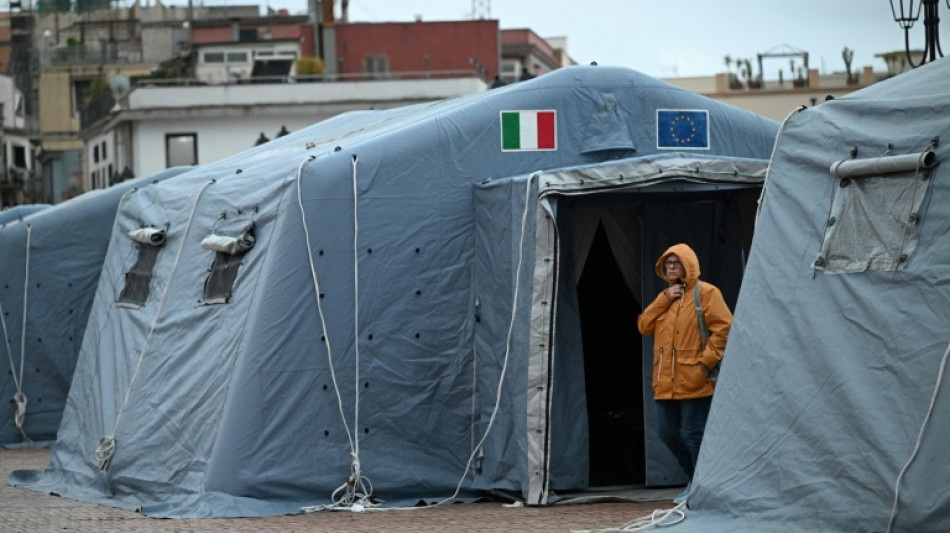
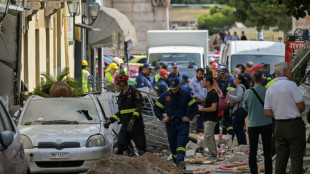
Schools, prison checked after quake 'swarm' near Naples / Photo: ANSA, Ciro FUSCO - ANSA/AFP

 Ahead of Paris mass, pope urges life together in 'dignity and peace'

 Austria 'ghetto' language classes leave children to repeat school
 S.African women runners arm themselves after string of killings

 'I felt embarrassed': Japan eSports whizz-kid, 11, wins Games gold

 Indonesia fires threatens critically-endangered orangutan: IUCN

 Bangkok declares flood disaster across city

 'World records not enough': North Korea weightlifters target Olympic gold rush

 Iran proposes Hormuz plan, Trump reportedly refuses
 El Nino rewrites the menu in the world's top restaurants

 Pope to hold giant mass on Champs-Elysees

 TikTok to pay Alabama $100 mn under pre-trial settlement

 Internationals take 7-3 Presidents Cup lead after foursomes sweep

 Brazil team returns to Colombian site of doomed jet crash

 Mbappe injured as Zidane wins on France debut, Italy lose on Mancini return

 Senegal draw in Vieira debut, Nigeria survive scare as Cape Verde crash
 U2 performs surprise 50th anniversary gigs in Dublin

 Pope calls worshippers 'saints of France' after AI warning

 US court sides with Pentagon in Anthropic AI ban

 Wall Street stocks rise, greeting optimism over possible US-Iran deal

 NFL players chief raises concerns over pitch for Maracana game

 Daytime Russian attacks kill seven in Kyiv

 Spotting AI writing: how reliable are the detectors?

 French youth await pope after AI 'paradise of machines' warning

 Man City found guilty of Premier League charges, set to appeal: reports
 Embolo follows Xhaka out of Swiss squad over fake Covid documents
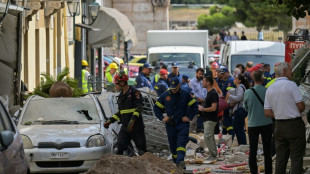
Italian authorities were checking schools and a prison on Tuesday after 150 tremors, including the biggest for 40 years, hit the volcanic region near Naples overnight, causing no major damage or injuries but sparking widespread fear.
"I'm scared. I opened this morning but there isn't anyone because people are scared," Gaetano Maddaluno, a 56-year-old hairdresser in the city of Pozzuoli, told AFP by telephone on Tuesday morning.
One 4.4-magnitude quake was registered shortly after 8:00 pm (1800 GMT) on Monday evening at a depth of 2.5 kilometres (1.6 miles), according to the National Institute of Geophysics and Volcanology (INGV).
It was part of what the institute called a "seismic swarm" in which some 150 quakes were recorded, including the most powerful for four decades.
Many residents of Pozzuoli rushed out of their homes into the street following the tremors.
Local authorities set up tents and were organising around 400 temporary bunks for people too scared to go home.
Seismic activity is nothing new in Pozzuoli, located on the Campi Flegrei (Phlegraean Fields), Europe's largest active caldera -- the hollow left after an eruption.
But many of the 500,000 inhabitants living in the danger zone had already been spooked by a 4.2-magnitude quake last September.
Some residents railed against what they saw as a lack of preventative action by authorities, including checking how buildings might withstand an even bigger shock.
"My shop has never been checked," said a second hairdresser in Pozzuoli, Nella Aprea, 55.
"Action plans are in place but there are still not enough resources."
- Prisoners transferred -
Emergency services reported cracks and pieces falling from buildings after Monday's quakes.
Italy's Civil Protection Department said on Tuesday morning that 39 families had been evacuated from 13 buildings following the outcome of inspections.
Schools were also closed in Pozzuoli for inspections, and 140 inmates of the women's prison were transferred to other institutions while damage to the jail was examined.
"How long will the buildings be able to hold out while (there are) all these shocks? That's what we wonder," one resident told RAI News television.
The mayor of Pozzuoli, Gigi Manzoni, had on Monday night urged people to remain calm but acknowledged it was a situation that was "stressing us all".
The mayor of Naples, Gaetano Manfredi, insisted on Tuesday the situation was "under control", adding: "There is currently no risk of eruption."
The INGV said it would continue to monitor the caldera.
"Other seismic events cannot be ruled out, including ones of a force similar to that which has already been recorded during the current swarm," it cautioned.
The eruption of Campi Flegrei 40,000 years ago was the most powerful in the Mediterranean.
A resurgence of seismic activity in the early 1980s led to a mass evacuation which reduced Pozzuoli to a ghost town.
Specialists, however, say a full-blown eruption in the near future remains unlikely.
The INGV recalled on Tuesday that in the 1980s, there were more than 1,300 seismic events a month and hydrothermal activity caused the ground to lift by nine centimetres (3.5 inches) a month.
By contrast, around 450 seismic events have been recorded in the last month and the lifting speed remained steady at two centimetres a month.
S.Caetano--PC