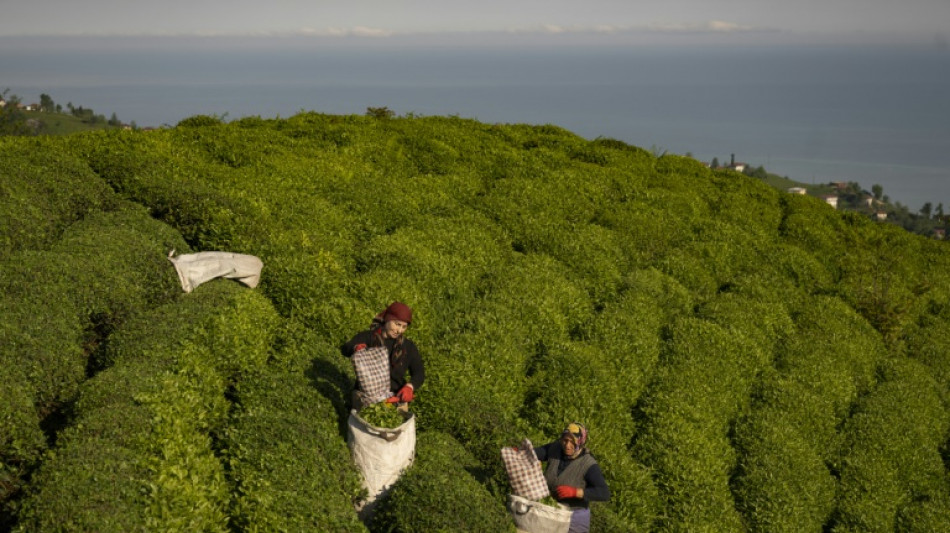
Fear brews in Turkey's landslide-plagued tea hills / Photo: Yasin AKGUL - AFP

 Ahead of Paris mass, pope urges life together in 'dignity and peace'

 Austria 'ghetto' language classes leave children to repeat school
 S.African women runners arm themselves after string of killings

 'I felt embarrassed': Japan eSports whizz-kid, 11, wins Games gold

 Indonesia fires threatens critically-endangered orangutan: IUCN

 Bangkok declares flood disaster across city

 'World records not enough': North Korea weightlifters target Olympic gold rush

 Iran proposes Hormuz plan, Trump reportedly refuses
 El Nino rewrites the menu in the world's top restaurants

 Pope to hold giant mass on Champs-Elysees

 TikTok to pay Alabama $100 mn under pre-trial settlement

 Internationals take 7-3 Presidents Cup lead after foursomes sweep

 Brazil team returns to Colombian site of doomed jet crash

 Mbappe injured as Zidane wins on France debut, Italy lose on Mancini return

 Senegal draw in Vieira debut, Nigeria survive scare as Cape Verde crash

 U2 performs surprise 50th anniversary gigs in Dublin

 Pope calls worshippers 'saints of France' after AI warning

 US court sides with Pentagon in Anthropic AI ban

 Wall Street stocks rise, greeting optimism over possible US-Iran deal

 NFL players chief raises concerns over pitch for Maracana game

 Daytime Russian attacks kill seven in Kyiv

 Spotting AI writing: how reliable are the detectors?

 French youth await pope after AI 'paradise of machines' warning

 Man City found guilty of Premier League charges, set to appeal: reports

 Embolo follows Xhaka out of Swiss squad over fake Covid documents
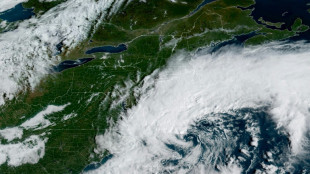
Every time it rains heavily in Turkey's spectacular Black Sea tea growing region -- where it rains a lot -- Zikrullah Komurcu starts to worry.
Last August he was almost swept away by a mudslide when a tea garden above his home in the village of Abdullahhoca began to slide down the mountain during a downpour.
The house above his was destroyed with part of the field ending up in his kitchen.
"It's a miracle that no one was killed," Komurcu told AFP, an electricity pylon still perched dangerously over his mud-splattered home.
The tea-growing province of Rize in Turkey's northeast has been repeatedly hit by major landslides over the last 50 years.
Nearly twice as wet as Ireland, with 2.2 metres (86 inches) of annual rainfall, the Turkish disaster agency AFAD said last year alone there were 355 serious landslides there affecting homes.
And it is going to get worse, experts warn, with climate change making the Black Sea warmer and rainstorms even more violent, putting still more pressure on the soil.
- Dangerous monoculture -
Hakan Yanbay, of the province's chamber of geological engineers, said the "uncontrolled" construction of roads cut into the sides of mountains to link its scattered villages has exacerbated the problem.
They undermine the stability of the soil of the mountainous region, 80 percent of which is made up of steep hillsides.
Yanbay blames the spread of tea plantations over the last century for much of the soil erosion. Long encouraged by the state, they now take up a staggering 90 percent of the region's agricultural land.
While no one has died in a landslide in Rize in nearly three years, three workers were swept away in one in neighbouring Trabzon province in March -- 40 kilometres (25 miles) from Abdullahhoca.
But painful memories of other disasters that have claimed 130 lives in Rize since the 1960s are never far from the surface.
"We are going to prevent the floods and landslides that we have been experiencing in the Black Sea region for years," Turkish President Recep Tayyip Erdogan -- whose family comes from Rize -- vowed in April.
After six villagers were killed in floods and mudslides in 2021, Erdogan called for a ban on "five- to 10-storey buildings being put up on hillsides".
The president was scathing about the damage being done. "Look at what nitrogen fertilisers are doing to the tea gardens," he said on a visit to Rize after that disaster. "They turning the soil into mud," he added.
- 'Man-made disasters' -
But three years later "no serious measures have been taken", insisted Tahsin Ocakli, the only opposition MP in the province dominated by Erdogan's AK party.
Ocakli, who has demanded a parliamentary inquiry, said that "these events, which are now happening several times a year, are no longer natural catastrophes but man-made disasters."
The Rize chamber of agriculture raised the alert about discounted nitrogen fertilisers being sold in February, warning they were likely to further undermine the soil.
But experts say the real problem is the tea plants themselves whose roots are not deep enough to stabilise the ground.
They recommended planting trees like poplars and eucalyptus whose deeper roots absorb more water.
To try to reduce the risks, the authorities have begun building drainage channels and retaining walls below some tea gardens.
A concrete barrier has been built to protect the home of Zikrullah Komurcu's nephew, who lives near him in Abdullahhoca.
Komurcu and his wife Medine are waiting for a similar one to shield them.
"Every time it rains we wonder if there will be another landslide," Medine said. "I don't sleep anymore -- we're afraid."
T.Vitorino--PC