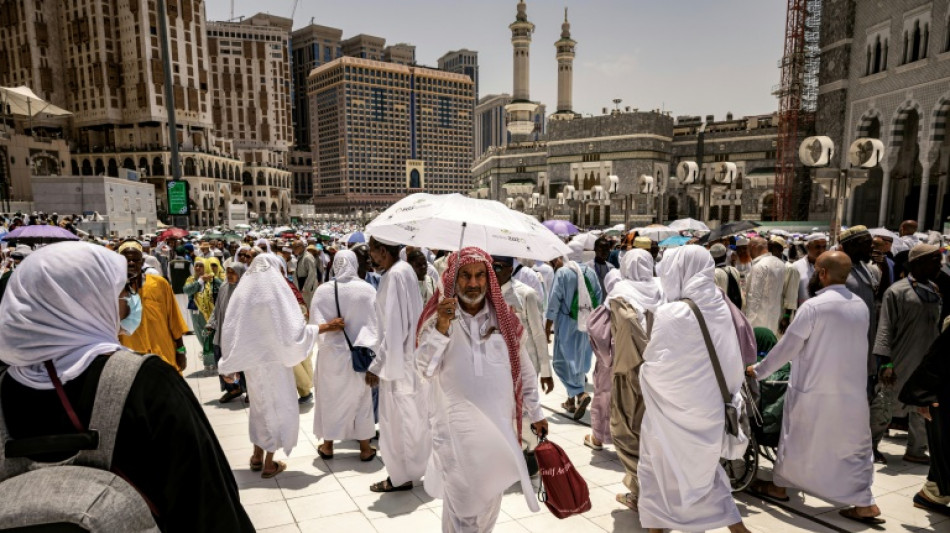
As pilgrims swelter, climate change looms over hajj / Photo: FADEL SENNA - AFP

 'World records not enough': North Korea weightlifters target Olympic gold rush

 Iran proposes Hormuz plan, Trump reportedly refuses
 El Nino rewrites the menu in the world's top restaurants

 Pope to hold giant mass on Champs-Elysees

 TikTok to pay Alabama $100 mn under pre-trial settlement

 Internationals take 7-3 Presidents Cup lead after foursomes sweep
 Brazil team returns to Colombian site of doomed jet crash

 Mbappe injured as Zidane wins on France debut, Italy lose on Mancini return

 Senegal draw in Vieira debut, Nigeria survive scare as Cape Verde crash

 U2 performs surprise 50th anniversary gigs in Dublin

 Pope calls worshippers 'saints of France' after AI warning

 US court sides with Pentagon in Anthropic AI ban

 Wall Street stocks rise, greeting optimism over possible US-Iran deal

 NFL players chief raises concerns over pitch for Maracana game

 Daytime Russian attacks kill seven in Kyiv

 Spotting AI writing: how reliable are the detectors?

 French youth await pope after AI 'paradise of machines' warning

 Man City found guilty of Premier League charges, set to appeal: reports

 Embolo follows Xhaka out of Swiss squad over fake Covid documents
 Trump, Xi inspect founding documents of US democracy to close summit

 'Bottle Claus': Kipchoge's 'hero' helping runners chase Berlin marathon glory

 Olympic medallist Samba-Mayela handed provisional doping ban

 First US trial against TikTok to open Monday

 Palmer misses 'too many' England games, says Tuchel

 UN refugees chief warns conditions in W.Sahara 'deteriorating'
From misting systems to heat-reflective road coverings, Saudi officials are trying to aid hajj pilgrims in coping with heat, but scientists caution that climate change may outpace these efforts.
The annual pilgrimage, one of the world's largest religious gatherings, coincides again this year with the hot Saudi summer, with officials predicting average highs of 44 degrees Celsius (111 Fahrenheit).
Travelling to Mecca from Chicago in the United States, Shariq Memon prepared for the worst, though he told AFP conditions had been manageable so far.
"We were told it would be very hot," the 44-year-old said as he left the Grand Mosque this week.
"It's hot, but somehow, with the spirit of Allah, we don't feel the heat that much."
Heat mitigation measures implemented at the holy sites in recent years may also have something to do with it.
Near the Kaaba, the black cubic structure in the Grand Mosque towards which all Muslims pray, new air-conditioned spaces allow pilgrims to cool off, and a climate-controlled pathway now connects the hills of Safa and Marwa inside the mosque compound.
Since last year, roads used by the faithful have been covered in a white cooling material that Saudi officials say reduces the temperature of the asphalt by 20 percent.
On top of that, volunteers distribute water and umbrellas and offer advice to pilgrims on avoiding hyperthermia, while misting systems and air-conditioned shopping malls provide temporary relief between prayers.
- Heat-related illnesses -
Yet officials have few options to alleviate certain stages of the hajj, notably Saturday's day-long prayers under the blazing sun on Mount Arafat.
As he waited ahead of Friday's formal start of the hajj, Memon said he was not worried.
"I am a very easy-going guy, so I didn't take any measures. My wife has done a lot of measures," he said, citing the rehydration solution she packed in his suitcase.
"I don't know. I will just follow her."
The pilgrimage, which takes most people at least five days to complete, is a "marathon", said Mohammed al-Abdulali, spokesperson for the Saudi health ministry.
Pilgrims, especially those who are elderly or have health issues, "are exposed to the risk of exhaustion or heat stroke, which are dangerous", he said.
Last year more than 10,000 cases of heat-related illnesses were documented, 10 percent of which were heat stroke, he said.
Saudi Arabia has not provided figures on hajj fatalities last year, though at least 240 people -- many from Indonesia -- died during the pilgrimage, according to figures announced by various countries which did not specify causes of death.
Abdulali said there were at least some deaths connected to heat stress in 2023 "but their number was limited" because of rapid interventions taken by medical teams and their experience "acquired over decades".
The timing of the hajj is determined by the Islamic lunar calendar, and years in which it takes place during summer have long brought high numbers of heat stress cases, according to a study published last month by the King Faisal Specialist Hospital and Research Centre based in Riyadh.
In 1987, for example, about 1,000 pilgrims died from heat-related conditions, the study says.
But in the past 40 years, thanks to "mitigation measures", incidents of heat stress have fallen by 74.6 percent and the mortality rate from these cases has fallen by 47.6 percent, it says.
- Water sprays 'not enough' -
The same study notes, however, that temperatures in the region are rising by 0.4 degrees Celsius per decade.
"Worsening heat may be outpacing the comprehensive mitigation strategies in place," it says.
Distributing water and installing misting systems "will not be enough" to adapt, said Fahad Saeed of Climate Analytics, an institute based in Germany.
If conditions worsen, he said, there is a risk that "we are going to lose some of the rituals" seen as essential to the pilgrimage.
It is a threat that underscores the need for Saudi Arabia to reduce its use of planet-warming fossil fuels, he said, a stated goal of the kingdom's ongoing Vision 2030 economic reform agenda.
"Saudi Arabia is the biggest oil exporter... it is also one of the hottest countries in the world," the climatologist said.
The kingdom needs "to make this transformation of their economy towards greener options, towards more renewables, because it is also host of this very important hajj."
F.Moura--PC