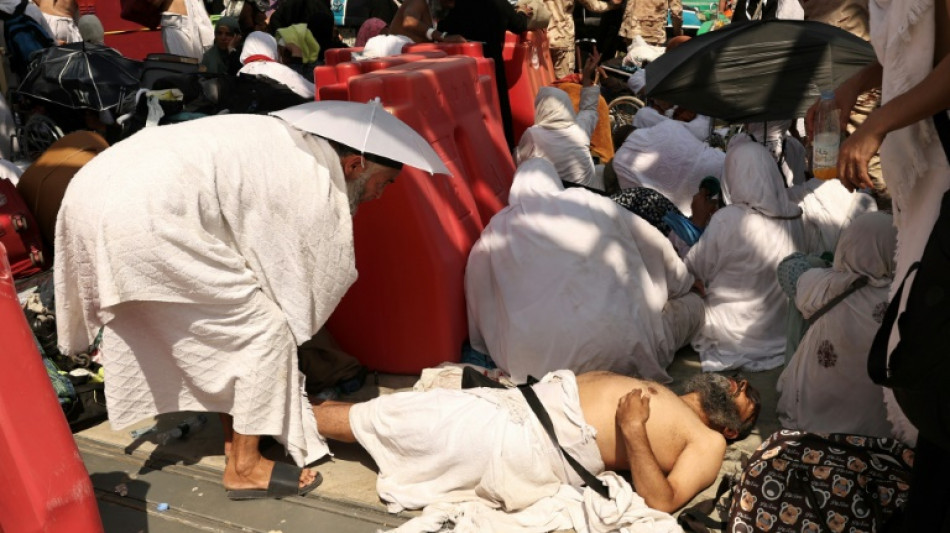
Saudi hajj pilgrims' deaths highlight how extreme heat kills / Photo: FADEL SENNA - AFP

 'World records not enough': North Korea weightlifters target Olympic gold rush

 Iran proposes Hormuz plan, Trump reportedly refuses

 El Nino rewrites the menu in the world's top restaurants

 Pope to hold giant mass on Champs-Elysees

 TikTok to pay Alabama $100 mn under pre-trial settlement

 Internationals take 7-3 Presidents Cup lead after foursomes sweep

 Brazil team returns to Colombian site of doomed jet crash

 Mbappe injured as Zidane wins on France debut, Italy lose on Mancini return

 Senegal draw in Vieira debut, Nigeria survive scare as Cape Verde crash

 U2 performs surprise 50th anniversary gigs in Dublin

 Pope calls worshippers 'saints of France' after AI warning

 US court sides with Pentagon in Anthropic AI ban

 Wall Street stocks rise, greeting optimism over possible US-Iran deal

 NFL players chief raises concerns over pitch for Maracana game

 Daytime Russian attacks kill seven in Kyiv

 Spotting AI writing: how reliable are the detectors?

 French youth await pope after AI 'paradise of machines' warning

 Man City found guilty of Premier League charges, set to appeal: reports

 Embolo follows Xhaka out of Swiss squad over fake Covid documents
 Trump, Xi inspect founding documents of US democracy to close summit

 'Bottle Claus': Kipchoge's 'hero' helping runners chase Berlin marathon glory

 Olympic medallist Samba-Mayela handed provisional doping ban

 First US trial against TikTok to open Monday

 Palmer misses 'too many' England games, says Tuchel

 UN refugees chief warns conditions in W.Sahara 'deteriorating'

More than 1,000 people have died at this year's hajj pilgrimage in extreme heat in Saudi Arabia, an AFP tally showed on Thursday.
The pilgrimage involved hours of walking and praying in a country where temperatures reached 51.8 degrees Celsius (125 Fahrenheit) this week.
The World Health Organisation (WHO) has calculated that heat kills at least half a million people every year but warns that the real figure could be up to 30 times higher.
Here a scientist explains how extreme heat damages the body and how physical activity outdoors raises the risk.
- Heat effect on body -
In normal conditions, the body regulates its own temperature like a thermostat, holding it steady at about 36.8C (98.2F).
When outside heat rises, the body cools itself by raising blood-flow to vessels near the skin.
This emits heat at the surface, while perspiration also cools the outside of the body.
"To ensure the correct functioning of the cells, enzymes and vital organs, the body's temperature must stay constant, whatever the external conditions," said Pieter Vancamp, a neurobiologist at the French research institute INRAE.
- Dying of heat -
During an activity such as the hajj, where pilgrims spend hours outdoors in the sun, "the body can quickly become exhausted and can no longer find the reserves of water needed to perspire", Vancamp said.
Then the kidneys, heart and brain risk overheating and "stop working", he added.
When the body's natural thermostat is overwhelmed in this way, symptoms strike: fatigue, headaches, fever and broken sleep.
These can herald more serious effects, such as dehydration, which chokes off water to the vital organs.
The biggest risk is heatstroke, when the body's temperature exceeds 40C (104F).
"The body has its limits," said Vancamp. "When the weather is too hot or when extreme heat is combined with physical activity, for example, the body can find itself unable to self-regulate."
- Aggravating factors -
Babies, the elderly, people with health problems and outdoor workers are most at risk.
The number of sweat glands in the body decreases with age, leaving the body less able to cool itself.
"Several factors determine our reaction to heat: age, body mass, physical activity, genes," said Vancamp.
"But when the heat is too strong, even young, healthy bodies can lack the energy to keep the temperature close to 37C."
The WHO warns that hot nights pose a particular health risk.
Nighttime heat gives the body no chance to cool down, leading to a rise in heart attacks.
- More heat deaths in future? -
Worldwide, people were exposed to an average of 86 days of life-threatening temperatures in 2022, according to the Lancet Countdown report last year.
The number of people over 65 who died from heat rose by 85 percent between the periods 1991-2000 and 2013-2022, the leading medical journal added.
Climate change caused by humans burning fossil fuels is increasing heatwaves and other extreme weather events.
On the current trajectory, the world is on track to warm about 2.7C above the pre-industrial average by the end of this century, according to Climate Action Tracker.
The Lancet Countdown projected that under a 2C warming scenario, about five times as many people will die from the heat each year by 2050.
J.Pereira--PC