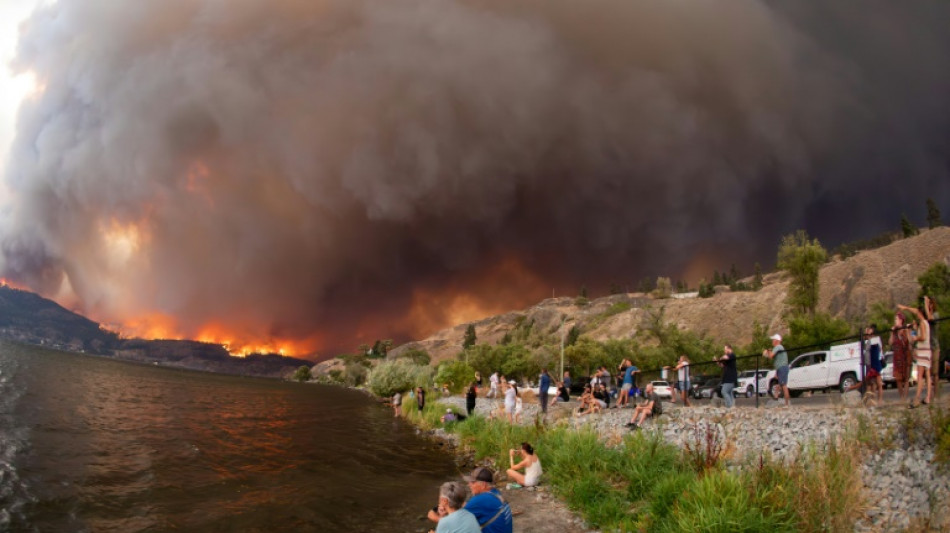
World not ready for climate change-fuelled wildfires: experts / Photo: Darren HULL - AFP/File

 Lula bans sports betting days ahead of Brazil's election

 Guatemala ensures survival of vulnerable 'fossil' fish
 Mancini finds positives in Italy loss, accepts fans' jeers

 Alcaraz helps Europe into Laver Cup lead

 Six missing after building collapses in historic Athens district

 Mbappe scores but suffers knee injury as Zidane gets debut France win

 Mancini's Italy return spoiled by Belgium defeat
 Rodri confident in Man City innocence despite reported charges

 Jay-Z rape accuser says she made 'false accusations'

 Senegal draw first match under Vieira and Nigeria survive scare
 Trump, Xi end summit long on pomp, but short on progress

 Russia not preparing for conflict with Europe, Putin says
 Trump's photo of Xi greeting carries signs of AI

 Six missing after building blast in historic Athens district

 Millions in US northeast brace for powerful storm
 Assefa seeks 'better than my best' at Berlin marathon
 US court refuses to overturn Pentagon ban on Anthropic

 Verstappen and Norris blame slow cars as Mercedes tops qualifying

 Crowds cheer pope in Paris after AI 'paradise of machines' warning

 Teen swimmer makes Games history as Thai, Chinese sprinters win gold
 Man City found guilty of 114 Premier League charges - reports
 Concerns over 'missing' UK explorer Ranulph Fiennes

 Suspected Paris killer of Argentine rugby star begs forgiveness

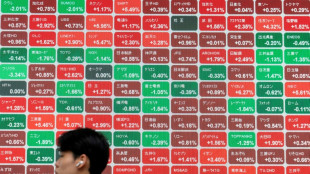 Oil prices fall on cautious hopes for US-Iran progress

 Noskova, Muchova take Czech Republic into BJK Cup final

The world is unprepared for the increasing ferocity of wildfires turbocharged by climate change, scientists say, as blazes from North America to Europe greet the northern hemisphere summer in the hottest year on record.
Wildfires have already burned swathes through Turkey, Canada, Greece and the United States early this season as extreme heatwaves push temperatures to scorching highs.
While extra resources have been poured into improving firefighting in recent years, experts said the same was not true for planning and preparing for such disasters.
"We are still actually catching up with the situation," said Stefan Doerr, director of the Centre for Wildfire Research at the UK's Swansea University.
Predicting how bad any one blaze will be -- or where and when it will strike -- can be challenging, with many factors including local weather conditions playing into calculations.
But overall, wildfires are getting larger and burning more severely, said Doerr, who co-authored a recent paper examining the frequency and intensity of such extreme events.
A separate study published in June found the frequency and magnitude of extreme wildfires appeared to have doubled over the past 20 years.
By the end of the century, the number of extreme wildfires around the globe is tipped to rise 50 percent, according to a 2022 report by the UN Environment Programme.
Doerr said humanity had not yet faced up to this reality.
"We're clearly not well enough prepared for the situation that we're facing now," he said.
Climate change is a major driver, though other factors such as land use and the location of housing developments play a big part.
- 'We cannot fight the fires' -
Fires do not respect borders so responses have evolved between governments to jointly confront these disasters, said Jesus San-Miguel, an expert for the European Commission Joint Research Centre.
The EU has a strong model of resource sharing, and even countries outside the bloc along the Mediterranean have benefited from firefighting equipment or financial help in times of need, San-Miguel said.
But as wildfires become increasingly extreme, firefighting simply won't be a fix.
"We get feedback from our colleagues in civil protection who say, 'We cannot fight the fires. The water evaporates before it reaches the ground,'" San-Miguel said.
"Prevention is something we need to work on more," he added.
Controlled burns, grazing livestock, or mechanised vegetation removal are all effective ways to limit the amount of burnable fuel covering the forest floor, said Rory Hadden from the University of Edinburgh.
Campfire bans and establishing roads as firebreaks can all be effective in reducing starts and minimising spread, said Hadden, an expert on fire safety and engineering.
But such efforts require funding and planning from governments that may have other priorities and cash-strapped budgets, and the return is not always immediately evident.
"Whatever method or technique you're using to manage a landscape... the result of that investment is nothing happens, so it's a very weird psychological thing. The success is: well, nothing happened," said Hadden.
- 'Short memories' -
Local organisations and residents often take the lead in removing vegetation in the area immediately around their homes and communities.
But not everyone is prepared to accept their neighbourhood might be at risk.
"People don't think that it will happen to them, but it eventually will," San-Miguel said, pointing to historically cold or wet climates like the US Pacific Northwest that have witnessed major fires in recent years.
Canada has adapted to a new normal of high latitude wildfires, while some countries in Scandinavia are preparing for ever-greater fire risk.
But how best to address the threat remains an open question, said Guillermo Rein from Imperial College London, even in places where fire has long been part of the landscape.
Even in locations freshly scarred by fire, the clearest lessons are sometimes not carried forward.
"People have very short memories for wildfires," said Rein, a fire science expert.
In July 2022, London witnessed its worst single day of wildfires since the bombings of World War II, yet by year's end only academics were still talking about how to best prepare for the future.
"While the wildfires are happening, everybody's asking questions... When they disappear, within a year, people forget about it," he said.
E.Raimundo--PC