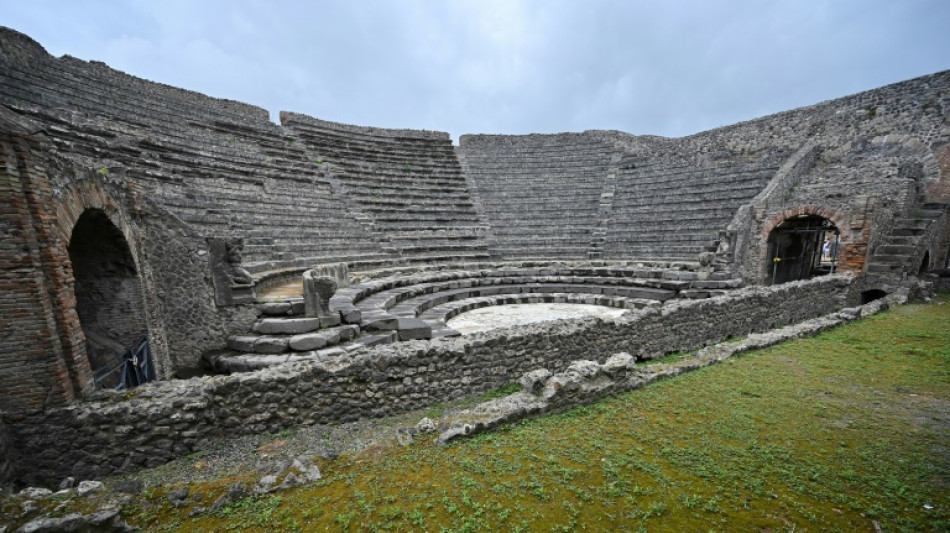
Earthquakes, not just volcanic ash, a Pompeii killer: research / Photo: Andreas SOLARO - AFP/File

 Wall Street stocks rise, greeting optimism over possible US-Iran deal

 NFL players chief raises concerns over pitch for Maracana game

 Daytime Russian attacks kill seven in Kyiv

 Spotting AI writing: how reliable are the detectors?

 French youth await pope after AI 'paradise of machines' warning
 Man City found guilty of Premier League charges, set to appeal: reports
 Embolo follows Xhaka out of Swiss squad over fake Covid documents
 Trump, Xi inspect founding documents of US democracy to close summit

 'Bottle Claus': Kipchoge's 'hero' helping runners chase Berlin marathon glory

 Olympic medallist Samba-Mayela handed provisional doping ban
 First US trial against TikTok to open Monday
 Palmer misses 'too many' England games, says Tuchel

 UN refugees chief warns conditions in W.Sahara 'deteriorating'

 Antonelli 'mad' about crash in Azerbaijan qualifying

 'Perfect lap' gives Russell pole for Azerbaijan GP as Antonelli crashes out

 UN Security Council condemns Houthi attacks on Saudi Arabia

 China swimmer makes Asian Games history as Thai wins 100m sprint

 Top French literary prize drops best-selling novel over AI claims

 US 'must choose' whether to end war: Iran president

 Pope warns against losing humanity in AI-driven 'paradise of machines'

 Pope warns against losing humanity in 'paradise of machines'

 From FBI warning to literary acclaim: the Russian journalist who took on Putin

 China swimmer in Asian Games first as North Korea lifters reign

 French literary prize removes novel from longlist after AI claims

 China's Zhang wins record seventh Asian Games swimming gold

Victims who perished in Pompeii after the devastating 79 AD eruption of Mount Vesuvius may have been killed by a simultaneous earthquake, according to new research published on Thursday.
Scholars have debated for decades whether seismic activity occurred during the eruption of Vesuvius in southern Italy nearly 2,000 years ago, and not just before it, as reported by Pliny the Younger, an author and administrator in Ancient Rome, in his letters.
The article published on Thursday in the academic journal "Frontiers in Earth Science" takes a new look at the now world-famous archaeological site, arguing that one or more concurrent earthquakes were "a contributing cause of building collapse and death of the inhabitants".
"Our conclusions suggest that the effects of the collapse of buildings triggered by syn-eruptive seismicity (seismic activity at the time of an eruption) should be regarded as an additional cause of death in the ancient Pompeii," it said.
Archaeologists estimate that 15 to 20 percent of Pompeii's population died in the eruption, mostly from thermal shock as a giant cloud of gases and ash covered the city.
Volcanic ash then buried the Roman city, perfectly preserving the homes, public buildings, objects and even the people until its discovery in the late 16th century.
In May 2023, archaeologists uncovered the skeletons of two men who appeared to have been killed not by heat and clouds of fiery gas and ash but from trauma due to collapsed walls -- providing precious new data.
One of the victims was discovered with his left hand raised, as if to protect his head.
"It is worth noting that such traumas are analogous to those of individuals involved in modern earthquakes," wrote the authors, who determined that the collapsed walls were not due to falling stones and debris but to seismic activity.
"In a broader view that takes into account the whole city, we consider, as a working hypothesis, that the casualties caused by seismically triggered building failures may not be limited to the two individuals," the authors wrote.
The intersection of phenomena from both volcanic and seismic activity requires a multidisciplinary approach, the study argues, with the collaboration of both archaeologists and earth scientists.
P.Cavaco--PC