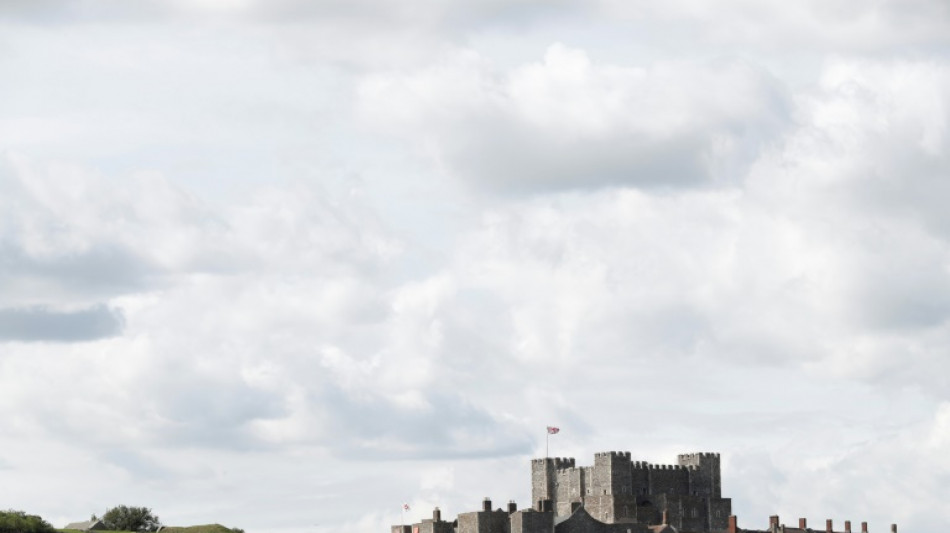
Soldiers' gallows graffiti revealed for first time at English castle / Photo: Adrian DENNIS - AFP

 Wall Street stocks rise, greeting optimism over possible US-Iran deal

 NFL players chief raises concerns over pitch for Maracana game

 Daytime Russian attacks kill seven in Kyiv

 Spotting AI writing: how reliable are the detectors?

 French youth await pope after AI 'paradise of machines' warning

 Man City found guilty of Premier League charges, set to appeal: reports

 Embolo follows Xhaka out of Swiss squad over fake Covid documents
 Trump, Xi inspect founding documents of US democracy to close summit

 'Bottle Claus': Kipchoge's 'hero' helping runners chase Berlin marathon glory

 Olympic medallist Samba-Mayela handed provisional doping ban
 First US trial against TikTok to open Monday
 Palmer misses 'too many' England games, says Tuchel

 UN refugees chief warns conditions in W.Sahara 'deteriorating'
 Antonelli 'mad' about crash in Azerbaijan qualifying

 'Perfect lap' gives Russell pole for Azerbaijan GP as Antonelli crashes out
 UN Security Council condemns Houthi attacks on Saudi Arabia

 China swimmer makes Asian Games history as Thai wins 100m sprint

 Top French literary prize drops best-selling novel over AI claims

 US 'must choose' whether to end war: Iran president

 Pope warns against losing humanity in AI-driven 'paradise of machines'

 Pope warns against losing humanity in 'paradise of machines'

 From FBI warning to literary acclaim: the Russian journalist who took on Putin

 China swimmer in Asian Games first as North Korea lifters reign

 French literary prize removes novel from longlist after AI claims

 China's Zhang wins record seventh Asian Games swimming gold

Macabre depictions of hangings carved by soldiers guarding England's biggest medieval castle at a time of looming war with France went on display Monday.
The graffiti-covered door -- part of a new exhibition at Dover Castle on the country's south coast -- dates from the late 18th century when soldiers garrisoned there faced the threat of invasion by Napoleon Bonaparte's French forces.
Historian Paul Pattison said scaling a ladder to the top floor of the castle's St John's Tower and seeing the carvings on the long-forgotten door had been an "astonishing discovery".
He said the soldiers' fascination with public execution gave "a unique glimpse into the minds of these soldiers, especially during such a charged period of time".
The door features some 50 pieces of carved graffiti including nine hangings, many initials and two surnames.
There are also a number of dates including 1789, the year of the French Revolution, and 1798.
Pattison, a historian with English Heritage which manages Dover Castle, said the threat of impending invasion would have made strategically important Dover a hive of activity with ships filling the harbour and soldiers a constant presence.
Dover is the closest port to continental Europe and has been a prime target for invaders down the centuries.
- 'Strange and macabre' -
Researchers believe the "strange and macabre repetition" of hangings carved into the door could depict an actual execution in Dover where they would have provided a form of public entertainment during the late 18th century, attended by thousands of people.
In one of the carvings, however, the figure is dressed in military uniform and one of Napoleon's trademark two-cornered bicorne hats, making it possible it was intended to be the French military and political leader himself.
Also carved into the door is a detailed and accurate depiction of a single-masted sailing ship, thought to be an 8-gun cutter which was in use by Britain's Royal Navy at the time.
"What makes this door such an extraordinary object is that it is a rare and precious example of the ordinary person making their mark, whether that be simply for the purpose of killing time or wanting to be remembered," Pattison added.
Dover Castle, which is now visited by more than 350,000 people a year, underwent a wide-ranging modernisation in the 1790s to transform it from an ageing medieval castle into a modern military garrison.
With the ultimately unrealised threat of an invasion from the other side of the Channel growing, it became home to thousands of soldiers.
St John's Tower, with its commanding view over the vulnerable northern end of the castle, would have been guarded by between six and 12 men at any one time, leaving them hours to kill time by carving graffiti with knives or possibly bayonets, according to English Heritage.
The door has been painstakingly conserved and features in the castle's new "Dover Castle Under Siege" exhibition.
The exhibit delves back into the castle's bloody and dramatic 1216-17 siege when it repelled an attack by French and rebel English forces.
Using digital reconstruction, it also reveals the fortress's original entrance from the time, multiple lost towers and long-lost defensive walls.
E.Ramalho--PC