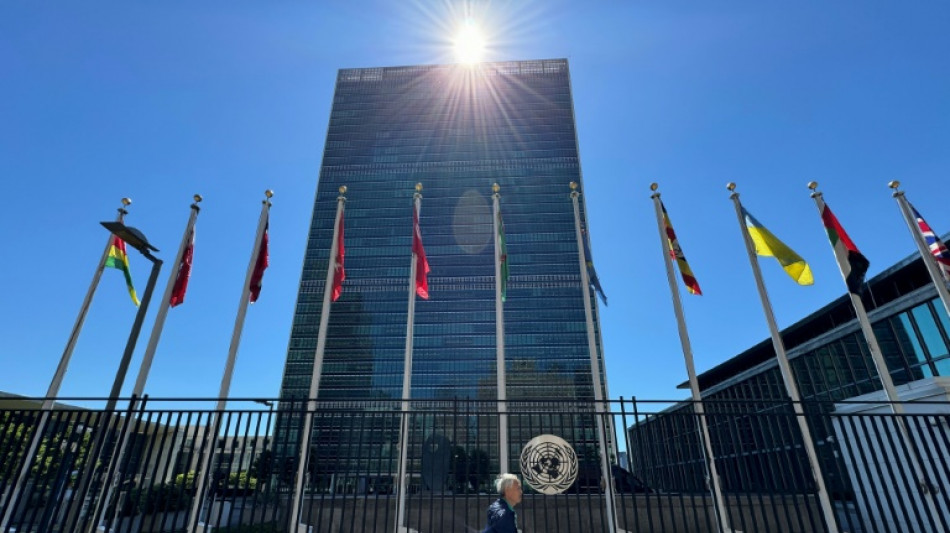
UN cybercrime text faces new scrutiny from tech firms, rights groups / Photo: Daniel SLIM - AFP/File

 Spotting AI writing: how reliable are the detectors?
 French youth await pope after AI 'paradise of machines' warning
 Man City found guilty of Premier League charges, set to appeal: reports

 Embolo follows Xhaka out of Swiss squad over fake Covid documents

 Trump, Xi inspect founding documents of US democracy to close summit

 'Bottle Claus': Kipchoge's 'hero' helping runners chase Berlin marathon glory

 Olympic medallist Samba-Mayela handed provisional doping ban

 First US trial against TikTok to open Monday

 Palmer misses 'too many' England games, says Tuchel

 UN refugees chief warns conditions in W.Sahara 'deteriorating'

 Antonelli 'mad' about crash in Azerbaijan qualifying

 'Perfect lap' gives Russell pole for Azerbaijan GP as Antonelli crashes out
 UN Security Council condemns Houthi attacks on Saudi Arabia

 China swimmer makes Asian Games history as Thai wins 100m sprint

 Top French literary prize drops best-selling novel over AI claims

 US 'must choose' whether to end war: Iran president

 Pope warns against losing humanity in AI-driven 'paradise of machines'

 Pope warns against losing humanity in 'paradise of machines'

 From FBI warning to literary acclaim: the Russian journalist who took on Putin
 China swimmer in Asian Games first as North Korea lifters reign
 French literary prize removes novel from longlist after AI claims

 China's Zhang wins record seventh Asian Games swimming gold

 Verstappen edges Russell in final practice in Azerbaijan

 English, Spanish, Italian, German football leagues call for FIFA reform

 Pope arrives in France on first official visit in 18 years

UN member states meet Monday seeking to finalize an international treaty on the fight against cybercrime, a text strongly opposed by an unlikely alliance of human rights groups and big technology companies.
The "United Nations Convention Against Cybercrime" originated in 2017 when Russian diplomats sent the world body's secretary-general a letter outlining the initiative.
Two years later, and despite US and European opposition, the General Assembly created an intergovernmental committee tasked with drawing up such a treaty.
Now, the draft text will finally come up for a vote by member states at the end of a two-week session.
But after seven negotiating sessions to date, criticism has only grown.
If the revised draft includes "some welcome improvements," according to the office of the UN High Commissioner for Human Rights, concerns remain "about significant shortcomings, with many provisions failing to meet international human rights standards."
"These shortcomings are particularly problematic against the backdrop of an already expansive use of existing cybercrime laws in some jurisdictions to unduly restrict freedom of expression, target dissenting voices and arbitrarily interfere with the privacy and anonymity of communications," it said in an analysis.
The treaty, according to the draft language, would aim to "prevent and combat cybercrime more efficiently and effectively" and to strengthen international cooperation, notably regarding child pornography and money laundering.
But its detractors say the text claims sway over far too expansive a field, as reflected in its subtitle: "crimes committed through the use of an information and communications technology system."
The text could thus require governments "to facilitate investigations into things like same-sex conduct, criticizing one's government, investigative reporting, participating in protests or being a whistleblower," said Human Rights Watch executive director Tirana Hassan.
Rather than a cybercrime treaty, the text "actually resembles a global surveillance treaty that would address all crime," she told reporters, adding that it exceeds "even the most expansive possible interpretation of its mandate."
- A preference for 'no outcome' -
Debate over the draft has brought together some strange bedfellows -- rights groups are aligning with tech mammoths like Microsoft, which said in a written submission that "no outcome is better than a bad outcome."
Nick Ashton-Hart heads the Cybersecurity Tech Accord delegation to the treaty talks, representing more than 100 technology companies.
"There is a need for more cooperation by most states, especially developing states, on cybercrime," Ashton-Hart told AFP, but added: "This convention does not have to be the vehicle for that cooperation."
Better options would be either the Council of Europe's Budapest Convention on Cybercrime or the UN Convention Against Organized Transnational Crime, he said.
Unless the current draft is substantially improved, Ashton-Hart added, his organization will call on member states not to sign or ratify the treaty.
"Democratic states would expect opposition from the private sector, very aligned with the civil society world, were this to come up for ratification at the national level," Ashton-Hart said.
Russia, meanwhile, has defended its vision.
"Excessive attention to human rights provisions in the Convention is significantly detrimental to international cooperation and will in fact hinder the cooperation between law enforcement agencies of states," the Russian delegation said.
In a statement, it accused Western countries of wanting to "politicize discussions."
The Russians favor a return to the text's original 2019 title, which called for an "international convention on countering the use of information and communications technologies for criminal purposes" -- not the current "United Nations Convention Against Cybercrime."
P.L.Madureira--PC